A familiar dance in orchestral colour
Brahms's Hungarian Dance No. 5 is familiar enough to arrive with its own momentum. This session offers a more precise way in: the Wiener Symphoniker's work record identifies Brahms as the composer and Albert Parlow as the orchestrator of No. 5 in G minor. The performance heard here is by the Vienna Philharmonic under Fritz Reiner.1
That orchestration credit changes the listening question. Rather than treating the tune as a fixed object, follow how an orchestra carries its identity through shifts of weight, colour and scale. A first pass can simply keep the dance intact; on a second, notice how the orchestral writing gives its turns different proportions without losing the line that makes it immediately recognisable.1
From the London LP to the MBL system
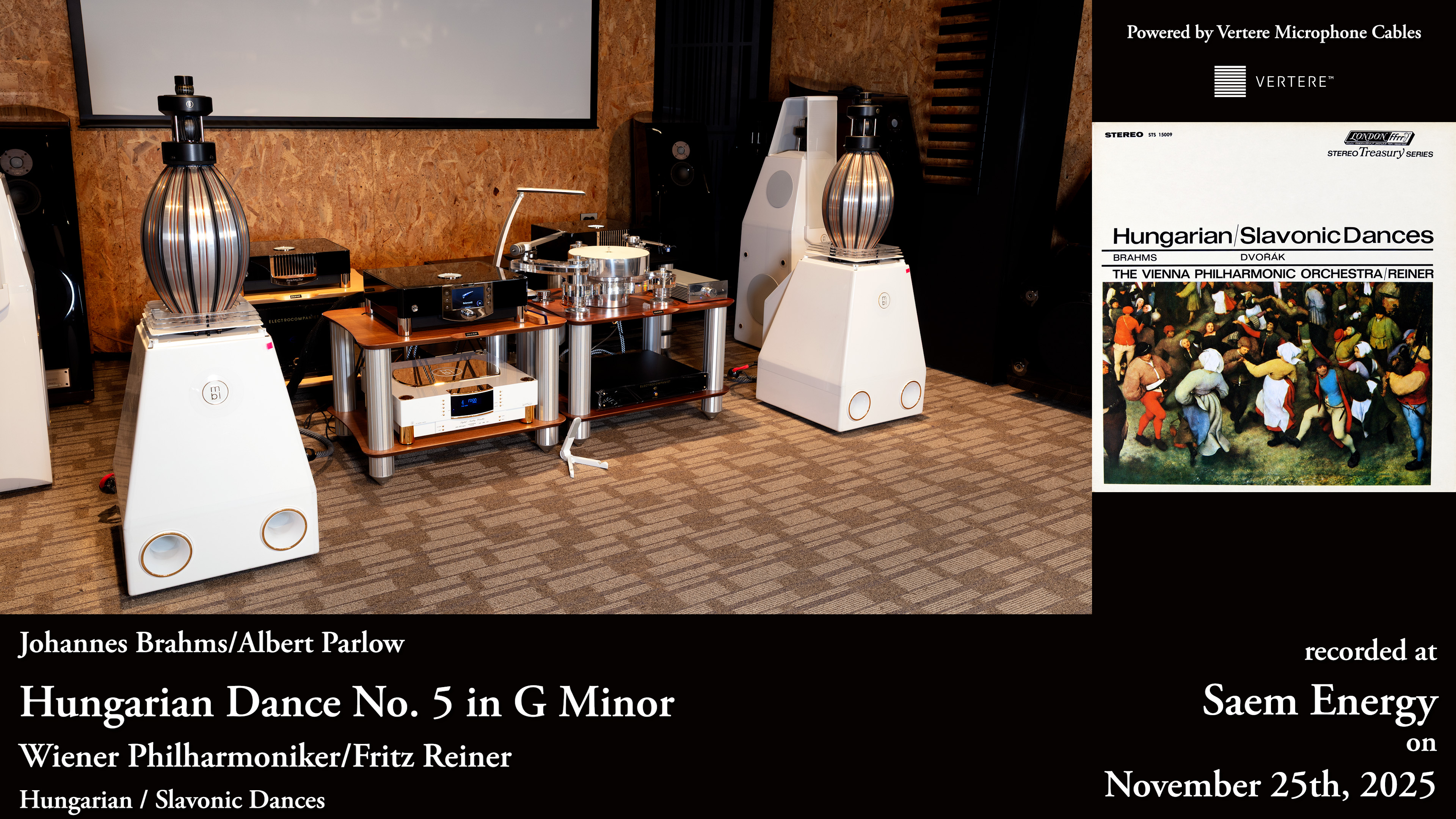
HFI used the January 1967 stereo vinyl reissue of Hungarian / Slavonic Dances on London Records, catalogued as STS 15009 and STS.15009.
A Transrotor Rondino Bianco FMD turntable with a Hana Umami Blue cartridge fed an Electrocompaniet ECP 2 MKII phono stage. The signal then passed through an MBL N11 preamplifier and N15 monoblock power amplifiers to MBL 101 E MKII loudspeakers.
A different question for the same system
This playback system has appeared in an earlier Saem Energy story, where the MBL 101 E MKII's radial radiation made the loudspeaker's relationship with the room the central question. Here the supported system angle moves upstream. MBL describes the N15's LASA 2.0 amplifier architecture as stable even with complex and demanding loudspeaker loads; the company specifies 560 watts at 4 ohms and a peak output current of 36 amperes.2
The listening question belongs to the complete system: as the orchestra changes scale, can the musical line remain easy to follow without the dance losing its forward motion? Follow that continuity through the complete playback-and-room encounter, then return to the opening with the larger arc still in mind.2
A sweet-spot perspective from Saem Energy
HFI recorded the session at Saem Energy on 25 November 2025. A matched pair of DPA-4011 microphones fed a Zoom F8n Pro through Vertere microphone cables at 192 kHz/32-bit float; Sennheiser HD820 headphones were used in the production chain.
The microphone pair was distance-matched from the loudspeakers with a laser meter and positioned where that pair most closely captured the sound HFI heard at the sweet spot. Because microphone characteristics affect that position, it is not necessarily the physical listening seat.
Set a comfortable headphone level and let the first listen belong to the dance. Then return to Parlow's orchestral frame and the question of continuity as the music changes scale. Sit in your own sweet spot and allow a familiar piece to feel newly proportioned as the orchestral version comes into focus.12
Watch and listen
The complete HiFi Immersion video
For the clearest sense of the room, listen on headphones at a comfortable, consistent level.