A familiar name, a declared new frame
Elyan’s 2026 single carries a title that states its purpose plainly: ‘Rasputin (Epic Dark Gothic Orchestral).’ The credits retain Frank Farian, George Reyam and Fred Jay as the writers, so the useful starting point is not a claim of a new composition. It is the way this release asks a familiar song to live inside a newly declared production frame.1
HFI used the 44.1 kHz/16-bit single released by 12534854 Records DK on 10 June 2026.1
Listen for what the new frame changes
The most revealing first pass is musical rather than technical. Follow the identity you already recognise—the tune, pulse and dramatic profile—while noticing what the darker orchestral setting asks you to hear afresh. The question is not whether familiarity disappears, but how the production reshapes scale, weight and space around it.
On a second pass, shift attention from the song’s outline to separation within denser moments. Can individual lines remain easy to follow as the sound grows broader? Does the centre stay coherent when the production asks for more force? Those are useful listening questions for both the recording and the system without turning either into a verdict on the other.
A load-matching question behind the scale
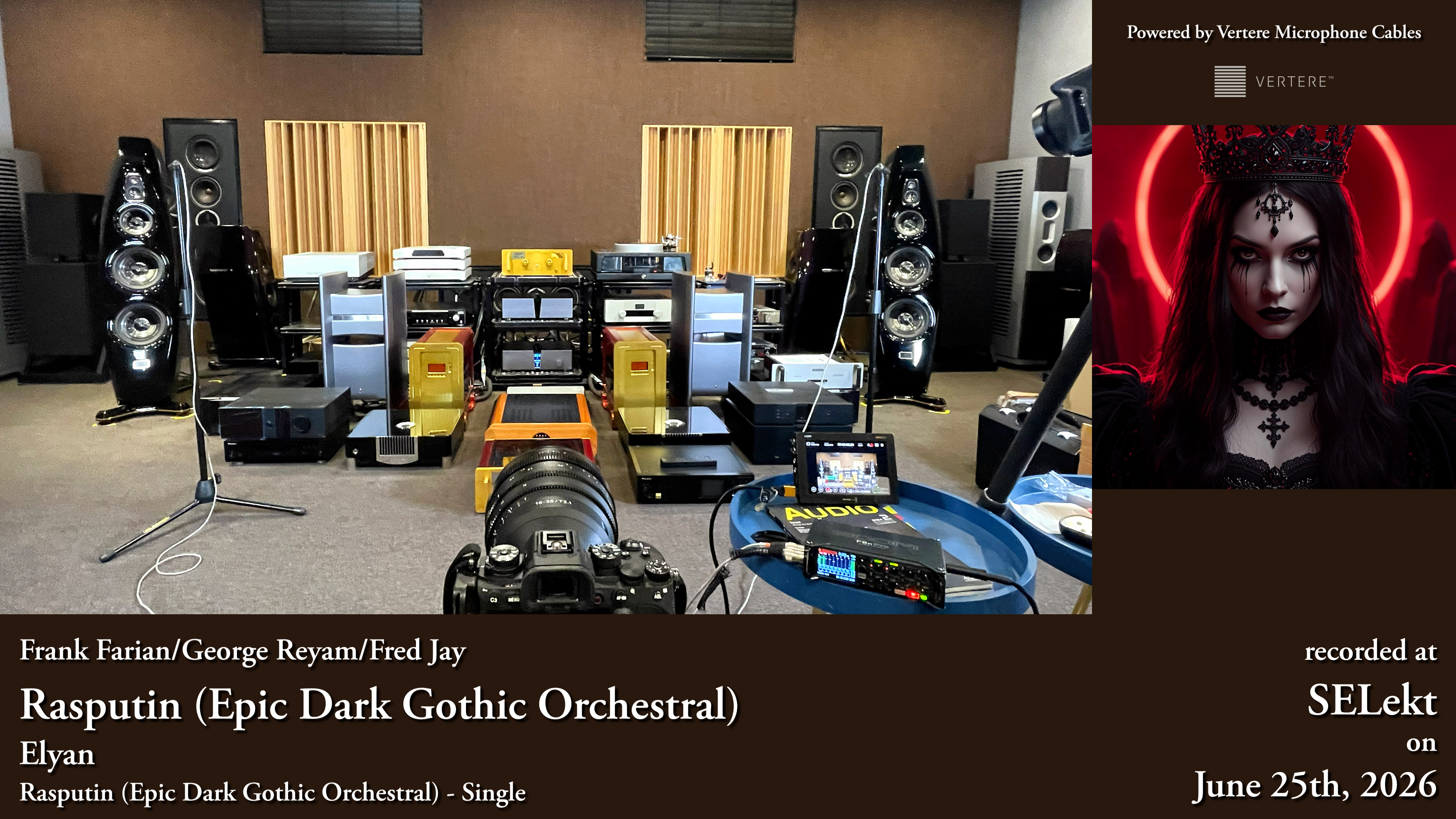
The SELekt playback chain used a Memory Player MP-32, MSB Cascade DAC, Halcro Equinox preamplifier, Halcro Eclipse monoblocks and Kharma Enigma Veyron 4D loudspeakers.
Kharma specifies the Enigma Veyron EV-4D at 4 ohms nominal, with a 1.8-ohm minimum. Halcro rates each Eclipse at more than 500 watts into a 4-ohm resistive load at 1 kHz. Read together, those published figures put amplifier-to-loudspeaker load matching at the centre of the system question. As the track’s scale changes, listen for whether pitch, placement and the relationship between foreground and background remain intelligible.23
The seat HFI set out to share
HFI recorded the session at SELekt on 25 June 2026 with a matched pair of DPA-4011 microphones and a Zoom F8n Pro at 192 kHz/32-bit float. A laser distance meter was used to match the microphones’ distances from the loudspeakers at the position where the pair most closely captured the sound heard at the sweet spot.
That perspective is the invitation: begin with the song’s transformation, then let the system questions emerge from it. Use headphones, settle into your own sweet spot, and give the familiar name time to become unfamiliar again.
Watch and listen
The complete HiFi Immersion video
For the clearest sense of the room, listen on headphones at a comfortable, consistent level.