
A son’s song at the end of a first duet
“Spiritual” arrives as a family song inside a friendship. Josh Haden wrote it, and Charlie Haden and Pat Metheny placed it at the close of Beyond the Missouri Sky (Short Stories). Verve’s original album feature traces the piece to Spain’s debut: Charlie speaks with a father’s pride, while Metheny remembers that the song stood out as soon as he heard Josh’s record. Their version therefore carries more than a composer credit. A son’s melody becomes the closing thought in the first duet album made by two musicians who had already met in many other settings.1
The same feature describes the album as the outcome of a 25-year friendship and identifies it as Haden and Metheny’s first duet recording. That history gives the small format unusual weight. There is no large ensemble to distribute attention; each entrance, pause and exchange belongs to a conversation whose shared past is part of the record.1
HFI selected the 2014 Verve/Universal LP edition of Beyond the Missouri Sky (Short Stories), catalogue DZ3095. Pat Metheny’s official discography dates the original album to 1997 and lists “Spiritual” as its thirteenth and final track.
An analog source meets horn and active bass
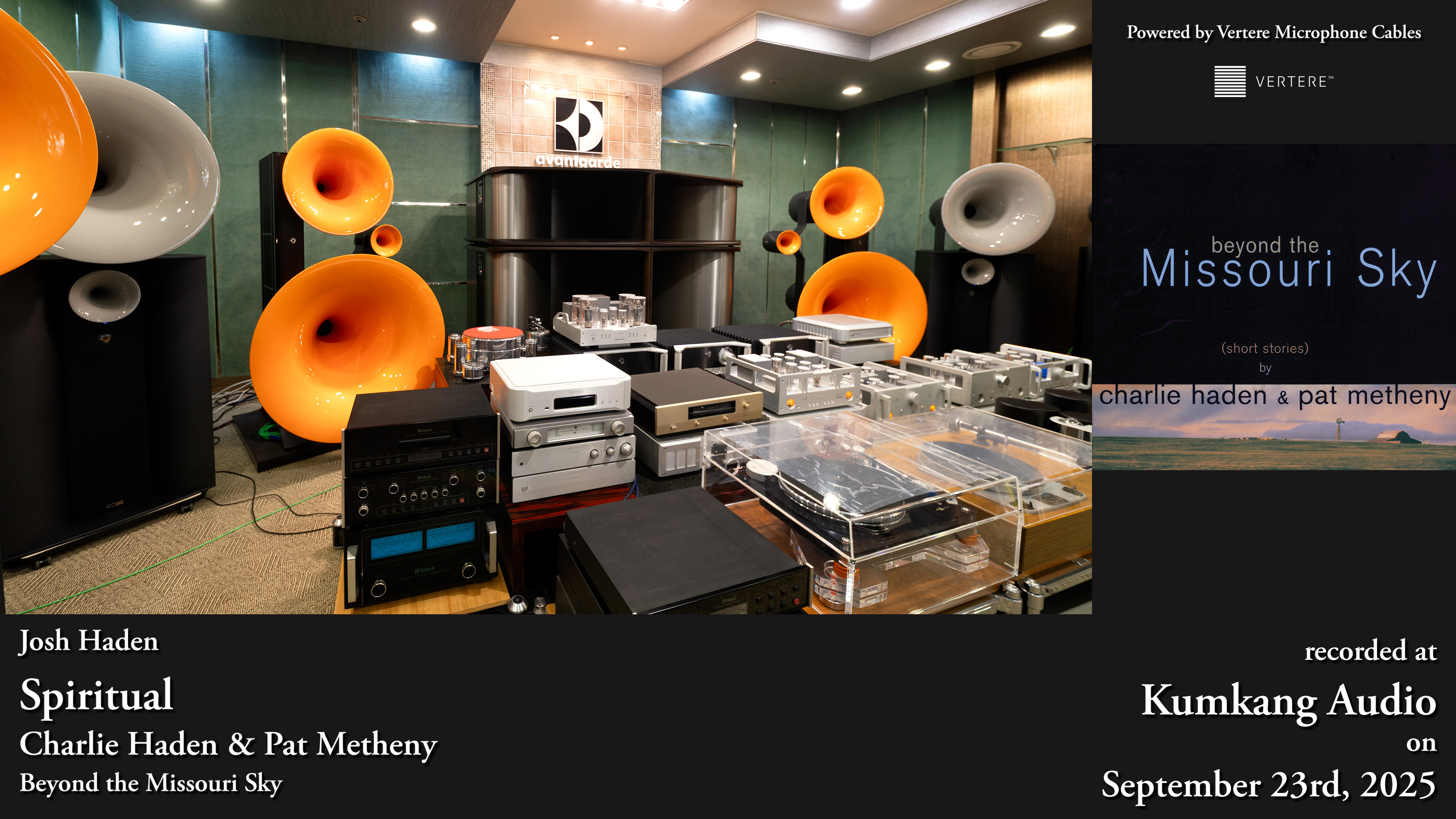
The approved HFI master identifies a Vertere MG-1 Magic Groove turntable with Mystic moving-coil cartridge, an Allnic Audio H-7000V phono stage, a Plinius Reference M-10 preamplifier and Avantgarde Acoustic Mezzo G3 loudspeakers.
Avantgarde’s product documentation places a 670 mm spherical midrange horn and 200 mm tweeter horn above two 12-inch woofers driven by a DSP-controlled 1,000-watt internal bass amplifier. That division of work gives this session a useful question: as bass fundamentals, plucked-guitar attacks, harmonics and room decay move through different ranges, does the duet still read as two people answering one another?2
The record begins in a physical groove, passes through moving-coil pickup and phono gain, and reaches line-level control at the Reference M-10. Plinius documents that preamplifier as a fully discrete dual-mono design with separate left- and right-channel signal paths; HFI’s master places it after the H-7000V in the documented analog source path.
Follow the exchange, not the inventory
Begin with the relationship between the two instruments. Follow whether Haden’s bass remains a line with pitch and phrase rather than becoming a general low-frequency cushion. Then move to Metheny’s plucked attacks and the decay behind them: notice where a note ends, where the room continues, and how much quiet the next phrase is allowed to keep. The published recording leaves the answers with the listener.1
A duet can feel intimate without feeling slight. Listen for the moment one player stops carrying the foreground and the other takes it, and for passages where neither needs to fill the whole space. The album’s subtitle, Short Stories, is apt here: the track can close a record without turning its final word into a grand gesture.
Kumkang Audio from one stable perspective
HFI recorded the system at Kumkang Audio on 23 September 2025. The matched DPA-4011 pair was positioned where those microphones most closely captured the sound heard at the sweet spot. A laser distance meter matched their distances from the loudspeakers, and a Zoom F8n Pro captured the session at 192 kHz/32-bit float.
Let the final track finish before reaching for the next record. With headphones at a comfortable level, settle into a sweet spot of your own and decide whether this family song feels like closure, remembrance or the start of another conversation.
Watch and listen
The complete HiFi Immersion video
For the clearest sense of the room, listen on headphones at a comfortable, consistent level.