A familiar song, heard as an ensemble
“Hallelujah” has accumulated so many versions that it can be easy to listen only for the lead voice or the chorus. This performance asks for a different kind of attention. Espen Lind, Kurt Nilsen, Alejandro Fuentes and Askil Holm share the song, so its shape comes from the way four distinct voices enter, withdraw and support one another.
HFI used the 2006 RCA release Hallelujah (Live) at 44.1 kHz/16-bit. Leonard Cohen wrote the song.
The song appears as track 16 of 17, just before the brief closer “En Natt Forbi.” The credits show all four singers also playing acoustic guitar, joined by Jørn Dahl on keyboards, Lars Christian Folkvord on bass, Truls Hval on guitar and Bjørn Sæther on drums. Near the end of the concert, “Hallelujah” feels like a gathering point for musicians who have already shared the stage all evening.1
From digital timing to the Tidal Akiras
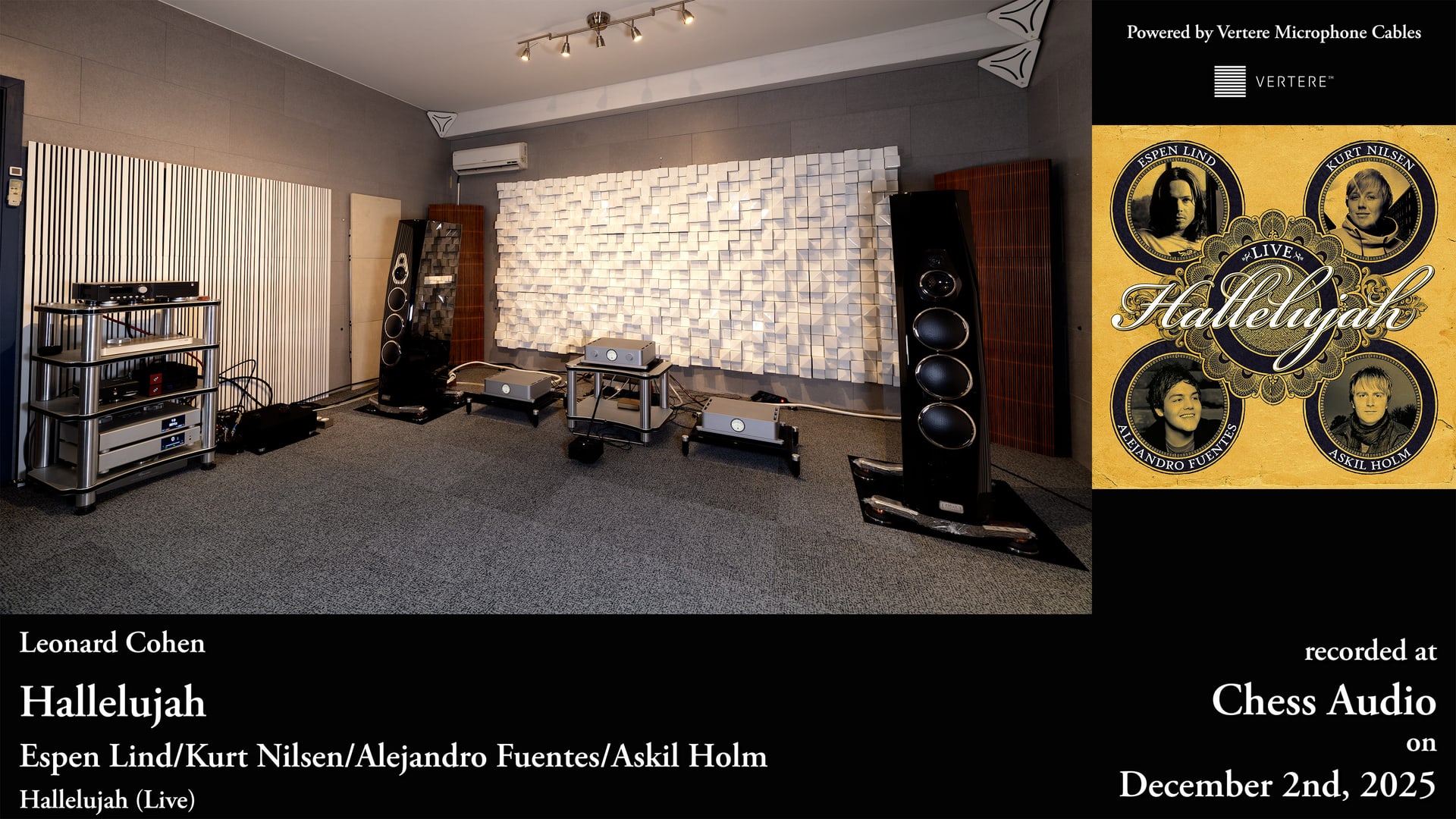
The playback chain begins with a Master Fidelity NADAC-C master clock and NADAC-D converter. A Vinnie Rossi Brama preamplifier feeds Brama monoblocks, which drive Tidal Akira loudspeakers.
Master Fidelity says the NADAC-C supplies a 10 MHz reference, while a clock-recovery stage inside the NADAC-D aligns the clock domains and generates the signals used by its one-bit conversion architecture. The two boxes therefore divide reference timing and conversion rather than passing an external clock straight through.2
From there, the Brama preamplifier and monoblocks drive the Tidal Akiras. Through the full system, the four voices and their band remain at the centre of the performance.
How HiFi Immersion captured it
The session was recorded at Chess Audio in Seoul on 2 December 2025. HFI used DPA-4011 microphones into a Zoom F8n Pro with Vertere microphone cables, recording at 192 kHz/32-bit float. Sennheiser HD820 headphones were used during the production process.
HFI positioned the matched DPA-4011 pair precisely for the sweet-spot sound, using a laser distance meter to set the microphones’ distance from the loudspeakers. On headphones, the spacing among the voices and the room around them are easier to follow.
Following four voices through one performance
Begin with the hand-offs between singers. Follow whether each voice remains individually intelligible when the harmony thickens, and whether the quartet still feels like one performance rather than four isolated tracks. On another pass, move your attention to the keyboards, bass, guitar and drums: listen for how the accompaniment supports a new lead without pulling the song apart.
Then listen to the space between the voices and the room’s decay after each phrase. The pleasure lies in hearing four individual characters become one shared performance.
Watch and listen
The complete HiFi Immersion video
For the clearest sense of the room, listen on headphones at a comfortable, consistent level.