An album opener built to keep moving
Off the Wall was Michael Jackson’s first solo album for Epic Records, and “Don’t Stop ’Til You Get Enough” opens Side A. Jackson wrote the song. Its place at the front gives the comparison a natural starting point: the first invitation into the album.
The pulse remains steady enough to examine in a short window, yet the song keeps gathering momentum through vocal entries, rhythmic accents and changes in density. It rewards both a close listen to one passage and the broader sweep of the performance.
This session used a 96 kHz/24-bit edition of Off the Wall, released by Epic Records on 10 August 1979.
One song, two comparison modes
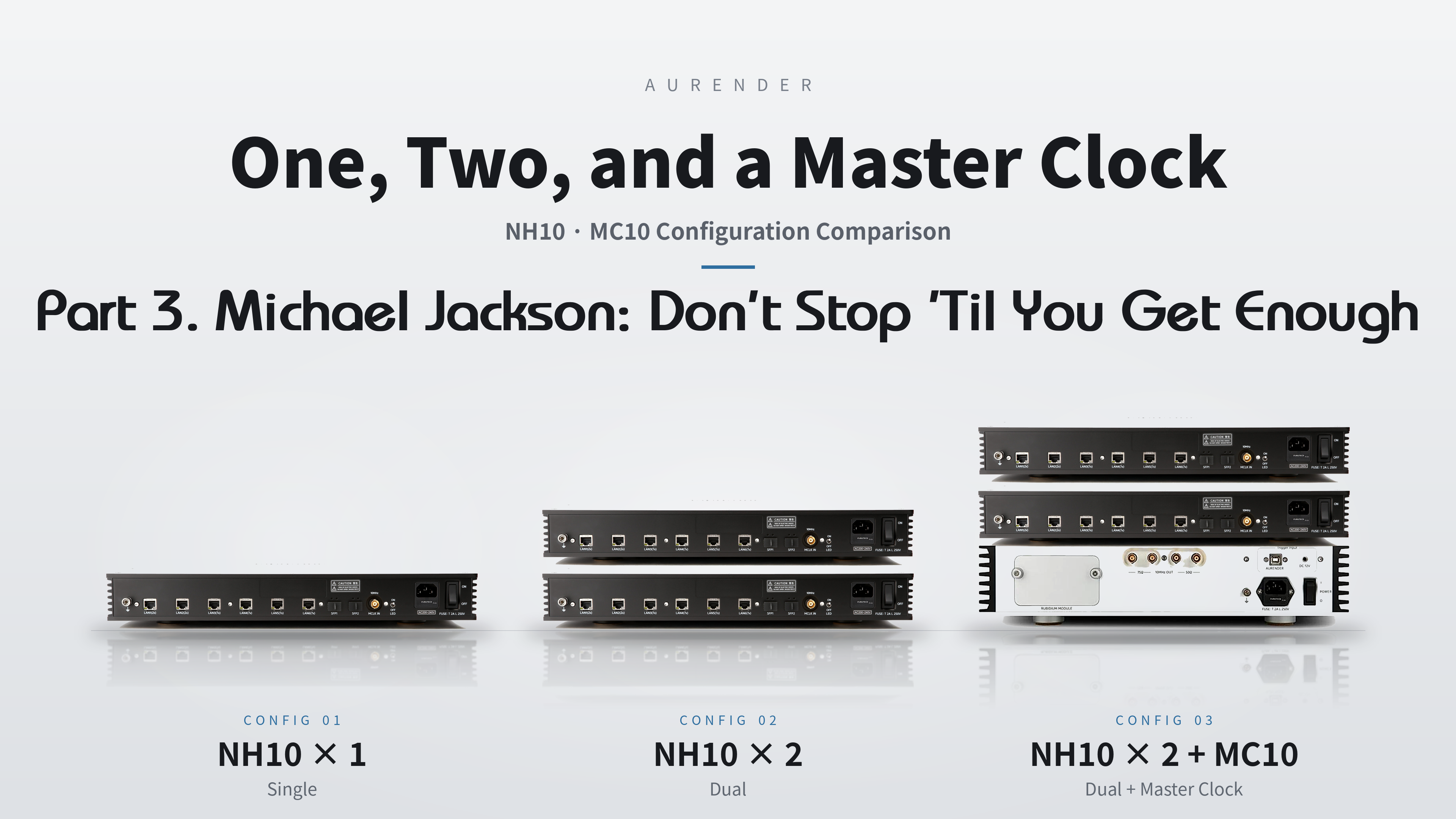
The video opens with thirty seconds of the two-NH10-plus-MC10 state, then revisits three thirty-second passages across the configurations. HFI settled on thirty-second windows after reviewing relevant psychoacoustic research, balancing enough time for musical context, spatial cues and decay with a short enough interval to compare adjacent states. Each passage moves through one NH10, two NH10s and two NH10s plus MC10; the first two groups also return to one NH10.
At 6:00 the comparison changes shape. The video advances through the rest of the song while rotating the three states every thirty seconds, with shorter final intervals completing the track.
Where the clocks sit in the chain
The comparison centres on the Aurender NH10 and MC10. HzProject’s HzCORE music server, HzBRIDGE Roon Bridge and HzRouter supported the playback environment. In the two-NH10 states, one unit faced the router and Internet; an Aurender-supplied 10G-rated SFP+ cable assembly linked it to the second NH10 on the downstream audio network. The MC10 joined the third state. The same amplification drove YG Acoustics Summit loudspeakers, with the system arranged on a HIFISTAY MYTHOLOGY X-1 rack.1
The NH10 accepts a 50-ohm 10 MHz master-clock input, and the MC10 provides matching reference-clock outputs. In the MC10 state, it supplied the reference to both NH10s and the downstream system clock, which continued to distribute word clock to the player.12
A seat at HzProject
HFI made the recording at HzProject in Yongin on 7 July 2026. To capture the sweet-spot sound, HFI positioned the DPA-4011 microphones precisely and used a laser distance meter to set their distance from the loudspeakers. The microphones fed a Zoom F8n Pro through Vertere microphone cables at 192 kHz/32-bit float.
Watch and listen
The complete HiFi Immersion video
For the clearest sense of the room, listen on headphones at a comfortable, consistent level.