A title track owned by the duo
The Proprius programme moves among spirituals, Duke Ellington, traditional songs, Schumann and Vivaldi. At its centre sits “Antiphone Blues,” jointly credited to Arne Domnérus and Gustaf Sjökvist. Naxos’s Proprius catalogue identifies Domnérus on saxophone and Sjökvist on organ, making the title track the pair’s own statement inside a record built from several musical traditions.1
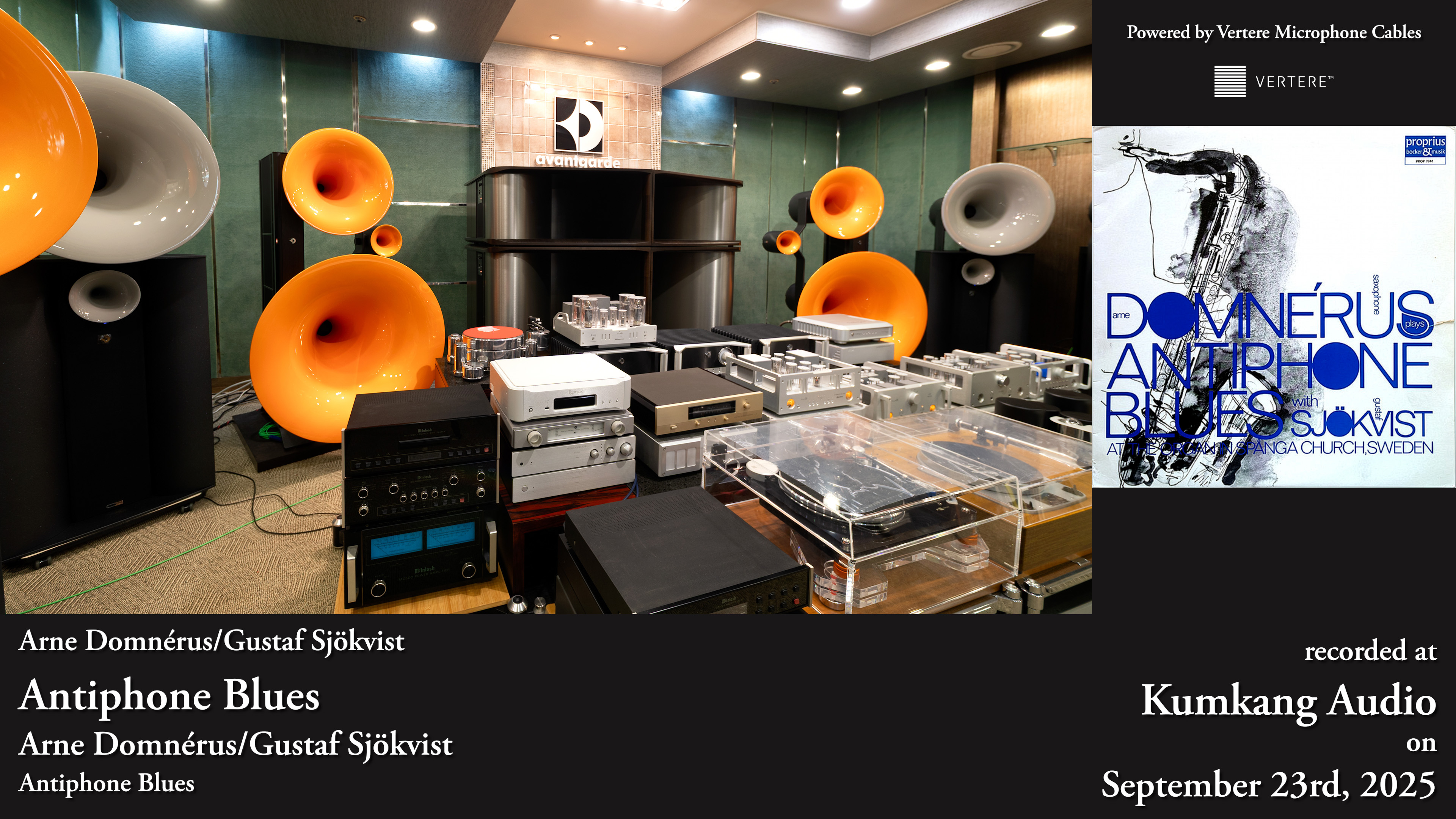
HFI used the original 1975 Proprius PROP 7744 vinyl LP. The album was recorded on 26 August 1974, and “Antiphone Blues” is its fourth track.13
Follow two voices through one piece
Begin with one uninterrupted pass. Instead of treating saxophone as soloist and organ as background by default, notice which instrument introduces an idea, which one answers, and when their roles stop feeling fixed. The useful subject is the exchange itself: a line can be carried, interrupted, supported or left in open space without either player disappearing from the piece.1
On a second pass, move between pitch and duration. Follow the saxophone’s shaped phrases, then the organ tones that continue beneath or beyond them. When both instruments are active, listen for whether each remains a distinct musical voice while the performance still moves as a single thought.
Gain between phono stage and loudspeaker
The record played on a Vertere MG-1 Magic Groove turntable with a Vertere Mystic moving-coil cartridge. An Allnic Audio H-7000V phono stage fed a Plinius Reference M-10 preamplifier and Avantgarde Acoustic Mezzo G3 loudspeakers.
Plinius specifies two line-stage gain choices for the Reference M-10: 0 dB and 12 dB. The company presents the low-gain position as a way to manage systems that already accumulate substantial gain through their connections. That selectable stage supplies the new system question here, between the H-7000V’s phono output and the Mezzo G3 system.2
Keep the first listen musical, then return to the places where a sustained organ tone meets a new saxophone entrance. Follow the change in musical roles before narrowing your attention to texture or scale.
A sweet-spot perspective from Kumkang Audio
HFI recorded the system at Kumkang Audio on 23 September 2025. A matched pair of DPA-4011 microphones fed a Zoom F8n Pro through Vertere microphone cables at 192 kHz/32-bit float. HFI placed the pair where those microphones most closely captured the sound heard at the sweet spot and used a laser distance meter to match their distances from the loudspeakers.
Choose a comfortable headphone level and let the complete track establish its own proportions. Then settle into your own sweet spot and follow the moment when one musical voice makes room for the other without ending the conversation.1
Watch and listen
The complete HiFi Immersion video
For the clearest sense of the room, listen on headphones at a comfortable, consistent level.