A slow movement shared by unlike instruments
This is the second-movement Adagio from Franz Schubert’s Sonata for Arpeggione and Piano, D. 821. Decca catalogs the release as a cello sonata with Mstislav Rostropovich and Benjamin Britten. The change of instrumental name matters less here as a historical footnote than as a way into the performance: cello and piano carry the same slow movement with very different kinds of duration.1
HFI used the 44.1 kHz/16-bit Decca edition of Schubert: Arpeggione Sonata / Schumann: Fünf Stücke im Volkston / Debussy: Cello Sonata, released on 10 August 1999.
Begin with Rostropovich’s sustained line, then shift attention to the piano’s attacks and the way each note falls away. On another pass, stop separating the instruments and follow how the two shapes complete one phrase. The useful question is not which sound attracts more attention, but how the movement keeps its calm continuity across unlike means of making a note last.1
A matching control inside the power amplifier
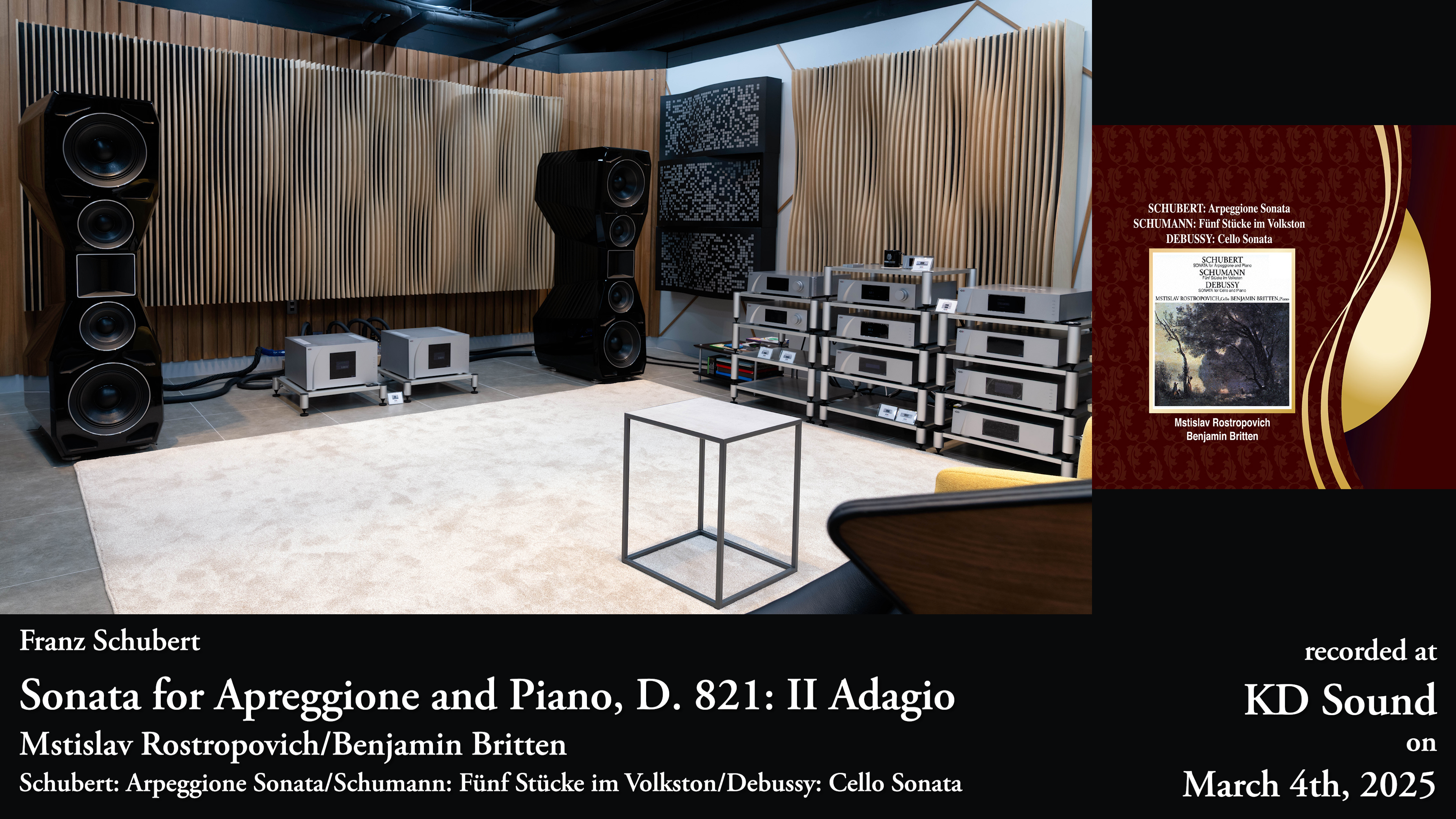
The KD Sound playback chain used a CH Precision X1 external power supply, T1 10 MHz time reference, C10 digital-to-analog converter, L1 line stage and M1.1 power amplifiers before the Göbel Divin Noblesse loudspeakers.
CH Precision describes the M1.1 as providing adjustable local and global feedback in 10% increments, with damping factor treated as a variable for matching the amplifier to a loudspeaker and acoustic environment. That architecture makes matching—rather than power alone—the useful system question to carry into the recording.2
Follow the phrase before the detail
A slow movement can tempt the ear toward isolated qualities: the body of the cello, the edge of a piano attack, or the length of a decay. First hear the phrase whole. Then return to the same span and notice whether the handover between held and fading sound remains easy to follow without turning either instrument into a demonstration piece.1
That order keeps the music in charge of the test. The system can invite attention to texture and space, but Schubert’s Adagio asks those details to serve a long line. Let the first listening establish its pace; use the second to hear how Rostropovich and Britten sustain that pace by different physical means.1
Recorded at KD Sound
HFI recorded the system at KD Sound in Seoul on 4 March 2025. A matched pair of DPA-4011 microphones fed a Zoom F8n Pro at 192 kHz/32-bit float. A laser distance meter matched the microphones’ distances from the loudspeakers at the position where that pair most closely captured the sound heard at the sweet spot.
Set a comfortable headphone level and take your own sweet spot. Give the Adagio time to establish its line, then return to the moment where cello sustain and piano decay become one shared measure of stillness.1
Watch and listen
The complete HiFi Immersion video
For the clearest sense of the room, listen on headphones at a comfortable, consistent level.