An answer written into the music
The title “Poor Man’s Moody Blues” began as somebody else’s judgment. The Barclay James Harvest archive says repeated comparisons with the Moody Blues prompted John Lees to keep only the basic chord framework of “Nights in White Satin” and construct a new song around it; the title itself came from a press review. What could have remained an insult became raw material for composition.1
That history gives the first listen a useful direction. Notice the familiar harmonic gravity without turning the song into a guessing game, then follow the melody, words and emotional emphasis that Lees places over it. The point is not resemblance alone, but the act of taking a comparison apart and making it carry another identity.1
HFI used “Poor Man’s Moody Blues” from the October 1977 Polydor vinyl edition of Gone to Earth, catalogued as 2442 148 and 2442-148. John Lees wrote the song, and Barclay James Harvest performed it.
Two timing relationships at the source
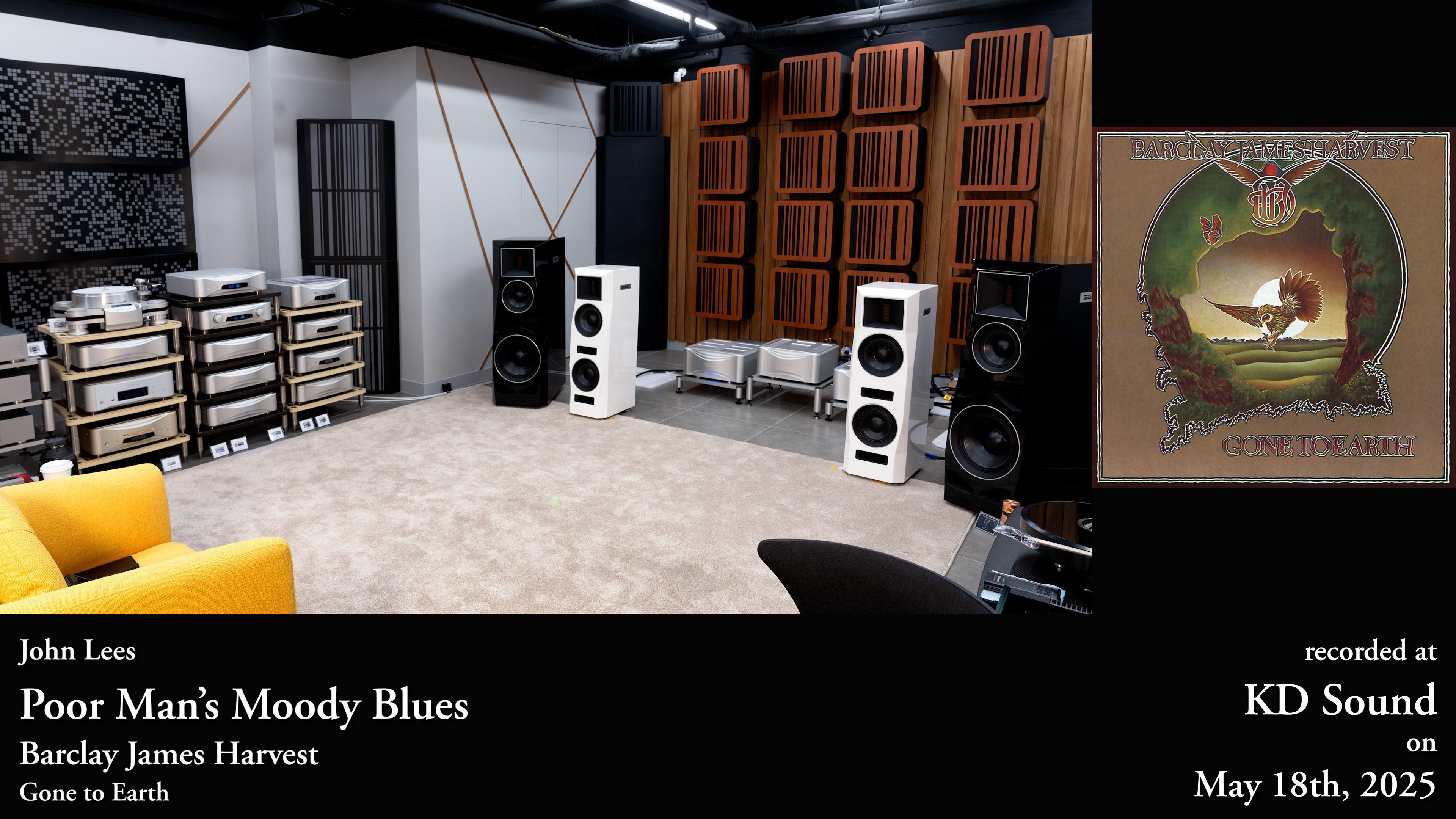
The playback chain paired an Esoteric Grandioso T1 turntable with a Grandioso G1X master clock generator. A Grandioso E1 balanced phono-stage preamplifier fed a C1X line-stage preamplifier, followed by Grandioso M1X monoblock power amplifiers and Göbel Divin Comtesse loudspeakers.
Esoteric describes the T1’s MagneDrive system as synchronizing its magnetic driver and platter by induction, without physical contact between them. The motor unit also accepts a 10 MHz external clock, and HFI’s session paired the T1 with the G1X. Magnetic synchronization inside the drive and an electronic reference supplied to the motor are therefore two different timing relationships, a more exact way to read this analog source than the broad label “all-Grandioso.”2
Let the reply become its own song
On a first pass, take in the complete musical arc. On a second, hold the chord framework in mind and listen for the choices that belong to this song: the shape of Lees’s melody, the band’s pacing and the way the performance turns a public comparison into a private declaration. That shift from reference to identity is where the story becomes human.1
HFI recorded the system at KD Sound in Seoul on 18 May 2025. A matched pair of DPA-4011 microphones fed a Zoom F8n Pro at 192 kHz/32-bit float, with their distances from the loudspeakers matched by laser distance meter.
Use a comfortable headphone level, allow the opening to establish its scale, and stay with the song as it claims its own emotional ground. Sit in the sweet spot and hear how a sharp comparison became music with a life beyond the argument that started it.1
Watch and listen
The complete HiFi Immersion video
For the clearest sense of the room, listen on headphones at a comfortable, consistent level.