A song assembled on the road
Led Zeppelin’s official chronology places “Ramble On” at Groove Sound Studios in New York on 1 June 1969. It says the band recorded the song and overdubs there with engineer Eddie Kramer. That small production detail gives the track a useful human scale: a studio date sits inside the first years of a group already moving quickly between stages and sessions.1
Jimmy Page and Robert Plant wrote “Ramble On,” and Led Zeppelin perform it. HFI used the 1969 stereo Atlantic LP Led Zeppelin II, catalogue SD 8236.
Follow the change in scale
The opening gives the acoustic guitar and voice room to establish the song before bass, drums and electric guitar enlarge its stride. Keep that change in scale as the first listening thread. The contrast works through touch and timing as much as level: picked detail, vocal phrasing and the rhythm section each take a different share of the motion.1
On a second pass, stay with the bass line through the transitions. Then widen attention to the drum accents and guitar figures around it. The song keeps changing its apparent weight without losing forward movement, which makes the joins between its lighter and heavier passages more rewarding than a checklist of isolated sounds.
A different beginning for a familiar Saem Energy chain
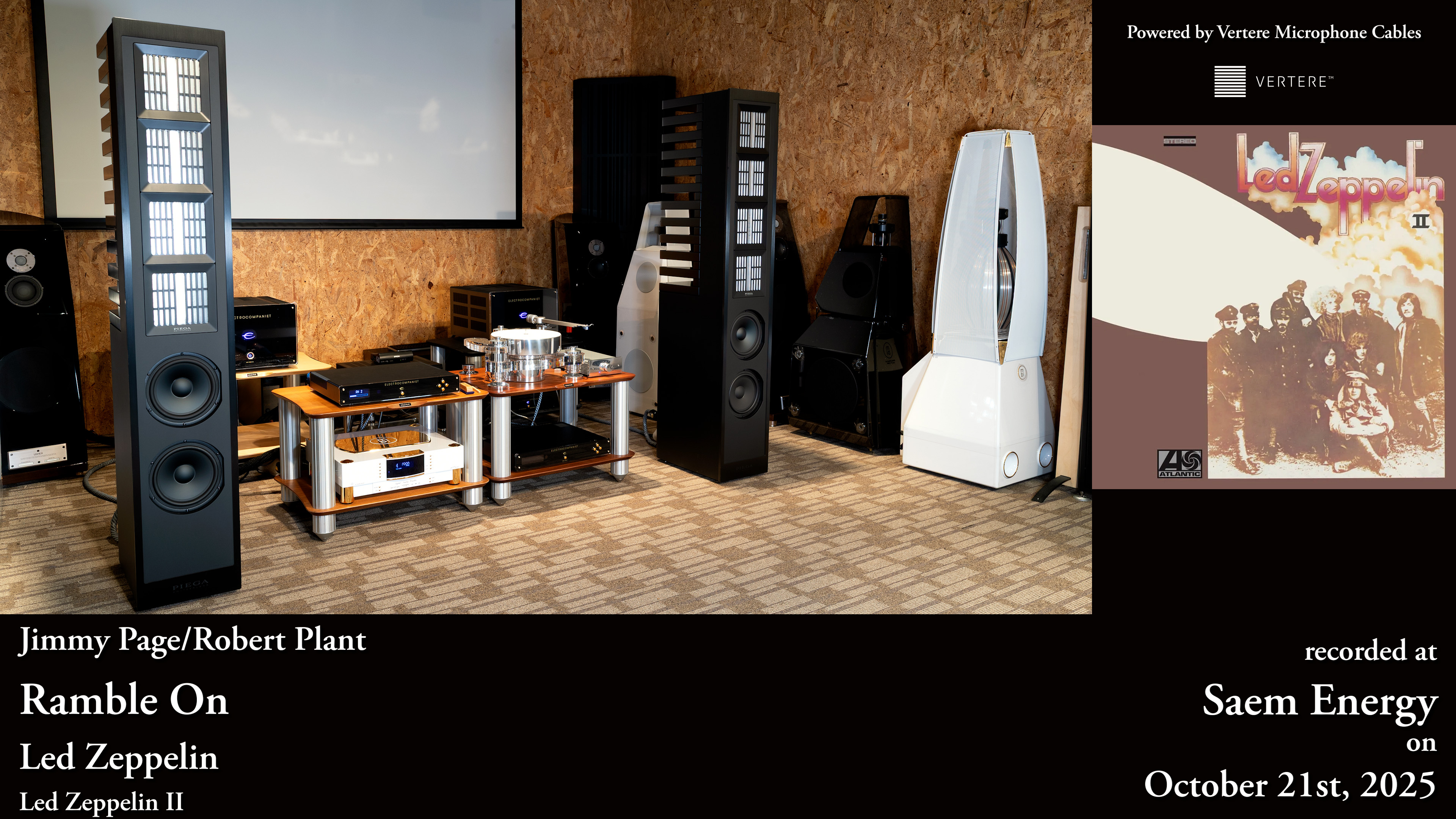
A Transrotor Rondino Bianco FMD turntable with a Hana Umami Blue cartridge played the LP. The signal then passed through an Electrocompaniet ECP 2 phono stage and EC 4.8 MKII preamplifier to AW 800 M monoblocks, which drove Piega Master Line Source 2 Gen2 loudspeakers.
Earlier HFI sessions at Saem Energy used the same Electrocompaniet line preamplifier, monoblocks and Piega loudspeakers with a digital source. Here the new system question begins before that shared downstream path: the Transrotor, Hana and separate phono stage make the record itself the starting point.
Piega describes the Master Line Source 2 Gen2 as a three-way dipole with four line-source ribbon drivers, two woofers and two passive radiators. Those facts define the loudspeaker architecture; the video lets the listener decide how the complete system carries the song’s shifts in density and momentum.2
Captured at Saem Energy
HFI recorded the playback at Saem Energy in Seoul on 21 October 2025. A matched pair of DPA-4011 microphones fed a Zoom F8n Pro through Vertere microphone cables at 192 kHz/32-bit float. Sennheiser HD820 headphones were used during production.
Put on headphones and sit in the sweet spot. Let the acoustic opening establish the song, then follow how the bass and drums change its gait when the full band arrives. The record, the room and the system meet in one listening session; the musical movement remains the reason to stay.
Watch and listen
The complete HiFi Immersion video
For the clearest sense of the room, listen on headphones at a comfortable, consistent level.