A finale built as a fugue
Four musicians can make a fugue feel less like a puzzle than a chase. Beethoven closes the String Quartet in C major, Op. 59 No. 3—the last of the three “Razumovsky” quartets—with an Allegro molto finale built as a fugue. Beethoven-Haus describes its fast, subtly restless motion as resembling a perpetual-motion machine. That is the thread to follow here as the subject passes from player to player without releasing the drive of the whole quartet.1
The Guarneri Quartet gives each entrance a clear place in the argument. Start with the opening statement, then follow the subject as it moves from player to player. Even when one line slips from the foreground, the movement keeps pressing ahead.1
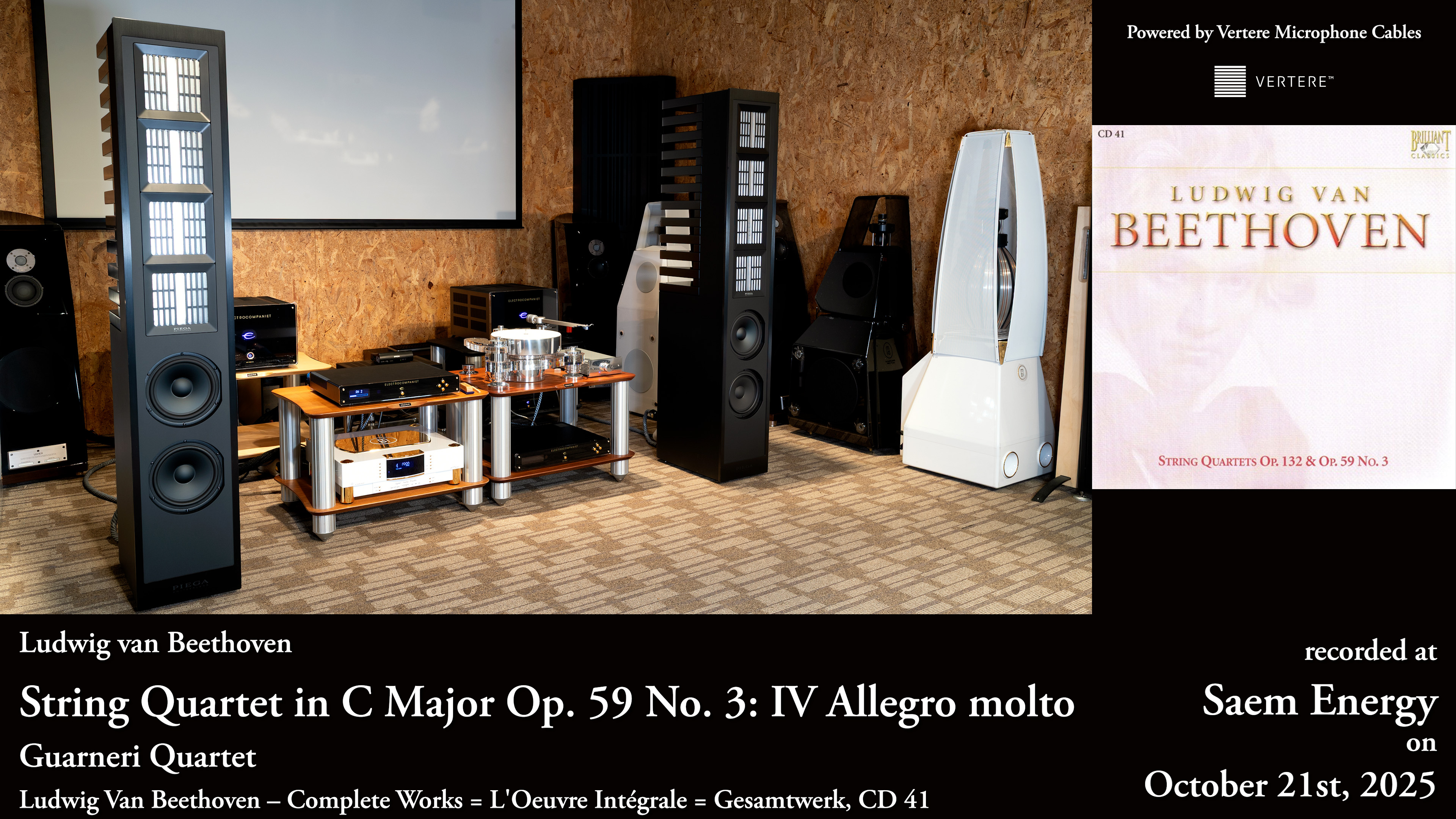
HFI selected the Guarneri Quartet performance from CD 41 of Brilliant Classics’ Ludwig van Beethoven – Complete Works (93553/41), released in 2007.
A dipole line source facing the room
An MBL 1611 F D/A converter fed an Electrocompaniet EC 4.8 MKII Reference preamplifier and AW 800 M Reference monoblock power amplifiers, which drove Piega Master Line Source 2 Gen 2 loudspeakers.
Piega documents the Master Line Source 2 Gen 2 as a three-way dipole system. Its four Line Source Driver 211 units form the mid/high array, and acoustic lenses behind them diffuse the sound radiated backward. Two 220 mm UHQD woofers and two matching passive radiators handle the low-frequency section.
Because the array also radiates backwards, its relationship with the room is part of the design. In the Saem Energy capture, listen to where the ensemble seems to sit and how the surrounding space changes as the quartet grows busier.
The listening position at Saem Energy
HFI recorded the system playback at Saem Energy in Seoul on 21 October 2025. The DPA-4011 pair was positioned precisely to capture the sweet-spot sound, with a laser distance meter used to set the microphones’ distance from the loudspeakers. They fed a Zoom F8n Pro through Vertere microphone cables at 192 kHz/32-bit float, and Sennheiser HD820 headphones were used during production.
From your own sweet spot, listen on headphones at a moderate level and locate the opening statement of the subject. When the texture becomes crowded, notice whether its rhythmic outline remains recognizable even while your attention rests elsewhere. Then return to the opening entry and decide for yourself when the four parts begin to register as one fugal motion.1
Watch and listen
The complete HiFi Immersion video
For the clearest sense of the room, listen on headphones at a comfortable, consistent level.