When a quiet song faces a public burden
Bruce Springsteen’s official account calls The Ghost of Tom Joad his first primarily acoustic set since Nebraska and places its stories among poverty, immigration and hardship in the American and Mexican Southwest. The title track carries that wider subject at a deliberately hushed scale: the human story arrives before any promise of spectacle.1
That scale gives this session its musical question. Begin with the complete narrative rather than treating the track as a sequence of sonic tests. On a second pass, stay with the pacing of Springsteen’s delivery and the space left around each line. The useful question is whether attention remains with the people in the song when the playback level is modest.1
HFI used the 44.1 kHz/24-bit edition of The Ghost of Tom Joad, originally released by Columbia Records on 21 November 1995. Springsteen is credited as writer and performer.1
The same chain, a different system question
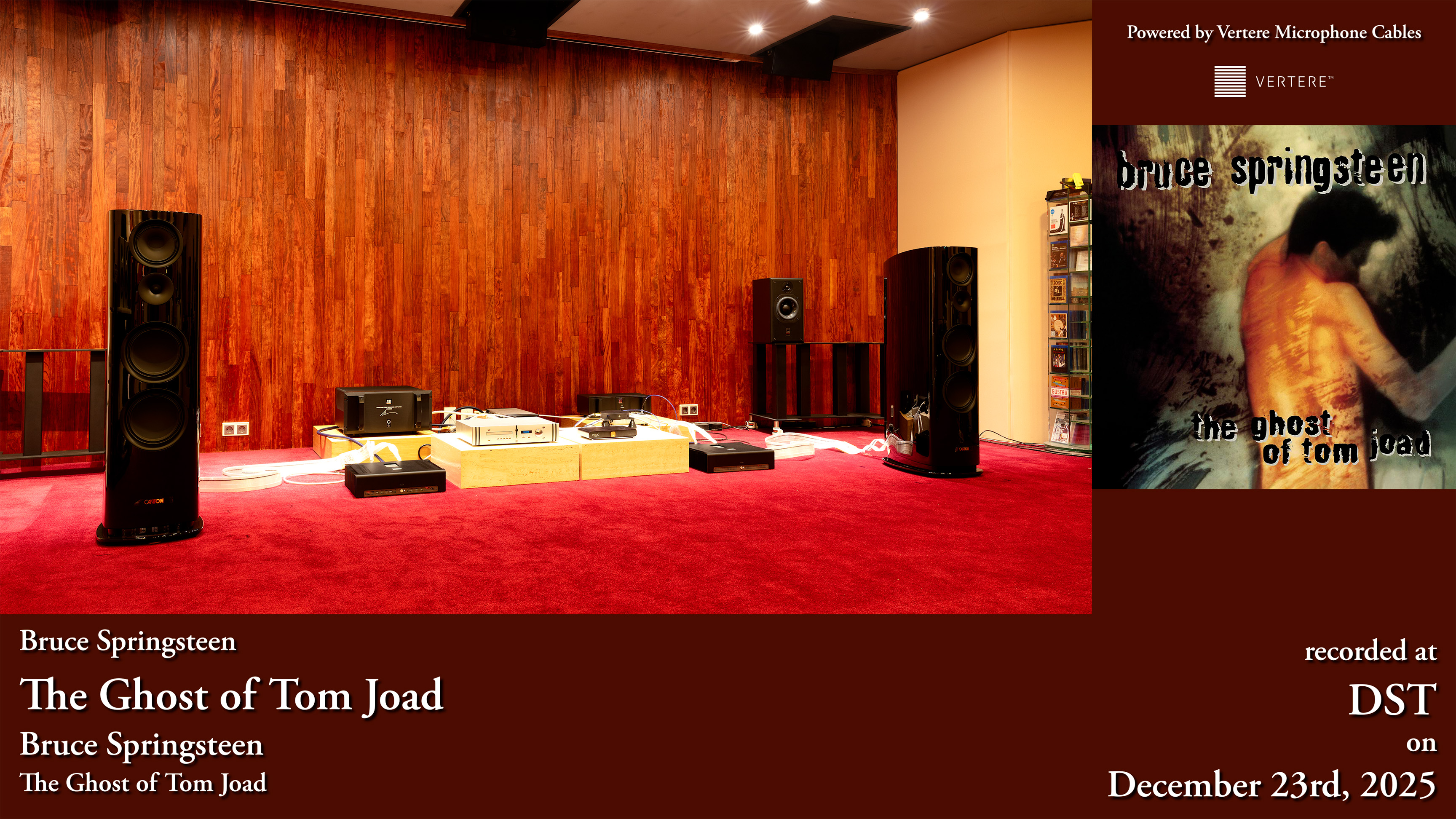
A Volumio Primo served as the network player. Its signal passed through an ATC CDA2 Mk2 to two Schiit Tyr monoblock power amplifiers driving Canton Reference 2 loudspeakers.
This exact system and venue also appear in HFI’s session with Howard Jones’s “No One Is to Blame.” That earlier article followed the combined CD, DAC and preamplifier role of the ATC unit. This time, the question moves downstream: Schiit describes Tyr as a differential monoblock built around a choke-input power supply, and one amplifier serves each channel.23
Canton identifies Reference 2 as a three-way bass-reflex floorstander with two woofers and adjustable midrange and treble levels for room matching. Together with the Tyr monoblocks, that architecture frames a practical listening question: through a system built from mono power stages and large three-way floorstanders, can a restrained song keep its proportions and narrative focus?23
A December recording at Damino Sound Technology
HFI recorded the system at Damino Sound Technology in Seoul on 23 December 2025. A matched pair of DPA-4011 microphones fed a Zoom F8n Pro at 192 kHz/32-bit float, with a laser distance meter used to match the microphones’ distances from the loudspeakers.
The matched microphones were positioned where that pair most closely captured the sound HFI heard at the sweet spot. Their characteristics affect that point, so it is not necessarily the physical listening seat. The method keeps the invitation positive and specific: sit in your own sweet spot, begin at a comfortable level and let the song establish its scale before changing anything.
Keep the road, voice and room in one frame
On headphones, first follow the words without chasing individual pieces of equipment. Then return to the spaces between phrases and to the relationship between the voice and the room around it. If the story remains coherent as the level comes down, note which cues preserve that attention; if it does not, that difference is equally useful.1
The system joins mono power stages to large three-way floorstanders, but the song asks for another kind of discipline. Give its quietness time. The most worthwhile result is not an equipment verdict; it is hearing whether Springsteen’s narrative still feels close enough to hold the room.123
Watch and listen
The complete HiFi Immersion video
For the clearest sense of the room, listen on headphones at a comfortable, consistent level.