The brackets around Op. 66
The name Fantaisie-Impromptu can feel inseparable from Op. 66, but the catalogue tells a more layered story. The official Chopin record dates the C-sharp minor Impromptu-Fantaisie to 1834 and places the opus number in brackets. Its catalogue note explains that bracketed opus numbers are those assigned by Julian Fontana. The music and the number by which it became familiar therefore belong to different moments in its history.1
That small typographic detail is a useful way into Valentina Lisitsa’s performance. Hear the piece first as a complete dramatic span, then return with its two identities in mind: a work composed in 1834, and a familiar catalogue name shaped by the history that followed it. The brisk surface attracts attention immediately, but the larger pleasure lies in hearing how the music makes room for a broader lyrical centre and then finds its way back.1
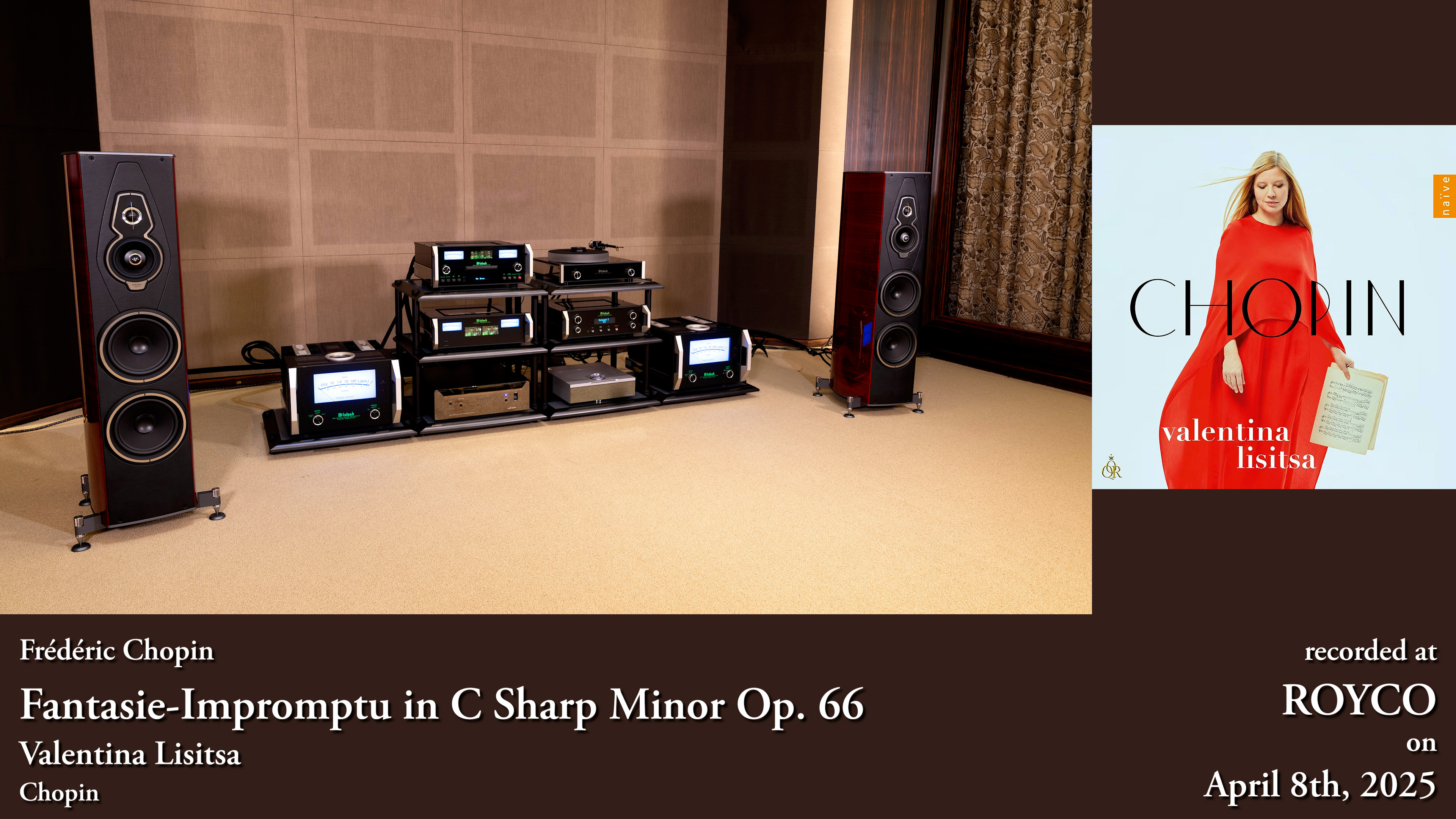
HFI used Valentina Lisitsa’s performance from Chopin, released by Naïve as V 7700 on CD in 2022.
A sealed midrange above vented bass
The disc was played on a McIntosh MCD12000 through a C12000 preamplifier and MC1.25KW monoblock power amplifiers. Sonus faber Amati G5 loudspeakers completed the playback chain, with an AudioQuest Niagara 7000 power distributor and AudioQuest Dragon, Hurricane and Thunder-series cables.
Sonus faber specifies the Amati G5 as a 3.5-way loudspeaker. Its midrange driver works in a sealed enclosure, while two 220 mm woofers share a vented enclosure; the published crossover points are 200 Hz, 270 Hz and 2.2 kHz. This is a more specific system question than scale alone: how does one loudspeaker hand a solo piano’s bass foundation, middle register and fast upper line across those ranges while the musical phrase remains continuous?2
On a second play, follow the left hand before following the rush above it. Then shift attention to the singing middle section, where continuity and touch matter more than sheer velocity. The Amati’s documented architecture supplies the map; Lisitsa’s changes of pace and emphasis supply the reason to use it.2
A sweet-spot perspective from ROYCO
HFI recorded the system at ROYCO in Seoul on 8 April 2025. A matched pair of DPA-4011 microphones fed a Zoom F8n Pro at 192 kHz/32-bit float. A laser distance meter matched the microphones’ distances from the loudspeakers at the position where that pair most closely captured the sound heard at the sweet spot. Kennerton Audio Rognir Bog Oak headphones with an Audience frontRow cable were used during production.
Begin at a comfortable headphone level and let the first pass move without interruption. On the next, listen for the instant when motion gives way to song, and for the different kind of tension created when the rapid material returns. Speed is only the doorway; proportion, touch and return make the performance cohere.1
Sit in your own sweet spot and give the final notes their full decay. The title may carry a number added by a later hand, but the invitation is immediate: one pianist, one room and a compact work whose contrasts can still make time feel elastic.1
Watch and listen
The complete HiFi Immersion video
For the clearest sense of the room, listen on headphones at a comfortable, consistent level.