Before the remake became the memory
“No One Is to Blame” arrived first on Howard Jones’s Dream into Action in 1985. Jones’s official history separates that album recording from the revamped version released the following year, produced by and featuring Phil Collins. HFI’s source is the earlier album version, so this session begins before the remake that many listeners came to know best.1
That distinction gives the song a useful place to stand. The 1985 recording is not a draft waiting for its later success; it is the version that belongs to the original album sequence. Hear it on those terms first, with Jones’s voice and the electronic setting allowed to establish their own pace before memory supplies a comparison.1
HFI used the 44.1 kHz/24-bit edition of Dream into Action, originally released by WEA and Elektra on 15 March 1985. Howard Jones is credited as writer and performer.
One compact front end, two mono amplifiers
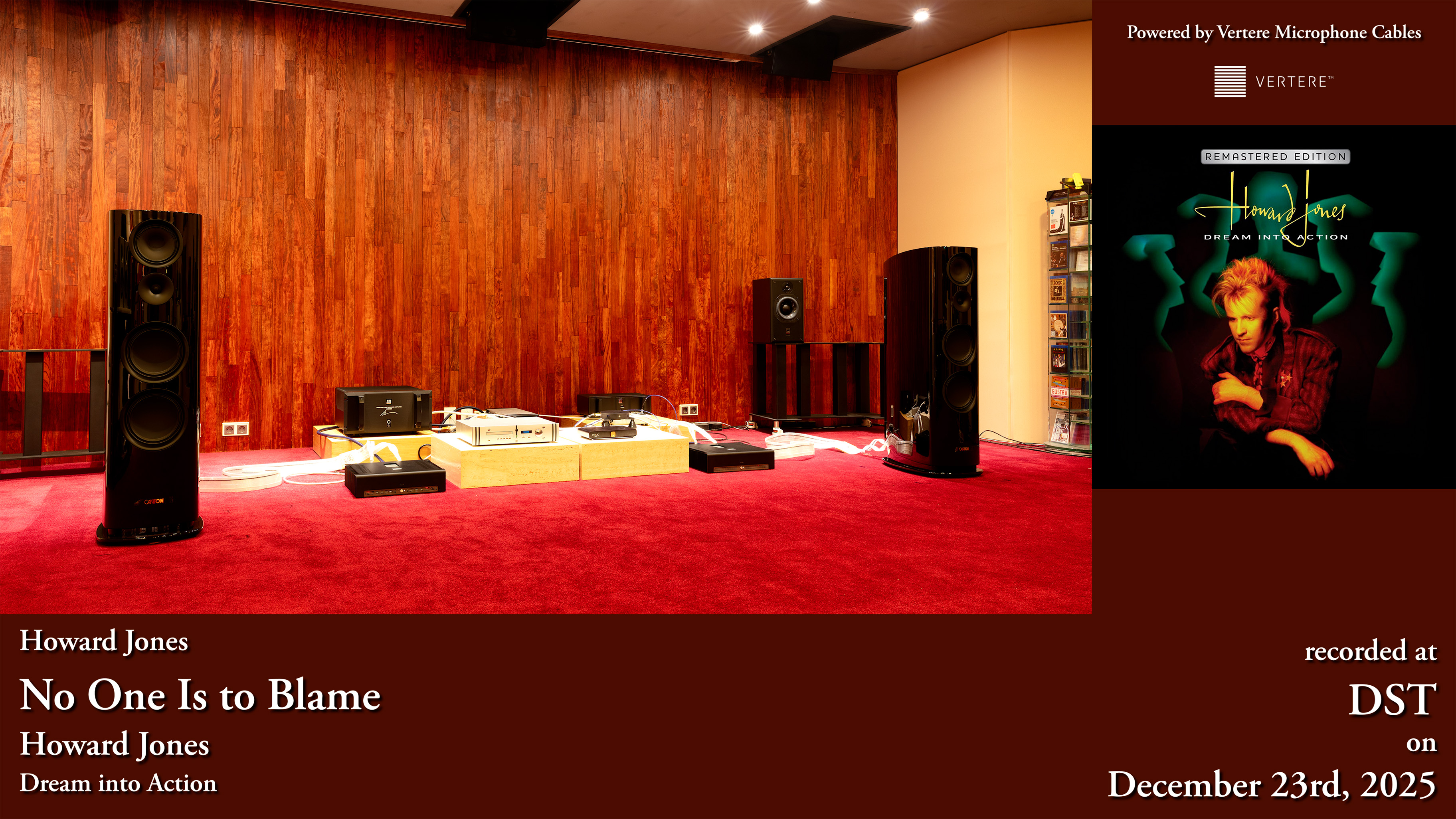
A Volumio Primo served as the network player. Its signal passed through an ATC CDA2 Mk2 to two Schiit Tyr monoblock power amplifiers driving Canton Reference 2 loudspeakers.
ATC describes the CDA2 Mk2 as a CD player, high-resolution DAC and preamplifier in one chassis. In this system, the Volumio handled network playback, the ATC unit combined conversion and level control, and the two Tyr amplifiers supplied one power-amplifier channel per loudspeaker.2
The architecture is useful because the responsibilities stay easy to follow: network source, combined digital and control stage, then separate left and right power stages. Keep that map in the background rather than turning the first play into an inventory. The song’s earlier identity remains the main subject.2
A December session at Damino Sound Technology
HFI recorded the system at Damino Sound Technology in Seoul on 23 December 2025. A matched pair of DPA-4011 microphones fed a Zoom F8n Pro at 192 kHz/32-bit float, with a laser distance meter used to match the microphones’ distances from the loudspeakers.
The channel’s sweet-spot method is defined by the microphones rather than by the chair: the chosen point is where that matched pair most closely conveys what HFI hears at the sweet spot. Because their response influences the choice, the point can lie elsewhere in the room. Start quietly on headphones and raise the level only until the song feels naturally scaled.
Hear the earlier shape of the song
Let the first pass belong to the complete song. On the second, follow Jones’s vocal through each phrase and notice how the keyboard parts and programmed textures move between support, reply and open space. If the later single is the version in your memory, hear where that memory anticipates a turn that this 1985 recording handles differently.1
There is no need to choose a definitive version. The value of returning to the album recording is more generous: it lets a familiar song recover an earlier shape. Settle into your own sweet spot, keep the level natural and give the Dream into Action version the time to speak for itself.1
Watch and listen
The complete HiFi Immersion video
For the clearest sense of the room, listen on headphones at a comfortable, consistent level.