Four station notes, one live return
Before Rattle That Lock was an album title, it was four notes at a French railway station. David Gilmour’s official account credits Michaël Boumendil with the SNCF announcement motif and says Gilmour captured it on his phone at Aix-en-Provence. Polly Samson drew the lyric from Book II of John Milton’s Paradise Lost. A public signal, a handheld recording and a literary image meet inside the song’s opening gesture.12
HFI’s chosen version carries that gesture into Pompeii. Gilmour’s official album record describes the two July 2016 shows—45 years after Pink Floyd filmed there—as the first rock concerts presented to an audience in the ancient venue. The shows became Live at Pompeii in 2017, and Rattle That Lock sits second in the official first-disc sequence. What began as a cue for travellers now enters a performance framed by return, scale and a crowd.2
Gilmour produced the album; he and Andy Jackson mixed it, with Damon Iddins assisting.2
A digital source with clearly divided roles
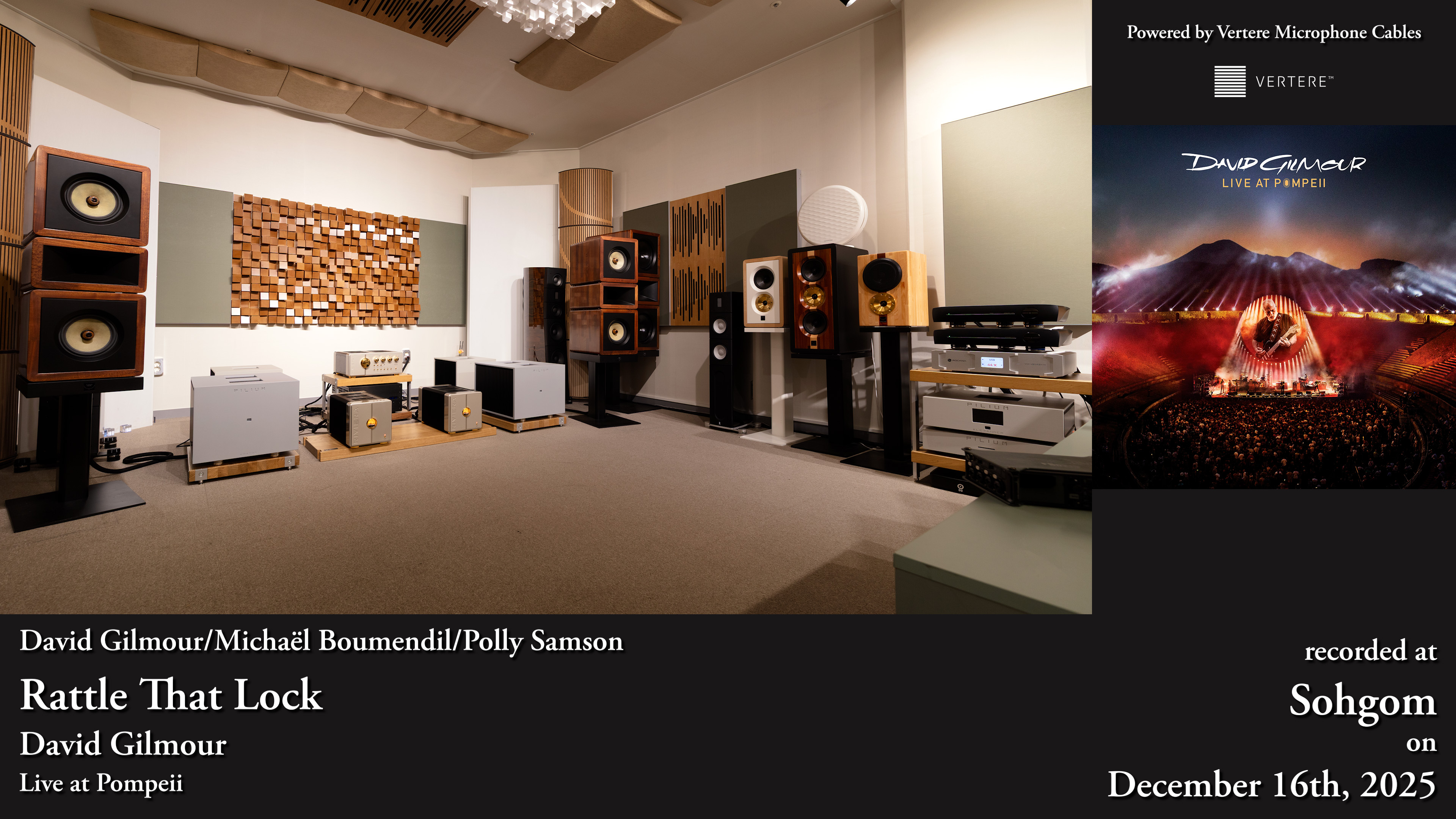
Antipodes describes each Oladra as a dual-computer server-player, with separate engines for server and player applications. In this session, however, the roles were divided more finely: one Oladra served only as the server, while the other served only as the player. The player Oladra’s USB output connected to the Wavedream Reference DAC’s USB input.34
Now leave the block diagram behind. The useful listening question begins with the music: does the short four-note signal remain a distinct prompt when the live performance grows around it? The published recording provides the material; the answer belongs to the listener.
Hear the signal before the spectacle
Start before the scale of Pompeii takes over. The four notes are short enough to register as an announcement, yet they also seed the song. Hear how quickly the ear stops treating them as public information and starts following them as music.1
Then widen attention from the cue to the ensemble, and from the ensemble to the audience in the amphitheatre. The point is not to hunt for one spectacular effect. Notice instead whether the small identifying figure still gives the performance direction as the stage becomes larger and busier.2
Return to the opening after the performance has established its scale. A familiar signal may now feel less like a borrowed sound and more like part of the song’s identity. That change of attention—from source object to musical function—is the comparison this article proposes.1
Sohgom from one microphone-specific perspective
HFI recorded the system at Sohgom on 16 December 2025. The matched DPA-4011 pair was positioned where those microphones most closely captured the sound heard at the sweet spot, and a laser distance meter matched their distances from the loudspeakers. Vertere microphone cables connected the pair to a Zoom F8n Pro, which captured the session at 192 kHz/32-bit float.
Set headphones to a comfortable level and take a sweet spot of your own. Follow the four station notes into the full live stage, and let that transition—not the equipment list—be the last thing you carry from the session.
Watch and listen
The complete HiFi Immersion video
For the clearest sense of the room, listen on headphones at a comfortable, consistent level.