A famous song changes its gait
Eric Clapton’s official release page calls this “Layla” a reworked acoustic version and places it seventh in a fourteen-song Unplugged set. The performance was recorded at Bray Film Studios on 16 January 1992. Heard in that sequence, the song is not a miniature copy of the electric recording; it is one turn in an evening built around acoustic instruments and a live audience.1
Recognition arrives quickly, but the motion has changed. The opening guitar figure settles into a relaxed swing, and the voice enters a groove with more room between its accents. That change of gait is the useful first question: how does a familiar song keep its identity when urgency gives way to conversation?1
HFI used “Layla” from Eric Clapton’s Unplugged, originally released by Reprise, Duck and MTV on 25 August 1992, at 44.1 kHz/16-bit. Eric Clapton and Jim Gordon wrote the song; Clapton is the credited performer in the session record.
Follow the pulse before the legend
On a first pass, leave the song’s history outside the room and follow the recurring guitar figure into the vocal. Notice which beats feel anchored and which are allowed to lean back. The performance becomes easier to read when the pulse, rather than the famous title, leads attention.
Then widen the frame. Listen for the low line beneath the guitars, the small percussive replies and the brief pockets of air around the vocal phrases. None needs to dominate. Their value lies in how several modest gestures keep the acoustic version moving without rebuilding the scale of the earlier electric record.
Where the loudspeaker meets the floor
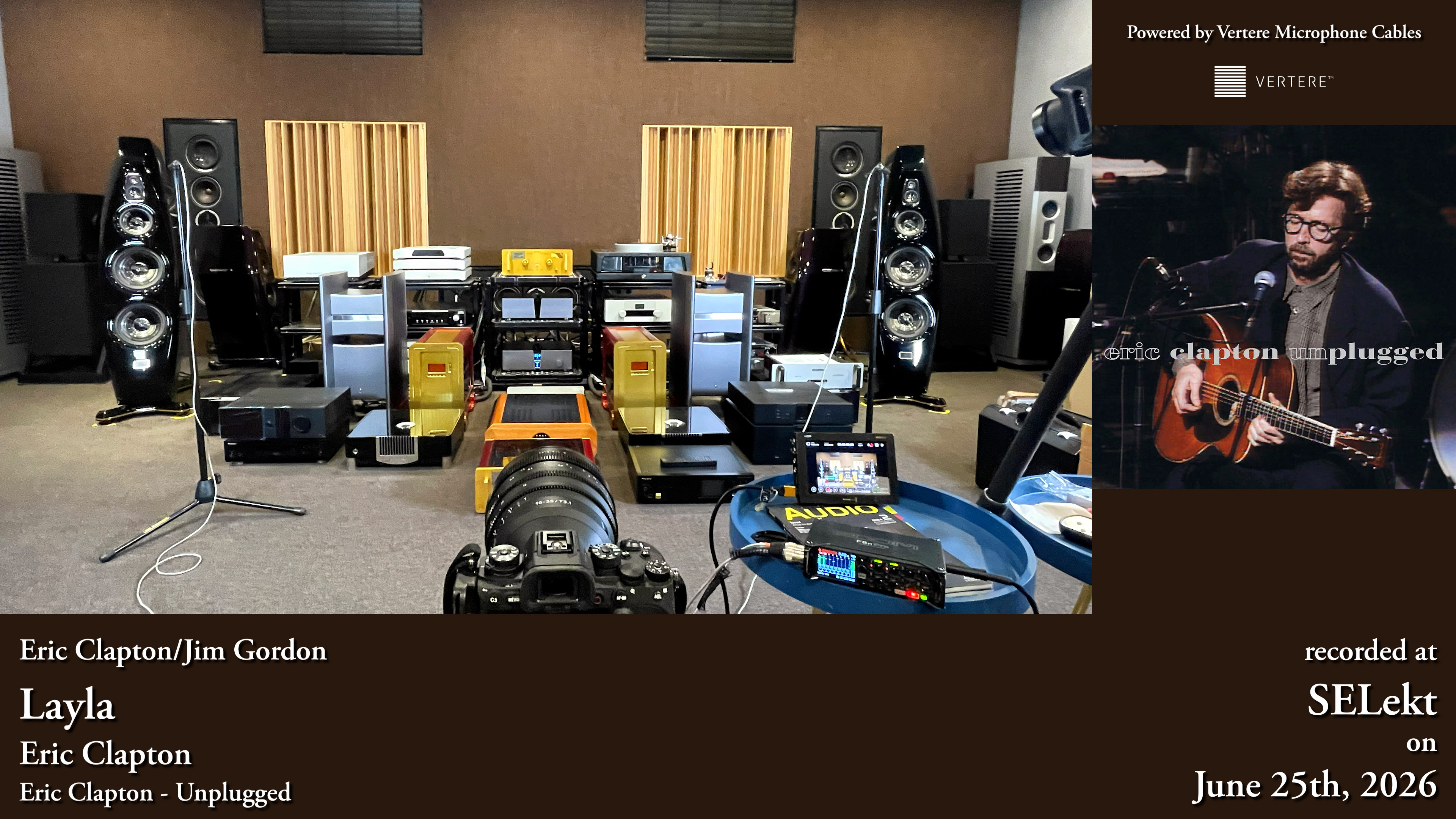
A Laufer Teknik Memory Player MP-32 fed an MSB Technology Cascade DAC. The analog path continued through a Halcro Equinox preamplifier and Eclipse mono power amplifiers to Kharma Enigma Veyron 4D loudspeakers.
Kharma specifies thick Bulletwood panels for the Enigma Veyron cabinet and a suspension system that reduces floor contact to small hard points. The 4D’s support interface therefore belongs to the system architecture just as surely as its drivers or terminals, but at the boundary between loudspeaker and room.2
For this track, move attention across scale rather than hunting for a single spectacular event: the outline of a guitar, the centre of the voice, then the low pulse that steadies the group. Those three points make a practical map for hearing how the performance occupies the room.2
Captured at SELekt
HFI recorded the session at SELekt on 25 June 2026. A matched pair of DPA-4011 microphones fed a Zoom F8n Pro at 192 kHz/32-bit float, with a laser distance meter used to match the microphones’ distances from the loudspeakers.
Put on headphones and sit in the sweet spot. Begin with the easy swing, stay for the spaces around the vocal, and let this quieter “Layla” establish its own proportions before comparing it with any version remembered from elsewhere.
Watch and listen
The complete HiFi Immersion video
For the clearest sense of the room, listen on headphones at a comfortable, consistent level.