Start with the spaces between notes
Asked to name tracks for timing, dynamics, tone and decay, Peter Foster declines the idea of a fixed audiophile programme. He begins instead with an instrument: piano. Its harmonics and the long fall of a struck note give him a way to follow tone and decay, while the interval from one note to the next makes pitch relationships unusually exposed.
His example is the opening of Billy Joel’s “Piano Man.” Foster is listening not only for isolated notes but for whether their progression remains intelligible. In his account, a less convincing amplifier leaves the notes sitting side by side; a better one lets him follow the space and pitch movement between them. That is Foster’s listening criterion, not an HFI measurement or a universal ranking of amplifiers.
Why familiarity matters more than a test label
For timing, Foster again resists prescribing a special recording. His practical answer is music the listener knows well. Familiarity supplies a memory of pace, emphasis and continuity, so a sluggish presentation can register as a disturbance in a relationship already understood rather than as a new sonic detail to catalogue.
The distinction is useful because familiarity is a listening aid, not a controlled test by itself. The interview documents neither level matching nor blinded trials, and Foster does not offer a single track as proof. His point is narrower and more human: music that has become part of your memory can reveal when timing or pitch relationships no longer feel coherent to you.
A home where musical borders stayed open
That preference for familiar music has a family history. Foster grew up in a home where records were always arriving because his parents distributed vinyl. Boxes passed through the house, some were donated to school fairs, and music from the 1960s and especially the 1970s played around him before audio equipment became a profession.
The pattern continues across generations, though not as a carefully handed-down playlist. Foster describes his children finding country music, older classics and music far outside the narrow range expected of their age. What pleases him is the breadth itself: a household in which music can arrive from another decade and still become someone’s own familiar reference.
From loving records to choosing what to represent
Foster traces his move into audio distribution to the same curiosity. He and his colleague Mike began with a chance to spend time with equipment that would otherwise have been beyond reach, then built a dealer network around products they genuinely wanted to represent. Foster frames that choice as an integrity question: enthusiasm could sustain a relationship with dealers only when the product had first earned their own belief.
This is personal and company history told by Foster, not an independent audit of every distribution decision. Its editorial value lies in the continuity it reveals: the same listener who trusts long familiarity with music also describes commercial commitment as something that must survive prolonged contact with a product.
The threshold for bringing Halcro back
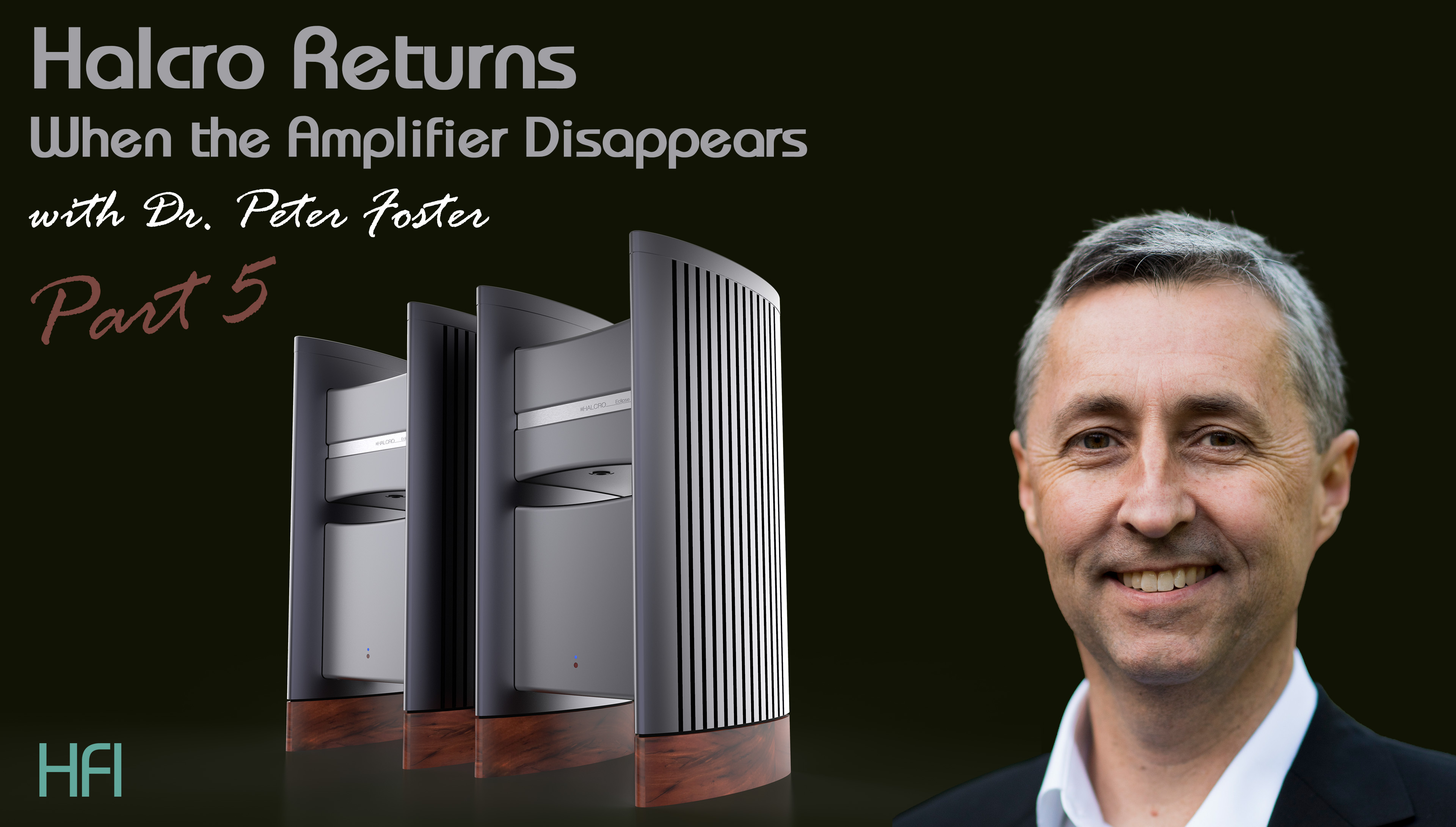
When the conversation turns to Halcro’s return, Foster places the beginning neither at an acquisition date nor at a public announcement. For him, the new company became real only after years of development, when the team believed its work represented a significant improvement over the earlier DM series. A new enclosure around an old design would not have met that threshold.
The improvement is Halcro’s internal judgment as Foster reports it; this interview does not supply a matched comparison or independent measurements against the DM amplifiers. What it does establish is the decision standard he says governed the return: the marque would wait until its team regarded the new architecture as more than a cosmetic revival.
The loudspeaker that remained a passion project
One detour makes that long development period tangible. Halcro also built a full-range electrostatic loudspeaker as a passion project and used it to demonstrate the amplifiers at a Melbourne hi-fi show. Foster says only a couple exist, none has been sold, and the company may never offer one. Its scale and difficulty of movement kept it far from an easy commercial proposition.
The loudspeaker is interesting less as a missing product than as evidence of what development can include: a test platform, a public demonstration and an engineering fascination need not become the next item in a catalogue. Foster’s account leaves the project valuable even without forcing it into a launch story.
Take the question back to your own music
The final episode therefore offers a listening question rather than a prescribed reference disc. Choose a piano recording whose decay and pitch movement you know, then choose another piece whose timing has lived with you for years. Listen for whether notes merely arrive or remain connected as a musical progression. The video lets Foster explain why those relationships, more than a track’s reputation as a test, are where his amplifier evaluation begins.
Watch and listen
The complete HiFi Immersion video
For the clearest sense of the room, listen on headphones at a comfortable, consistent level.