Why split one amplifier into two?
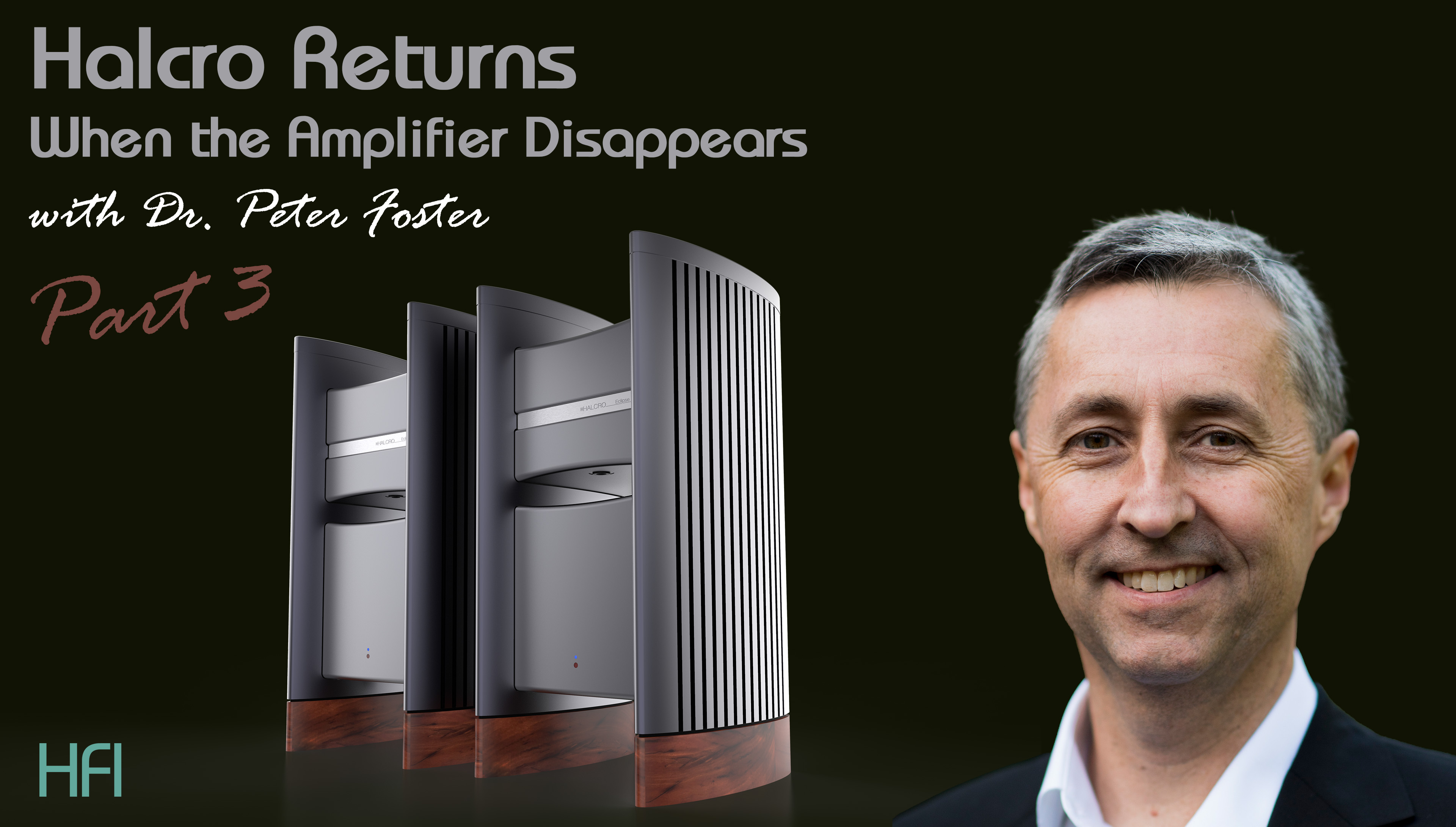
Peter Foster begins with a practical distinction between the stereo Eclipse and its monoblock counterpart. In his account, giving each channel an independent power supply improves channel separation and provides greater available power. He connects those changes with imaging, transient headroom and the ability to handle demanding passages.
An amplifier intended to leave no signature
Foster describes Halcro’s goal as transparency rather than a recognisable house sound. His explanation returns to nonlinear distortion: when a circuit creates harmonic or intermodulation products that were not in the source, he says, those additions can be heard as extra or “ghost” notes. He also sketches a distinction between odd- and even-order products, while acknowledging that real musical signals and circuits are more complicated than a single rule.
Distortion products can be measured. The link between lower distortion and a particular spatial or emotional result is Foster’s interpretation as a designer and listener.
The ten-millimetre boundary
Inside the Eclipse, Foster points to two switch-mode power supplies operating at high voltage and to the effort required to keep their electrical and mechanical activity away from the audio circuitry. He describes physical distance, individual screening and a ten-millimetre aluminium plate between functional areas, followed by additional shielding around sensitive sections.
An unlikely lesson from a battery drill
The interview’s most memorable object is not an amplifier at all. Foster recalls work on cardiac monitoring equipment that had to recover a tiny biological signal while a battery drill ran nearby. The lesson was that immunity to surrounding electrical noise can matter as much as a circuit’s nominal noise specification.
Foster carries that analogy into the in-development phono stage, which was still a work in progress at the time of the interview.
A roadmap, kept in the future tense
Foster also describes a more accessible integrated amplifier then in development, with possible expansion for phono and digital sources. He favours a switched-resistor relay ladder for volume control and says protection circuitry is arranged in parallel so that it stays out of the music signal path during normal operation.
Watch and listen
The complete HiFi Immersion video
For the clearest sense of the room, listen on headphones at a comfortable, consistent level.