Two dates around one song
Leonard Cohen’s official catalogue places “Hallelujah” on Various Positions, released in 1984. HFI’s source for this session is a different point in the song’s life: the 2006 RCA album Hallelujah (Live), performed by Espen Lind, Kurt Nilsen, Alejandro Fuentes and Askil Holm. Twenty-two years separate Cohen’s studio album and this four-singer concert reading.12
Those dates offer a simple way into a song that has travelled through many voices. Begin with the performance as a whole. On a second pass, keep its longer history quietly in mind and listen for what belongs to the writing itself and what belongs to this live occasion. The point is not to place the versions in a hierarchy, but to hear how a durable song can carry a new social shape when four singers bring it to a concert stage.12
Five drivers, three and a half ways
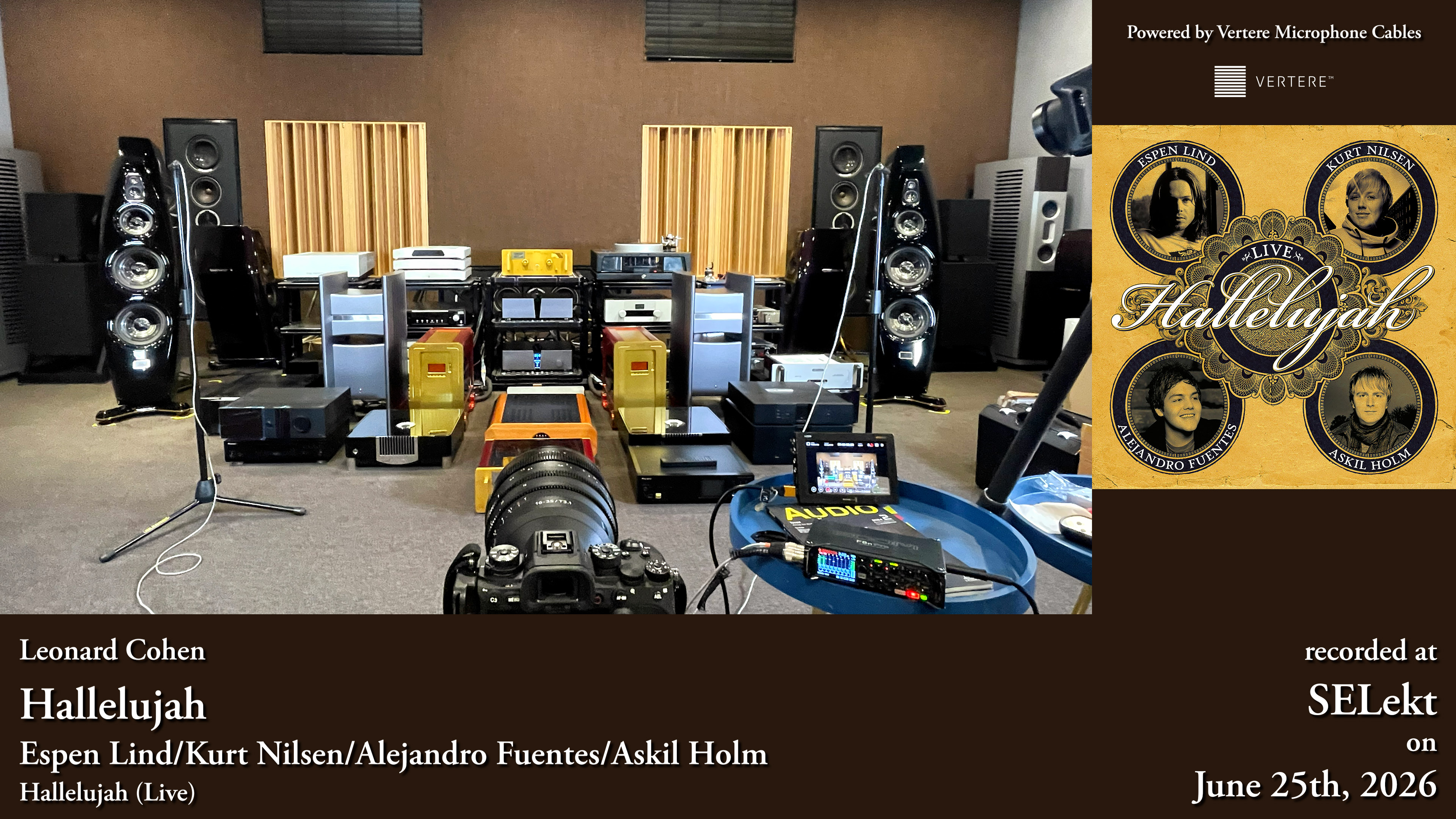
HFI played the 44.1 kHz/16-bit RCA source from a Laufer Teknik Memory Player MP-32. An MSB Cascade DAC fed a Halcro Equinox preamplifier and Halcro Eclipse monoblock power amplifiers, driving Kharma Enigma Veyron 4D loudspeakers.
Kharma specifies the Enigma Veyron 4D as a 3.5-way loudspeaker. Its published driver map uses two diamond units for the high frequencies, one 7-inch Omega-F driver for the midrange and two 11-inch Omega-F drivers for the bass. That map gives a second listening pass an orderly path: begin with the low foundation, move through the register carrying the voices, and then follow the upper edge of each line.3
The useful question is whether attention can move between those regions without losing the song’s larger span. Let the specification organise where you listen, then return to the complete performance rather than turning the system into a checklist.3
A June session at SELekt
HFI recorded the session at SELekt on 25 June 2026. A matched pair of DPA-4011 microphones fed a Zoom F8n Pro at 192 kHz/32-bit float, and Sennheiser HD820 headphones were used during production.
HFI used a laser distance meter to match the microphones’ distances from the loudspeakers, placing the pair where it most closely captured the sound heard at the sweet spot. That position reflects the microphones’ characteristics and is not necessarily the physical listening seat.
Sit in the sweet spot
Start with the four voices and the song’s long journey, then let the system map guide one more pass from foundation to middle register to upper detail. Finally, stop analysing and hear the performance from beginning to end. Put on headphones, settle into your own sweet spot and let “Hallelujah” take the room for a few minutes.
Watch and listen
The complete HiFi Immersion video
For the clearest sense of the room, listen on headphones at a comfortable, consistent level.