The last track on Transformer’s first side
Sony Music’s official Transformer sequence places “Walk On the Wild Side” fifth and last on Side A. That position matters: the track is both a self-contained song and the first half of the album’s closing statement before the record turns over.12
The Rock & Roll Hall of Fame describes Lou Reed’s sung-spoken, character-led lyric against a laid-back field of bass, brushed drums and R&B backing voices. The production does not ask every element to carry equal weight. A recurring low line supplies continuity while the words keep changing the person in view.12
HFI used the 96 kHz/24-bit Transformer source originally released on 8 November 1972.
Follow the thread beneath the portraits
Begin with the bass as the track’s continuous thread. Keep its rounded rise and return in view while Reed’s delivery moves from one portrait to the next. The useful question is not which detail sounds most spectacular, but how the low pattern lets a sequence of different lives remain part of one song.
Then widen attention to drums and backing voices. They change the scale around the lead without taking the narrative away from it. Hearing those roles as a relationship—ground, speech and response—reveals more than separating the track into an audiophile checklist.
Four isolated doors into the Digital Director
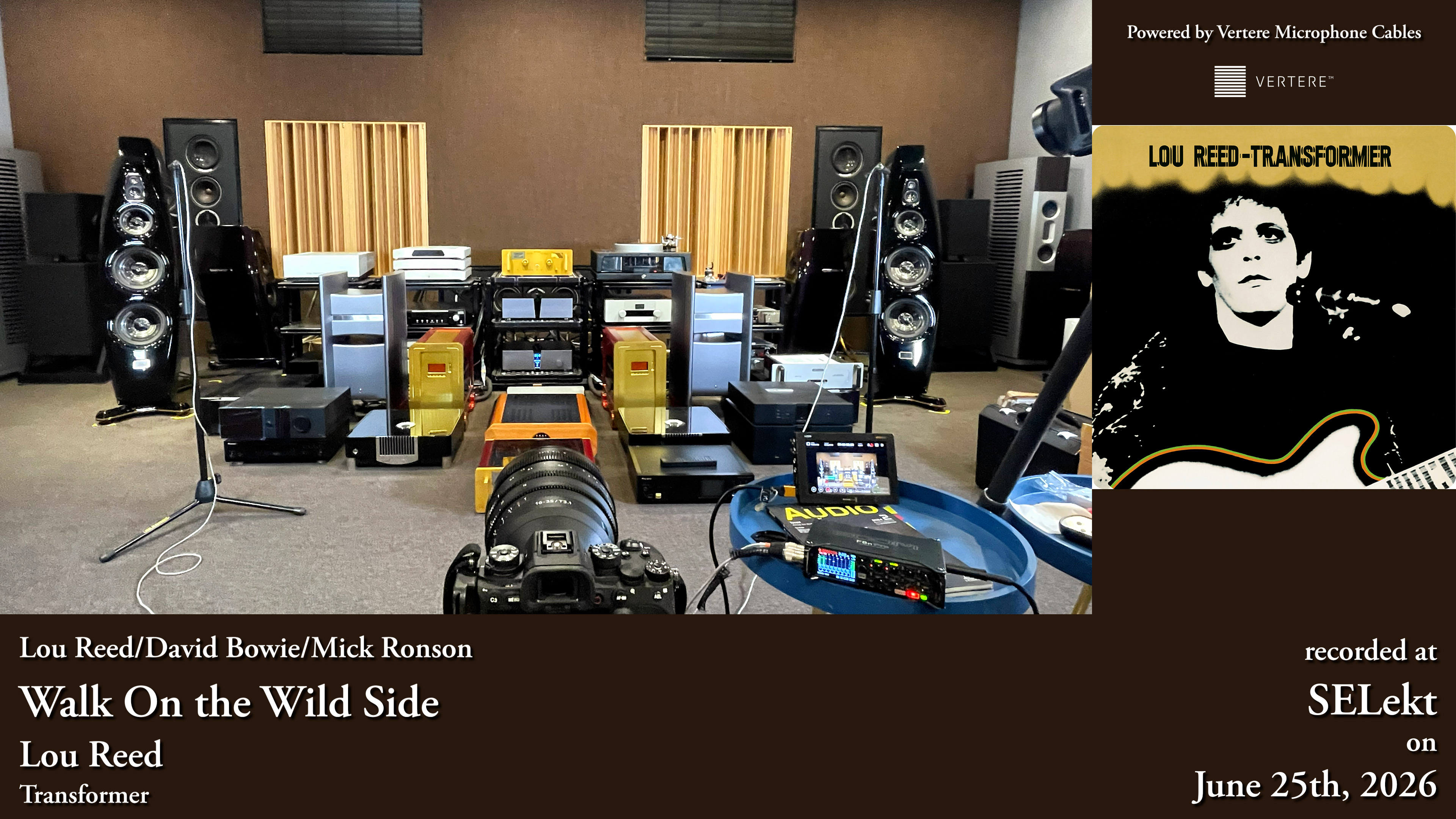
A Laufer Teknik Memory Player MP-32 fed an MSB Technology Cascade DAC. The analogue path continued through a Halcro Equinox preamplifier and Eclipse mono power amplifiers to Kharma Enigma Veyron 4D loudspeakers.
MSB gives the Cascade Digital Director four isolated slots for input modules. The Director handles source interfaces and digital processing in its own chassis, then sends data optically to the separate Analog Converter. In this session, that modular digital entrance is the new system question before the already established Halcro and Kharma stages take over.3
A sweet-spot perspective from SELekt
HFI recorded the session at SELekt on 25 June 2026 with a matched pair of DPA-4011 microphones feeding a Zoom F8n Pro at 192 kHz/32-bit float. A laser distance meter was used to match the microphones’ distances from the loudspeakers at the position where that pair most closely captured the sound heard at the sweet spot.
Use headphones at a comfortable level and sit in your own sweet spot. Let the bass hold the road while the portraits pass through the centre; then return for the quieter relationship among speech, pulse and response that keeps the journey moving.
Watch and listen
The complete HiFi Immersion video
For the clearest sense of the room, listen on headphones at a comfortable, consistent level.