A conversation across a generation
Steely Dan place “Hey Nineteen” second on Gaucho, immediately after “Babylon Sisters.” The song draws its tension from a conversation across an age and cultural gap: familiar references fail to land, confidence shades into discomfort, and the immaculate surface never quite resolves the distance between the people inside it.1
That contrast is a useful way into the session. First follow the song as an encounter whose ease is partly performance. On a second pass, notice how the steady pulse and precisely placed instrumental details hold the surface together while the narrative becomes less comfortable. The point is not to turn every detail into a system test, but to hear how polish and unease can occupy the same song.1
HFI used the 1980 MCA-6102 vinyl LP edition of Gaucho. Donald Fagen and Walter Becker wrote “Hey Nineteen,” and Steely Dan performed it.
From the record groove to a radial room
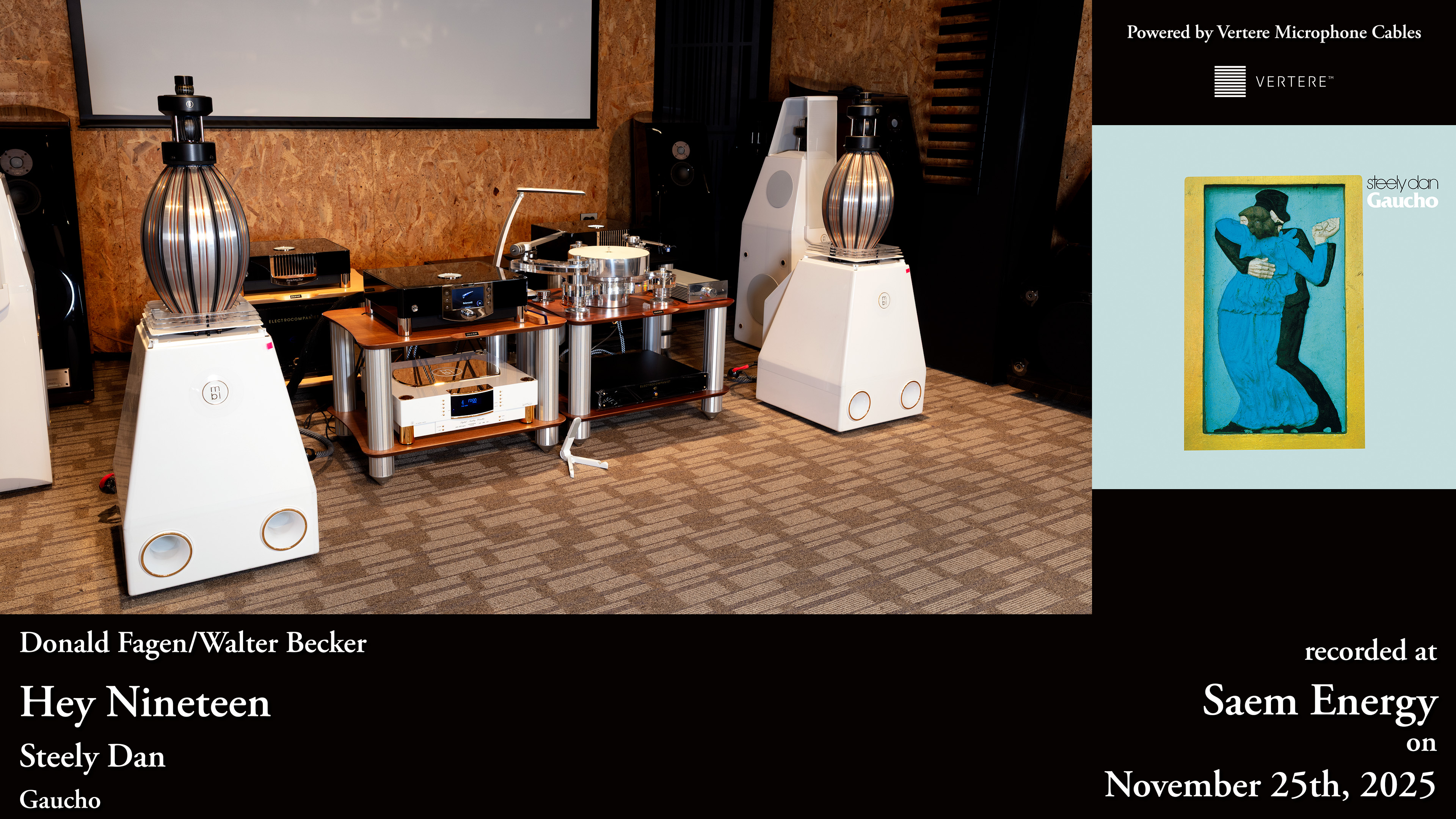
A Transrotor Rondino Bianco FMD turntable with a Hana Umami Blue cartridge fed an Electrocompaniet ECP 2 MKII phono stage. The signal then passed through an MBL N11 preamplifier and N15 monoblock power amplifiers to MBL 101 E MKII loudspeakers.
MBL describes the 101 E MKII as a four-way loudspeaker whose radial midrange and tweeter distribute sound through 360 degrees. Its documented architecture makes the room part of the listening question in a different way from the directional line-source systems heard in earlier Saem Energy sessions.2
Listen for spatial relationships rather than trying to assign a sonic trait to one component. The useful question is whether the central musical line, the rhythmic foundation and the small accents remain individually legible as the room contributes its own energy. That question belongs to this complete playback-and-room encounter, not to a claim about any single unit.2
A sweet-spot perspective from Saem Energy
HFI recorded the session at Saem Energy on 25 November 2025. A matched pair of DPA-4011 microphones fed a Zoom F8n Pro through Vertere microphone cables at 192 kHz/32-bit float; Sennheiser HD820 headphones were used in the production chain.
The microphone pair was distance-matched from the loudspeakers with a laser meter and positioned where that pair most closely captured the sound HFI heard at the sweet spot. Because microphone characteristics affect that position, it is not necessarily the physical listening seat.
Set your headphones to a comfortable level and let the first pass preserve the song’s composure. Then return to the places where its social ease begins to fray, while the pulse and instrumental spacing remain controlled. Sit in your own sweet spot and allow Steely Dan’s polished distance to reveal itself without rushing to turn the session into a verdict.12
Watch and listen
The complete HiFi Immersion video
For the clearest sense of the room, listen on headphones at a comfortable, consistent level.