The destination of an East-to-West journey
Chloe Chua’s album begins with the Butterfly Lovers violin concerto, continues through Chen Gang’s Sunshine Over Tashkurgan and then turns to Paganini’s First Violin Concerto. The Rondo is therefore more than an isolated virtuoso showpiece: it is the closing movement at the western end of a programme that travels between concerto traditions.1
Mario Venzago conducts the Singapore Symphony Orchestra, with Chua taking the solo line. Follow the rondo theme each time it returns, then notice how the orchestra changes the scale around it. The useful question is not simply how fast the violin moves, but how soloist and ensemble preserve the movement’s buoyancy through each new exchange.
One-bit conversion, another view of a familiar system
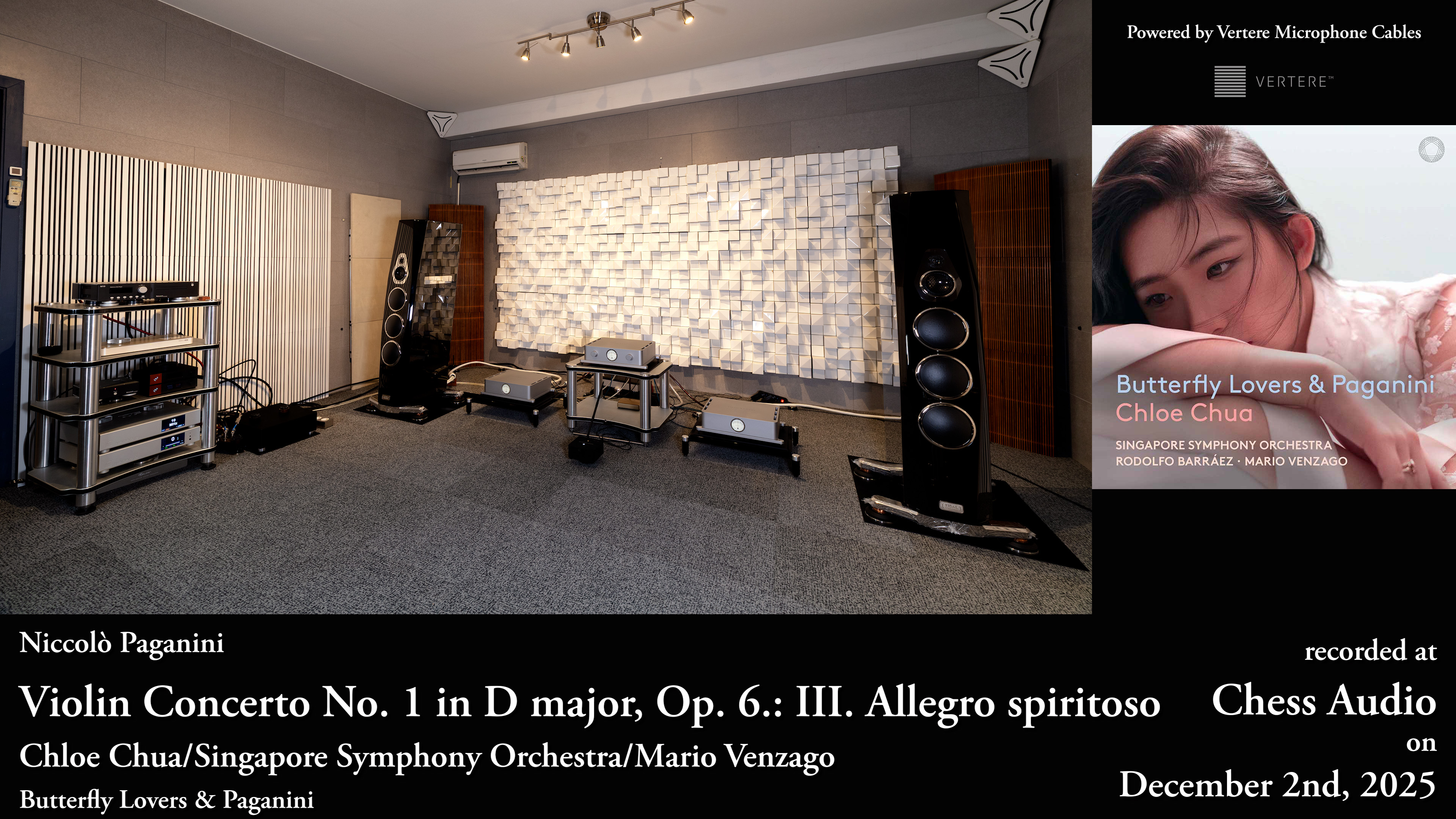
A Master Fidelity NADAC-C clock and NADAC-D converter fed a Vinnie Rossi Brama preamplifier and Brama monoblocks, with Tidal Akira loudspeakers completing the playback chain.
An earlier Chess Audio article examined how this pair divides external reference timing from clock recovery inside the converter. The fresh system angle here sits elsewhere: Master Fidelity describes the NADAC-D as a true one-bit design and gives its power unit a temperature-stabilised supply. Conversion and power therefore become separate parts of the system architecture to understand.2
Listen for returns, not fireworks alone
Begin with the main rondo idea and keep it in memory. When it returns, hear what has changed in articulation, orchestral weight and the distance between solo phrase and response. Paganini’s brilliance matters, but the movement also depends on recognition: momentum comes from finding familiar material in a newly charged setting.
On a second pass, shift attention to the orchestra just before each solo entrance. Those transitions reveal how the performance prepares the violin’s next gesture. The system serves the article best when it helps the listener stay with that musical hand-off rather than reducing the finale to a sequence of spectacular notes.
Captured at Chess Audio
HFI recorded the session at Chess Audio on 2 December 2025 with a matched pair of DPA-4011 microphones, a Zoom F8n Pro and Vertere microphone cables at 192 kHz/32-bit float.
HFI matched the microphones’ distances from the loudspeakers with a laser distance meter, placing the pair where it most closely captured the sound heard at the sweet spot. Sit in your own sweet spot, use headphones, and let the rondo’s returning theme lead the way.
Watch and listen
The complete HiFi Immersion video
For the clearest sense of the room, listen on headphones at a comfortable, consistent level.