A twentieth-century farewell after the Baroque
Il Gardellino’s Baroque Oboe Concertos moves through concertos and sinfonias before ending somewhere unexpected: Astor Piazzolla’s “Oblivion.” The ensemble, directed here by oboist Marcel Ponseele, makes the piece the closing turn of a programme rooted in another period.1
That position changes the listening question. Rather than treating “Oblivion” as an isolated encore, hear how its long oboe line arrives after the quicker exchanges and formal contrasts that precede it on the album. The useful relationship is not a claim that Baroque practice explains Piazzolla; it is the deliberate change of musical language at the end of one recorded programme.1
HFI used the 44.1 kHz/16-bit Accent source. The selected track runs 4 minutes 18 seconds and credits Il Gardellino under Marcel Ponseele.
Follow the line, then the space around it
Begin with the oboe as a singer: notice where a phrase holds its breath, where it leans into a note, and how the accompaniment leaves room for the next entry. On a second pass, move your attention outward to the quieter instrumental bed and the decay that follows each phrase. The two perspectives belong to the same performance, but they ask different things of attention.
The video is most useful when it remains a piece of music rather than a checklist. Let one complete phrase establish the emotional scale before listening for smaller cues such as the oboe’s edge, the body beneath it, and the ensemble’s restraint at the close.
Four possible interfaces at the power amplifiers
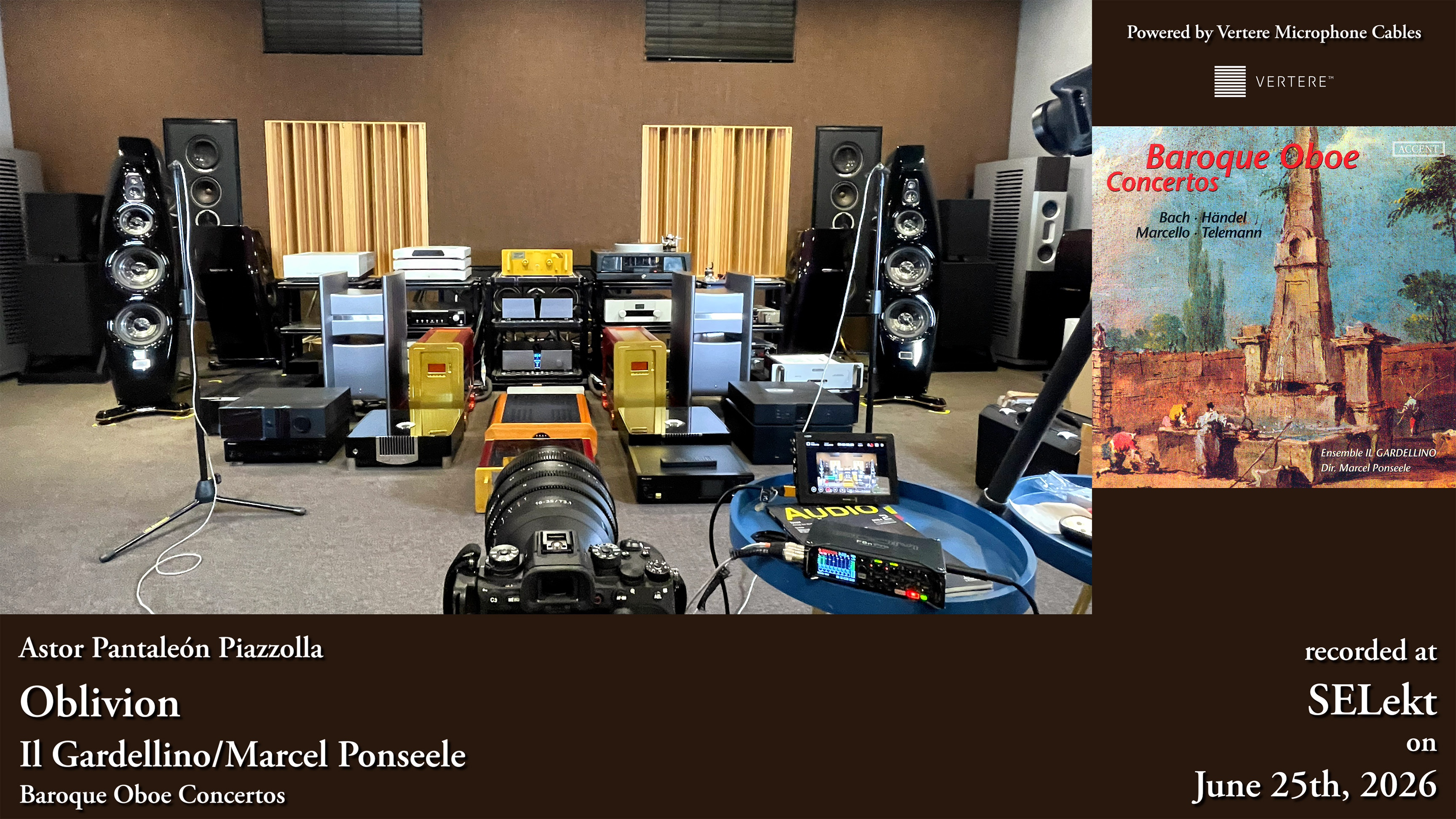
The playback chain comprised a Memory Player MP-32, MSB Cascade DAC, Halcro Equinox preamplifier, Halcro Eclipse monoblocks and Kharma Enigma Veyron 4D loudspeakers.
Halcro documents four input interfaces on each Eclipse: balanced and unbalanced voltage inputs, a current-mode input, and a minimal-path voltage input. The options show that the power amplifier was designed to accept more than one electrical relationship with the component ahead of it.2
A sweet-spot perspective from SELekt
HFI recorded the session at SELekt on 25 June 2026. A matched pair of DPA-4011 microphones fed a Zoom F8n Pro at 192 kHz/32-bit float.
A laser distance meter matched the microphones’ distances from the loudspeakers at the position where that pair most closely captured the sound heard at the sweet spot. That microphone-dependent position is not necessarily the physical listening seat.
Put on headphones and sit in the sweet spot. First follow the oboe without interruption; then return for the quieter space the ensemble builds around it. “Oblivion” closes this programme by changing its language, and the invitation is simply to stay with that change until the last decay has gone.
Watch and listen
The complete HiFi Immersion video
For the clearest sense of the room, listen on headphones at a comfortable, consistent level.