A small moment inside a large live set
Nils Lofgren’s official store describes Nils Lofgren Band Live as a 23-track double album drawn from a June 2002 concert at the Rams Head in Annapolis. “Bass & Drum Intro” is one of its compact connective moments: rhythm-section conversation brought forward before the next larger statement arrives.1
Its scale is the point. Listen first for pulse, then for reply: how one instrument establishes weight while the other changes the shape and direction of the exchange. The tension comes less from melody than from the sense that the band is preparing a door for the music that follows.1
HFI used the 44.1 kHz/16-bit Vision Music source. The album was issued on 18 March 2003.
Three jobs kept physically distinct
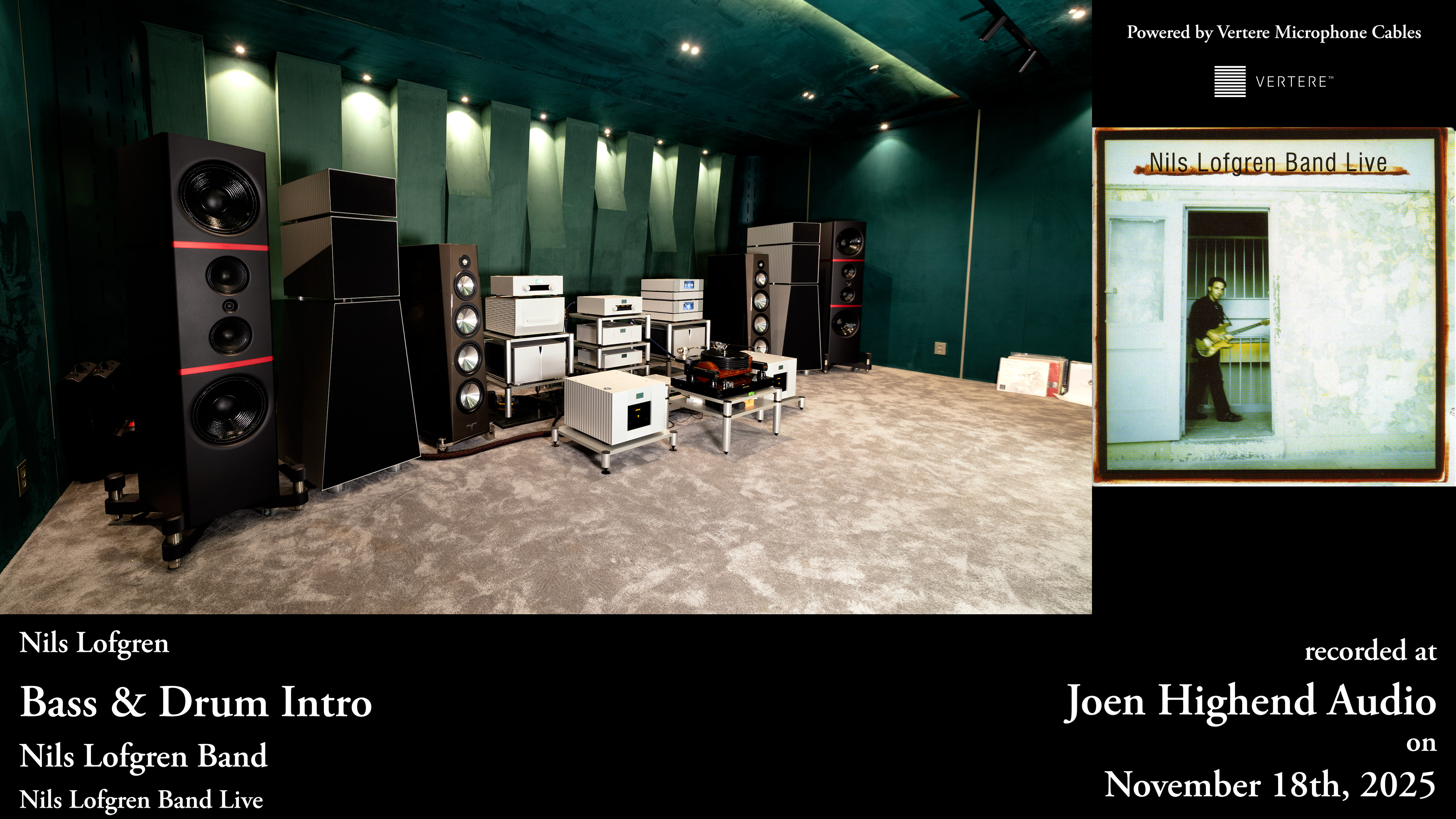
The playback chain comprised a Métronome c|AQWO 2 DAC, Goldmund Mimesis Reference preamplifier, Goldmund Telos 2800 monoblocks and Goldmund Theia loudspeakers.
Métronome describes the c|AQWO 2 as a converter with a separate power supply. Downstream, Goldmund assigns level and source control to the Mimesis Reference and power amplification to the Telos 2800 monoblocks. Those documented roles make the chain easy to read as three distinct stages—conversion, analogue control and power—without turning its architecture into a claim about what must be heard.234
With a bass-and-drum passage, that separation suggests a practical listening route rather than a verdict. Follow the bass note from onset through sustain, then notice whether the drum’s leading edge and decay remain their own events as the two players trade emphasis.234
Room energy without losing the players
Live rhythm sections can be heard at two scales at once. Up close are contact, timing and touch; around them is the concert room responding to low-frequency energy. Move between those scales rather than asking the passage for one spectacular effect. The exchange stays musical when the players, not the test, remain central.
A second listen can begin at lower volume. If the relationship between pulse and reply is still legible, raise the level only as far as your own room and headphones allow comfortably. This is an introduction, and its anticipation matters as much as its impact.
A sweet-spot perspective from Joen Highend Audio
HFI recorded the session at Joen Highend Audio on 18 November 2025. A matched DPA microphone pair fed a Zoom F8n Pro through Vertere microphone cables at 192 kHz/32-bit float.
A laser distance meter matched the microphones’ distances from the loudspeakers at the position where that pair most closely captured the sound heard at the sweet spot. That microphone-dependent position is not necessarily the physical listening seat.
Sit in the sweet spot with headphones and let the short passage establish its own pace. Follow the bass, meet the drum’s answer, and leave a little attention for the room around both. The music is already moving before the song arrives.
Watch and listen
The complete HiFi Immersion video
For the clearest sense of the room, listen on headphones at a comfortable, consistent level.