A ballad completed across two studios
“Angie” arrived on Goats Head Soup in 1973, written by Mick Jagger and Keith Richards and performed by The Rolling Stones. Its finished surface came together in stages rather than in one sealed moment.1
The label-run history traces the recording to Dynamic Sound Studios in Kingston, Jamaica, in late November 1972, where Nicky Hopkins played piano. Strings were added at Island Studios in London in May and June 1973 before the final version reached the album.1
Follow the change of scale
That production history gives the first listen a human centre. Stay with the song and its vocal address. On a return, shift attention between Hopkins’s piano and the later strings: not to rank the parts, but to hear how material recorded months and cities apart belongs to one restrained ballad.1
The HFI video presents that album version as a room-and-system encounter. Let the quiet passages establish the scale before the fuller moments arrive, and notice whether the line of the song remains easier to follow than any isolated hi-fi effect.
The loudspeaker and the room
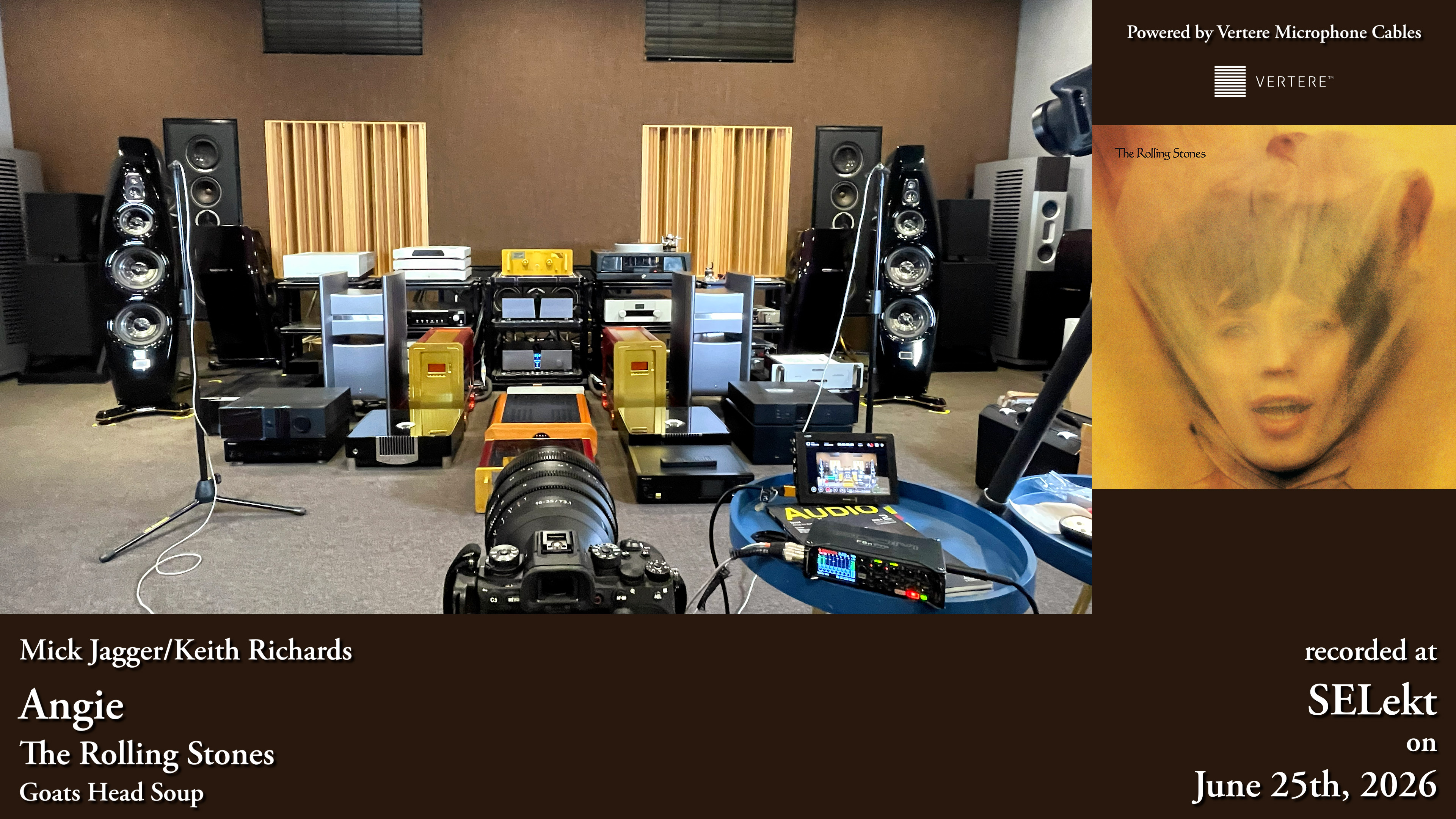
The playback chain comprised a Memory Player MP-32 network server and streamer, MSB Cascade DAC, Halcro Equinox preamplifier, Halcro Eclipse mono power amplifiers and Kharma Enigma Veyron 4D loudspeakers.
Kharma’s EV-4D manual treats the loudspeaker and room as one setup problem. It recommends experimenting with placement, keeping space around the pair symmetrical where possible, and begins from a straight-ahead rather than toed-in orientation. Rear- and side-wall distance remain variables because the company says they alter bass level, openness and perceived depth.2
The manual’s emphasis on the room is a useful frame for this session: the video presents the source, electronics, loudspeakers and SELekt room as one listening encounter.2
A sweet-spot perspective from SELekt
HFI recorded the session at SELekt on 25 June 2026. A matched pair of DPA-4011 microphones fed a Zoom F8n Pro at 192 kHz/32-bit float, with Sennheiser HD820 headphones used during production.
A laser distance meter matched the microphones’ distances from the loudspeakers at the position where that pair most closely captured the sound heard at the sweet spot. That microphone-dependent position is not necessarily the physical listening seat.
Put on headphones, settle into your own sweet spot and give “Angie” one uninterrupted play. Then return to the piano, strings and voice—not as separate demonstrations, but as the parts that carry one song across the room.1
Watch and listen
The complete HiFi Immersion video
For the clearest sense of the room, listen on headphones at a comfortable, consistent level.