Four minutes from a much larger argument
Shostakovich’s Tenth Symphony stretches across a large dramatic span, but its second movement compresses its force into a short Allegro. HFI’s video stays with that compact movement: an orchestral rush in which repeated figures, abrupt accents and changes of weight arrive before the listener has much time to settle.
The performance carries its own history. The London Philharmonic Orchestra identifies Bernard Haitink’s account as a live BBC Proms recording made at the Royal Albert Hall on 28 August 1986. The orchestra released it as LPO-0034 in September 2008, more than two decades after the performance.1
HFI used the 44.1 kHz/16-bit LPO source. The performance is by the London Philharmonic Orchestra under Bernard Haitink.
Listen for the hand-off inside the rush
Start with the movement’s forward motion, then return for the joins. Notice how a figure is handed from one orchestral group to another, how an accent changes the scale of the next phrase, and how low instruments add weight without stopping the upper lines. The useful question is not simply whether the passage sounds fast. It is whether the musical argument remains legible at speed.
On another pass, follow the spaces between attacks. A short silence or a sharply curtailed decay can be as structural as the note that precedes it. Those contrasts make the movement feel driven without reducing it to continuous loudness.
A line source above, moving air below
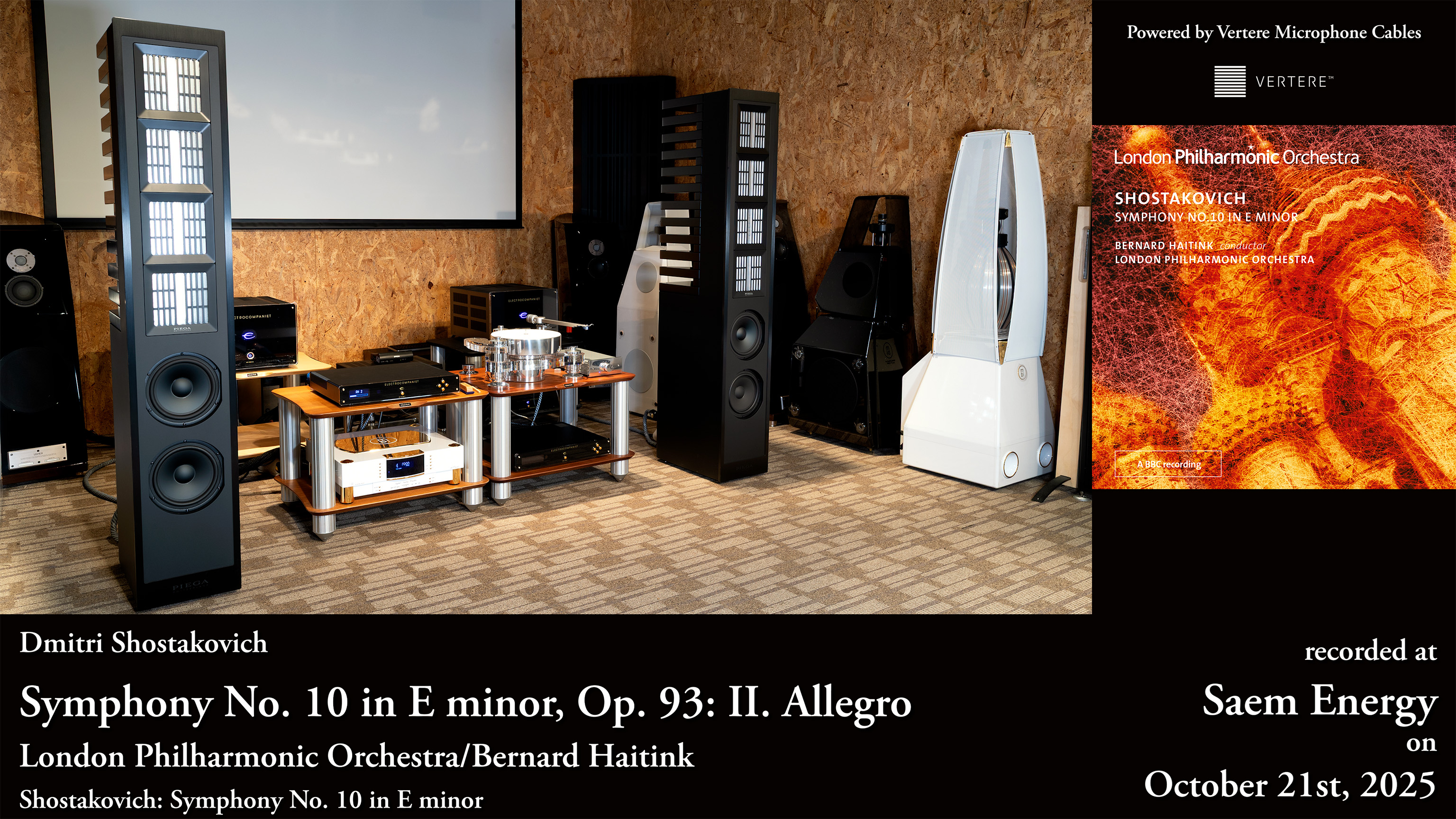
The playback chain comprised an MBL 1611 F DAC, Electrocompaniet EC 4.8 MKII preamplifier, Electrocompaniet AW 800 M monoblocks and Piega Master Line Source 2 Gen2 loudspeakers.
Piega specifies the loudspeaker as a three-way dipole. Four Line Source Driver 211 units handle the line-source section, while two 220 mm UHQD bass drivers and two passive radiators take on the lower range. That division gives the system angle for this session: listen across the vertical ribbon array and the piston-driven bass section as one orchestral gesture moves between registers.2
The EC 4.8 MKII uses a dual-mono layout with separate power supplies for the two channels. It handles line-level control here, followed by one AW 800 M monoblock for each channel before the signal reaches the Piega loudspeakers.34
A sweet-spot perspective from Saem Energy
HFI recorded the session at Saem Energy on 21 October 2025. A matched pair of DPA-4011 microphones fed a Zoom F8n Pro through Vertere microphone cables at 192 kHz/32-bit float.
A laser distance meter matched the microphones’ distances from the loudspeakers at the position where that pair most closely captured the sound heard at the sweet spot. That microphone-dependent position is not necessarily the physical listening seat.
Put on headphones and sit in the sweet spot. Let the movement run once for momentum; then return for the hand-offs, the sudden shifts of weight and the brief spaces that keep the rush articulated. Haitink and the LPO make four minutes feel like a complete encounter.
Watch and listen
The complete HiFi Immersion video
For the clearest sense of the room, listen on headphones at a comfortable, consistent level.