A song that stands up again
“Pick Yourself Up” first belonged to the 1936 film Swing Time. The American Film Institute credits Jerome Kern with the music and Dorothy Fields with the lyrics. Diana Krall’s official album record places her version tenth on When I Look in Your Eyes, bringing a song about recovering one’s motion into the final stretch of the album.12
The album widened the setting Krall had used on her two previous releases. Its core still places her piano and voice with guitar, bass and drums, while several cuts add Johnny Mandel’s orchestrations. That broader frame makes this return to an older standard feel less like a museum piece than part of a living repertoire.1
HFI used the 96 kHz/24-bit edition of When I Look in Your Eyes, originally released by Verve on 8 June 1999.
Follow the recovery, not a checklist
Let the song establish its own gait before turning to the system. On a first pass, follow how the performance carries the standard’s invitation to recover and continue. Then return to the small changes that keep that motion alive: the placement of a phrase, the space before the next entrance and the way the pulse resumes after a pause.
The useful question is musical: does the performance keep its poise while still feeling ready to move?
The power and loudspeaker interface at GLV
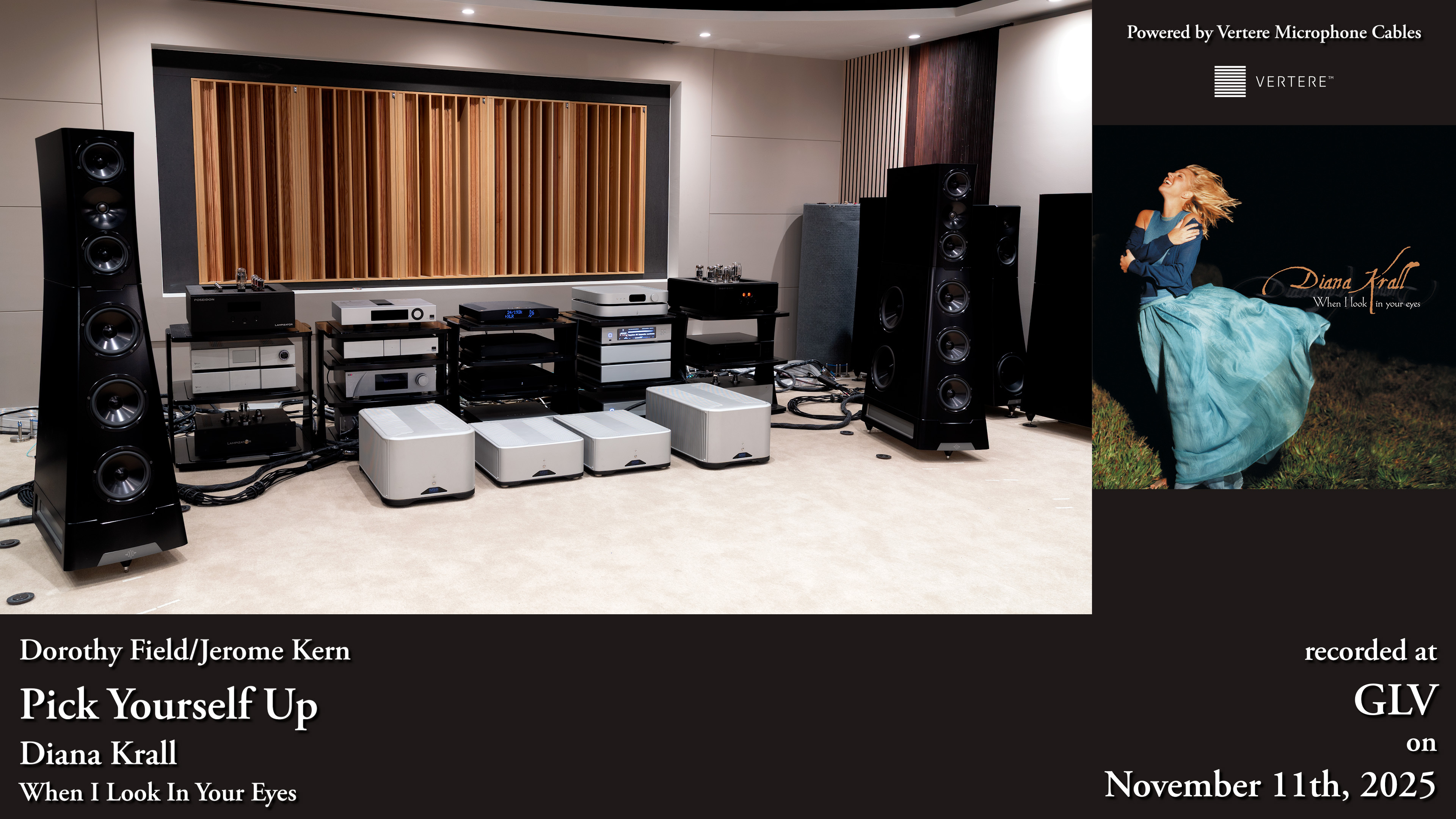
An Aurender NH10 network hub and MC10 master clock served the N50 digital-output network transport. The N50 fed an MSB Technology The Cascade DAC, followed by M500 monoblock power amplifiers and YG Acoustics XX loudspeakers.
MSB rates each M500 for 1,000 watts of continuous output into 4 ohms at less than 1% distortion. YG Acoustics specifies the XX as a four-way passive loudspeaker with an average impedance of 4 ohms and a 2.8-ohm minimum. Those published figures define the amplifier-to-loudspeaker load context for this GLV session.34
Take the sweet-spot perspective
HFI recorded the system at GLV in Seoul on 11 November 2025. A matched pair of DPA-4011 microphones fed a Zoom F8n Pro through Vertere microphone cables at 192 kHz/32-bit float. A laser distance meter was used to match the microphones’ distances from the loudspeakers.
The microphones were positioned where that pair most closely captured the sound heard at the sweet spot; their characteristics mean this is not necessarily the physical listening seat. With headphones at a comfortable level, settle into your own sweet spot and give the song time to find its feet.
Watch and listen
The complete HiFi Immersion video
For the clearest sense of the room, listen on headphones at a comfortable, consistent level.