A calm voice, a crowded field of meanings
The song draws its force from composure rather than volume. Official credits place Eric Woolfson on lead vocal and Wurlitzer, Chris Rainbow on backing vocals, Ian Bairnson on acoustic and electric guitars, Alan Parsons on Fairlight, Stuart Elliott on drums and David Paton on bass. Those roles make the track a carefully balanced ensemble: the singer remains the focal point while the surrounding parts keep its watchful idea in motion.1
The Project’s album history says Woolfson encountered the phrase “eye in the sky” in casino surveillance, a spy-satellite news item and a weather-helicopter report. That origin gives the title an unusually broad point of view. The song can feel personal and institutional at once: one voice addresses another while the album’s larger concept circles belief, authority and being watched.1
HFI used a 96 kHz/24-bit source from Eye in the Sky for this session. The album was originally released by Arista in June 1982.
The EV-4D divides the work at both ends
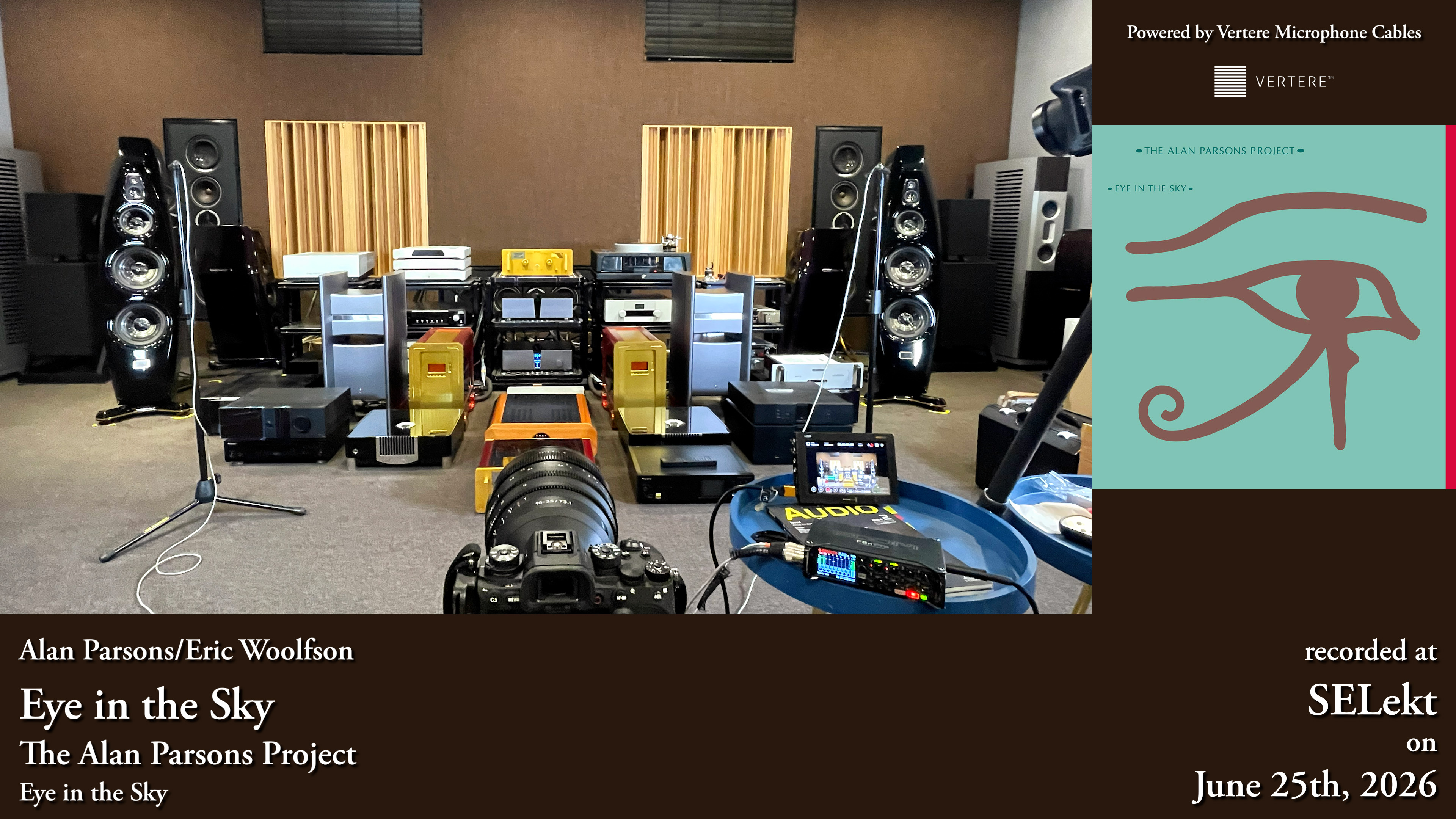
The playback path ran from a Laufer Teknik The Memory Player MP-32 to an MSB Technology The Cascade DAC, then through a Halcro Equinox preamplifier and Eclipse mono power amplifiers to Kharma Enigma Veyron 4D loudspeakers.
Kharma specifies the EV-4D as a 3.5-way design with 1-inch and 2-inch diamond tweeters, a 7-inch Omega-F midrange driver and two 11-inch Omega-F bass drivers. Its rear panel continues that division with separate connections for the bass and mid/high sections. The useful architectural point is the way the driver groups and connection groups follow the same division of roles.2
The listening position becomes the point of view
HFI recorded the system at SELekt on 25 June 2026. The matched DPA-4011 pair was positioned where those microphones most closely captured the sound heard at the sweet spot, and a laser distance meter was used to match their distances from the loudspeakers. They fed a Zoom F8n Pro at 192 kHz/32-bit float, and Sennheiser HD820 headphones were used during production.
That perspective brings the song’s internal balances into view without turning the music into a hunt for isolated effects. Keep the lead vocal in view while the backing line enters around it; then notice how guitar and Fairlight take different functions without pulling the pulse away from drums and bass. Rather than treating each layer as a separate spectacle, listen for the way voice, instruments and pulse hold together as one calm, watchful statement.
Composure as the tension
The track’s central contrast is easy to miss because nothing needs to lunge at the listener. A steady pulse supports a voice that sounds certain of its knowledge, while the surrounding parts widen the field without turning the song into a showpiece. Listen for the boundary between calm and control: the more even the delivery remains, the more watchful the premise can feel.
With headphones at a comfortable level, settle into a sweet spot of your own. Let the vocal, keyboard, guitars, rhythm section and room arrive as one composed surface, then decide which small relationship turns the familiar chorus into something more observant than reassuring.
Watch and listen
The complete HiFi Immersion video
For the clearest sense of the room, listen on headphones at a comfortable, consistent level.