Begin with the uncomfortable question
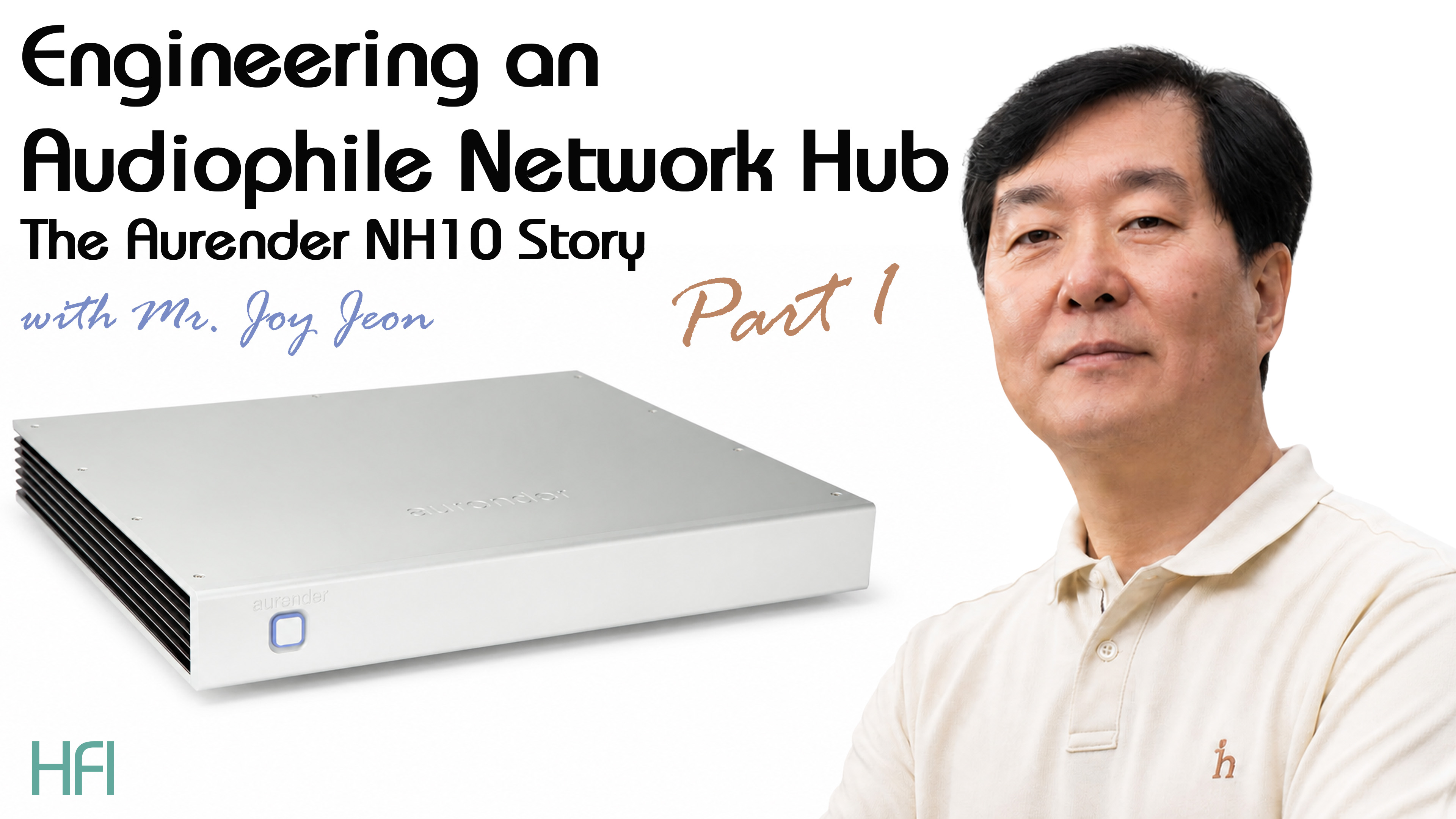
If network data arrives intact, why should the hub in the middle matter? HiFi Immersion begins there, at Aurender headquarters, rather than assuming the answer. Senior researcher Jeon Jin-woo replies that an ordinary hub may do nothing useful—or may even make matters worse—but argues that internal power, isolation and timing design can change the electrical conditions presented to connected audio equipment.
This first conversation follows the problems Jeon set out to solve, the earlier products that changed his thinking and the point at which user experience entered the design process.
From wireless links to audio hardware
Jeon came to Aurender after working in wireless communications. He says that background made two disciplines feel familiar: keeping power supplies under control and moving data without errors. At Aurender he went on to lead hardware design for products including the X100, N100, N200 and ACS series, the MC10 and MC20 master clocks, and most recently the NH10.
His description of project management is unusually concrete. Sales proposes a product idea; R&D turns it into a design concept; the teams negotiate cost, sound-quality priorities and features; then the project manager stays with the product after launch. When service cases appear, Jeon treats recurrence prevention as part of the design job rather than an afterthought.
That long responsibility gives the interview its human centre. Jeon says the greatest satisfaction comes when a stubborn problem finally yields—not because the answer arrived easily, but because the struggle produced knowledge that can travel into the next project.
One clock, several controllers
Jeon identifies power-supply filtering as a thread linking Aurender’s servers, clocks and network products. Noise cannot be removed absolutely, he says, so the practical aim is attenuation. The NH10 then brings timing into the same picture: its controllers are synchronized from one clock so that differences among their local timing domains can be reduced.
Aurender lists an oven-controlled crystal oscillator rated below 0.005 ppm, FPGA synchronization, a 10 MHz master-clock input, filtered RJ-45 ports and optically isolated SFP ports. Together they show how the NH10 approaches power, isolation and timing as parts of one design.1
Jeon’s sequence is clear: reduce incoming electrical coupling, control the internal power supply and give several processing sections a common timing reference. The rest of the interview follows how those ideas moved from earlier Aurender products into the NH10.1
What users taught the designer
The N50 taught Jeon to look closely at USB isolation. He recalls choosing an isolator and hearing what he regarded as an improvement, an observation that belongs to him. The N100 taught a different lesson: owners were trying power, clocking and mechanical changes that initially seemed unnecessary to the engineer who had designed a working product.
Instead of dismissing those experiments, he followed them. Some ideas accumulated into later products; he gives non-magnetic fasteners as one example. The larger point is not that every tweak deserves adoption. It is that a designer can treat informed user behaviour as field evidence, investigate it, and decide what survives engineering scrutiny.
Part 1 closes before the NH10 story is finished. Watch the full conversation for Jeon’s own account, and keep the opening question alive as you listen: not whether ‘bits are bits,’ but which electrical and timing conditions are actually being changed, who has demonstrated the consequence, and under what system conditions. That is where a useful product story begins.
Watch and listen
The complete HiFi Immersion video
For the clearest sense of the room, listen on headphones at a comfortable, consistent level.