The question left open by Part 1
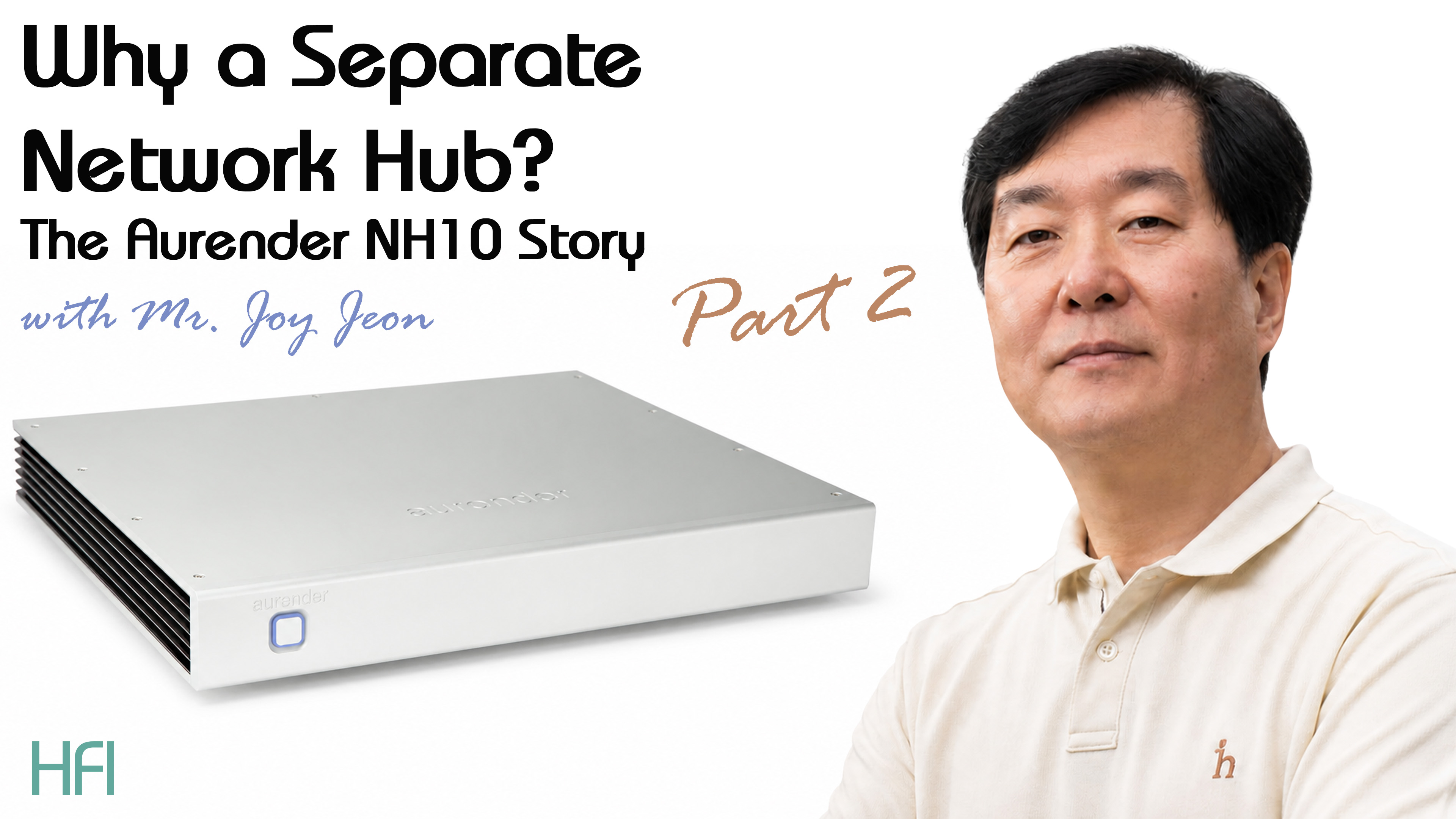
Aurender already builds network filtering and isolation into its music servers. Why, then, put another hub in front of them? HiFi Immersion returns to that question with senior researcher Jeon Jin-woo, this time following the practical experiments that turned an internal filter into the separate NH10.
Jeon follows the design through a series of practical constraints: how much space a filter needs, how power and grounding are divided, and what an optical connection requires at each end. Those choices shaped the NH10 as a separate product.
HiFi Immersion retained editorial control over the interview, editing and final presentation. Localized audio tracks, except the original Korean, use consented synthetic versions of the speakers’ voices without adding new statements.
When two filter stages became seven
Jeon traces the work back to the ACS10, where Aurender first used a two-stage LAN filter. The team then connected more than ten stages and listened across the sequence. He says roughly seven stages gave the balance they wanted: in their tests, high-frequency noise was filtered without operational problems and the sound improved to their ears.
That result created a mechanical problem. Seven stages occupy far more board space than two, and existing products did not have enough room. Aurender first made the filter as a separate module that could be inserted where space allowed. The NH10 takes the next step and gives the network section its own full-width chassis.
What a separate chassis changes
More space is the most immediate benefit, but Jeon places equal weight on separation. He says the dedicated enclosure lets Aurender isolate the power supply and keep the server and audio-side grounds apart. In his account, clean analogue power can then be fed to the individual blocks without noise passing as readily between sections.
Jeon also connects the extra space to clock and power-supply choices. He says a separate unit allows a higher-grade clock than the existing internal arrangement, while a substantial supply helps stabilize the digital circuitry and its signal. For him, the enclosure is part of the electrical design.
Three design choices, one network path
Asked to reduce the NH10 to three features, Jeon chooses the fully linear power supply, synchronization of the internal system to one clock, and the multistage LAN filter. His air-purifier analogy is deliberately simple: an ordinary hub circulates air, while the NH10 is intended to circulate and filter it at the same time.
By cleaner data, Jeon means filtering the high-frequency electrical noise that can accompany LAN traffic. He connects that aim to the multistage filter and to the power and clock conditions under which the network circuitry operates. His explanation gives the air-purifier analogy a specific engineering subject.
Why a 10 Gbps optical cable serves a 1 Gbps hub
Optical networking became a choice Jeon did not want to surrender. At the time of this interview, he identifies the N50 as the Aurender product able to receive the optical connection. The NH10 therefore needed one SFP port for incoming traffic and another for the link to the player. Although the NH10 is a 1 Gbps hub, Aurender supplies a 10 Gbps-rated SFP active optical cable.
Jeon reports that Aurender found substantially lower jitter with the higher-bandwidth optical assembly than with a 1 Gbps SFP in this application. He explains the choice in terms of a connection designed to carry higher-frequency signals passing lower-rate traffic more cleanly. That development result led Aurender to include the 10 Gbps SFP AOC cable despite its higher cost.
Part 2 traces a filter that outgrew the available space, a chassis that allowed power and grounds to be separated, and an optical path developed around the N50. The full conversation lets Jeon explain how those experiments became a product, including the choices he kept when they made the design more difficult or expensive.
Watch and listen
The complete HiFi Immersion video
For the clearest sense of the room, listen on headphones at a comfortable, consistent level.