An opera finale in Western dress
Gioachino Rossini wrote the music, the Cincinnati Pops Orchestra performs it, and Erich Kunzel conducts. The exact release title keeps both identities in view: ‘William Tell: Overture (Finale) [Lone Ranger Theme].’1
On Round-Up, the finale follows a 53-second ‘Sounds of the West’ opening and enters an album devoted to Western favourites. Concord credits master engineer Michael Bishop with the album’s Western sound effects. The sequence does not hide Rossini’s operatic source; it shows how decisively the music’s later screen identity shaped the way this recording was presented.12
Hear the double identity
HFI used the 44.1 kHz/16-bit Telarc edition of Round-Up, released in January 1987.
Give the performance one uninterrupted play as Rossini’s finale. On a return, keep the bracketed ‘Lone Ranger Theme’ in mind and notice how cultural memory changes the scene suggested by the same orchestra. The useful question is not which identity is correct, but how the recording can hold the opera and the open range at once.1
A transport divided into three jobs
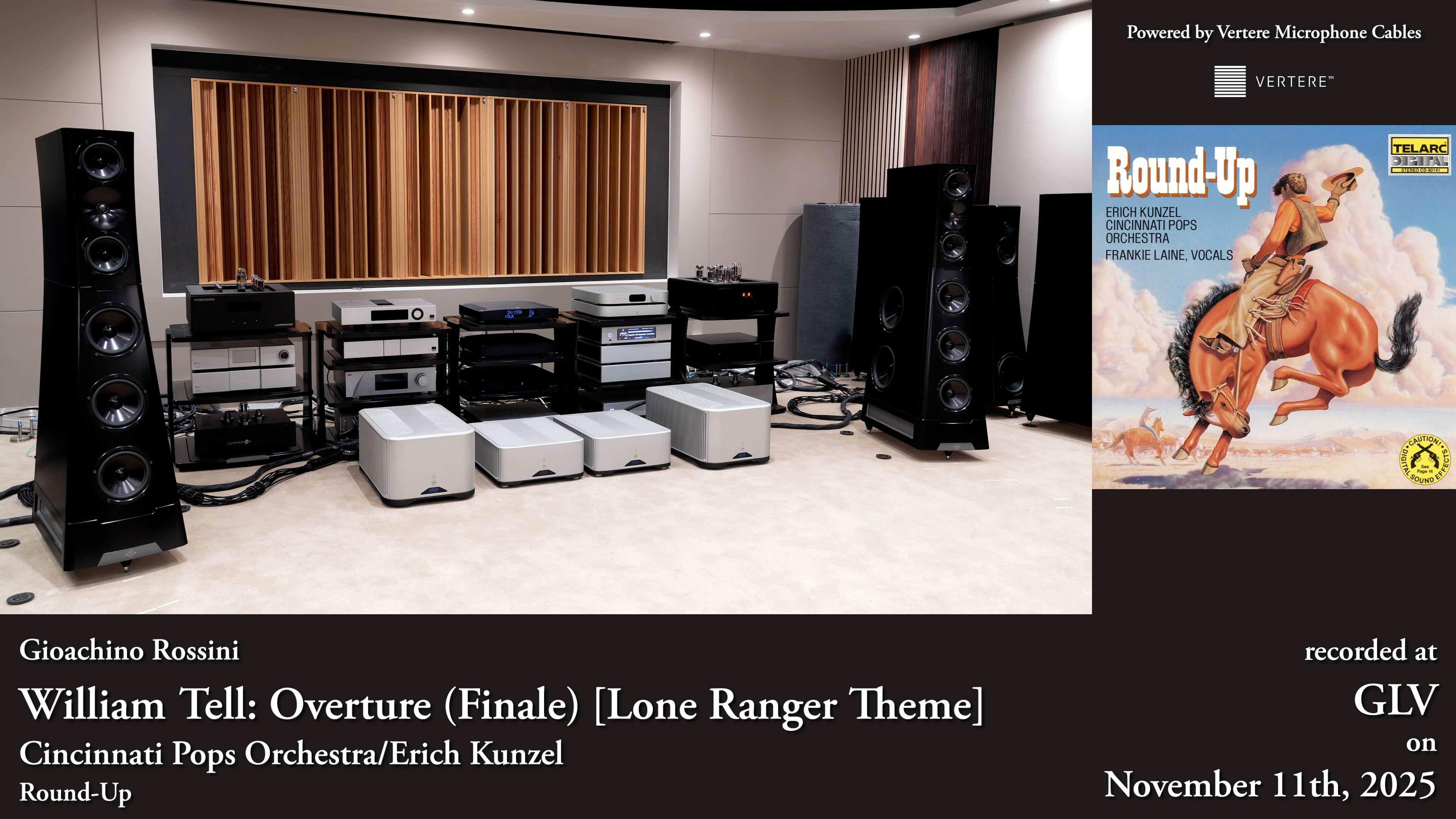
An Aurender NH10 network hub and MC10 master clock accompanied the N50 digital-output network transport. The N50 fed an MSB Technology The Cascade DAC, followed by M500 monoblock power amplifiers and YG Acoustics XX loudspeakers.
Aurender documents the N50 as three linked units: Server, Audio and Power. Its specifications also separate transformer supplies for the CPU board and digital-output board. That architecture gives the transport a clearly defined place between the network-and-clock stage and the DAC in this GLV system.3
The first listen can stay with the orchestra. On the next, follow the recording’s quick changes of scale without assigning them to one component: the system description tells us how the signal travelled, while the performance remains the reason to return.
A sweet-spot perspective from GLV
HFI recorded the system at GLV in Seoul on 11 November 2025. A matched pair of DPA-4011 microphones fed a Zoom F8n Pro through Vertere microphone cables at 192 kHz/32-bit float. Sennheiser HD820 headphones were used during production.
A laser distance meter matched the microphones’ distances from the loudspeakers at the position where that pair most closely captured the sound heard at the sweet spot. That microphone-dependent position is not necessarily the physical listening seat.
Choose a relaxed headphone volume, settle into your own sweet spot and follow Kunzel’s account of Rossini from its opening gesture. On a return, let the title’s second identity open the gate to the West.1
Watch and listen
The complete HiFi Immersion video
For the clearest sense of the room, listen on headphones at a comfortable, consistent level.