One song, several musical worlds
“Bohemian Rhapsody” appeared on A Night at the Opera in 1975, written by Freddie Mercury and performed by Queen. It begins with human scale, then keeps changing the size and language of the music around that centre.2
For its fiftieth anniversary, Queen described the song as a fusion of existential balladry, operatic grandeur and hard-rock power, conceived by Mercury and painstakingly pieced together by the band. That breadth is the reason to hear the whole piece before choosing a favourite instant.2
Follow the handovers
HFI used the 2011 remaster of A Night at the Opera, stored as a 96 kHz/24-bit FLAC file on the DELA N1 music library.
The six-minute arc moves from an intimate ballad into operatic vocal theatre, through hard rock and finally towards a quiet close. Returning to the joins between these sections offers another way into the song: its character changes, yet the story continues across those boundaries.2
A compact three-way loudspeaker
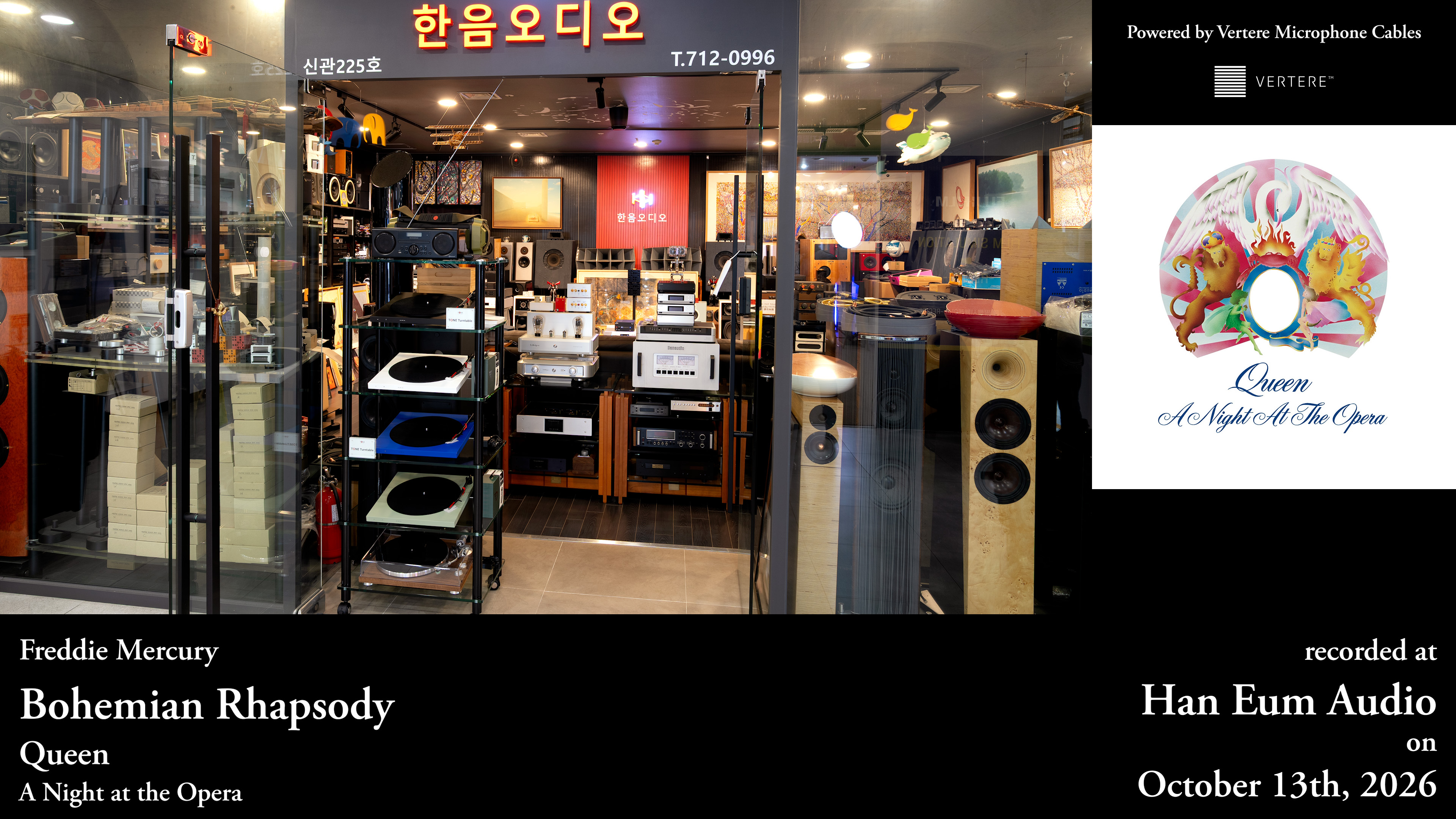
The system included a MUTEC REF10 SE120 master clock, a DELA N1 music library and a DELA S1 network switch. A Wattson Audio Madison Streamer, powered by a Madison Power S external supply, fed Madison amplifiers driving Jean Maurer JM 320E stand-mount loudspeakers.
Jean Maurer specifies the JM 320E as a three-way vented design with a 20-litre acoustic volume, four-ohm nominal impedance and sensitivity of 92 dB/W/m. It is a compact stand-mounted loudspeaker asked here to carry a song that repeatedly expands and contracts in scale.3
That contrast offers a practical listening route. Notice whether the quieter opening leaves room around individual musical lines, then whether the denser passages remain intelligible when the song asks the system for a much broader gesture.
A sweet-spot perspective from Han Eum Audio
HFI recorded the session at Han Eum Audio on 13 October 2026. A matched pair of DPA-4011 microphones fed a Zoom F8n Pro through Vertere microphone cables at 192 kHz/32-bit float.
A laser distance meter matched the microphones’ distances from the loudspeakers at the position where that pair most closely captured the sound heard at the sweet spot. That microphone-dependent position is not necessarily the physical listening seat.
Settle into your own sweet spot with headphones and give the song one complete play. Then return to the boundaries between its musical worlds, listening for the thread that keeps Mercury’s improbable design moving as one piece.2
Watch and listen
The complete HiFi Immersion video
For the clearest sense of the room, listen on headphones at a comfortable, consistent level.