Two people build a private scale
“Billie Bossa Nova” keeps its world small enough for tiny decisions to matter. The official track credits put Billie Eilish at the microphone and at the vocal-engineering desk. FINNEAS produced and engineered the recording, arranged the vocals and played every listed instrumental part: electric guitar, bass, drum programming, piano and synthesizer. The sense of closeness does not come simply from leaving sounds out. It comes from two people making every small choice count.1
Eilish has described a long affection for bossa nova and Brazilian music. Here, that influence becomes a contemporary pop response rather than a claim to a traditional ensemble: the pulse is lightly programmed, the vocal stays near, and pauses carry as much weight as the parts around them. The song’s restraint makes attention more important than spectacle.
Eilish and FINNEAS wrote the song. HFI used a 96 kHz/24-bit source from Happier Than Ever, released by Interscope Records on 30 July 2021.
Two returns, then the song moves forward
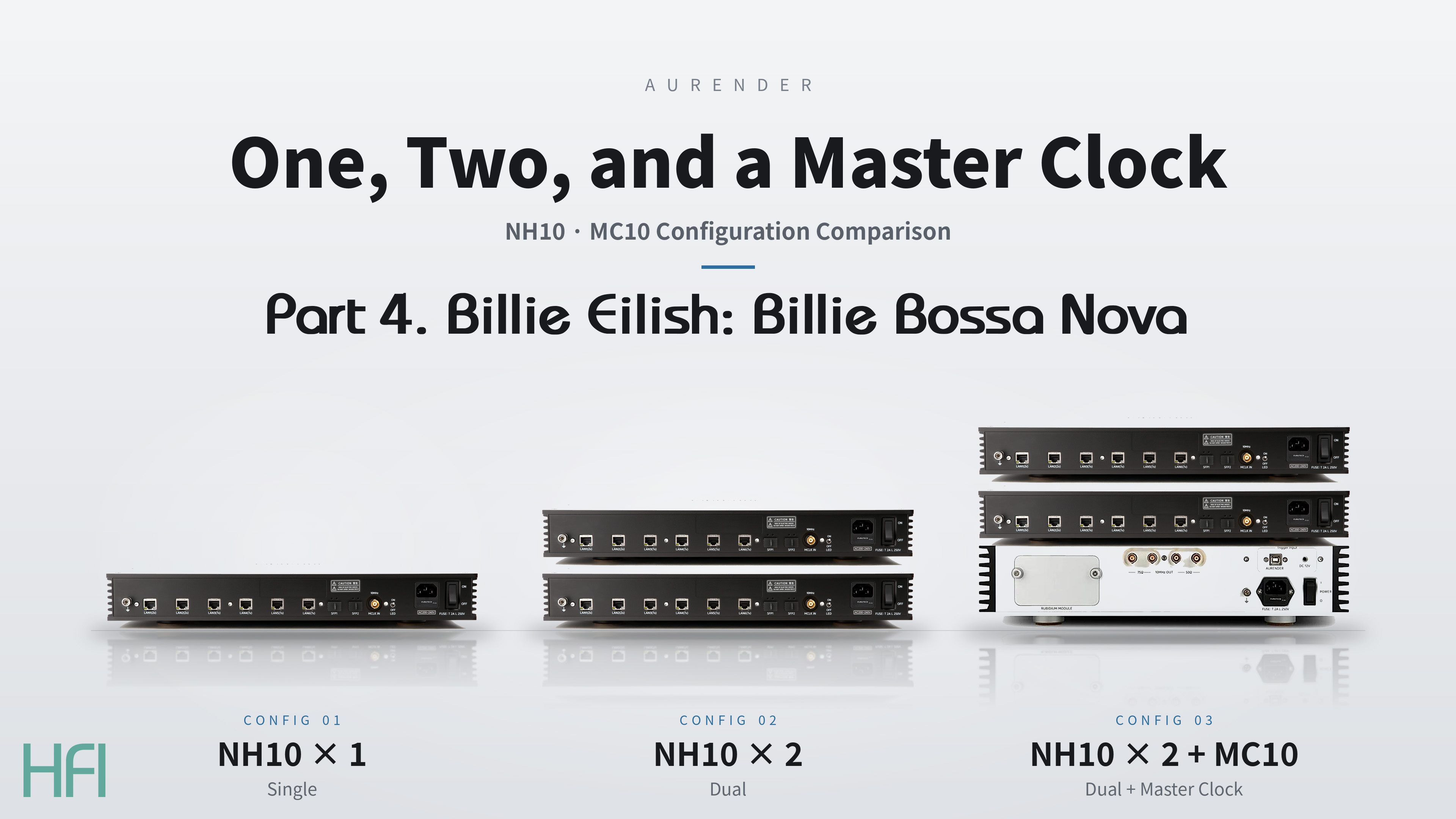
The video opens with thirty seconds of two NH10s plus MC10. From 0:30 to 2:30, the song’s 0:30–1:00 passage plays through one NH10, two NH10s, two NH10s plus MC10, then one NH10 again. From 2:30 to 4:30, the 1:00–1:30 passage follows the same order. Each block therefore returns to the first configuration after the three labelled states.
At 4:30, repetition stops and the song continues: 1:30–2:00 plays through one NH10, 2:00–2:30 through two NH10s, and 2:30–3:14 through two NH10s plus MC10. The lead vocal, short backing responses, bass entries and surrounding pauses remain musical landmarks, but the closing stretch presents different moments of the song rather than the same passage repeated. The same amplification and volume setting remain in place throughout.
Network path first, reference clock second
HzProject’s HzCORE music server, HzBRIDGE Roon Bridge and HzRouter supported the playback environment. In the two-NH10 states, one NH10 faced the router and Internet; an Aurender-supplied 10G-rated SFP+ cable assembly linked it to the second NH10 on the downstream audio network. In the clocked state, the MC10 supplied a 10 MHz reference to both NH10s. The same amplification drove YG Acoustics Summit loudspeakers, with the system arranged on a HIFISTAY MYTHOLOGY X-1 rack.
A sweet-spot perspective at HzProject
HFI made the recording at HzProject in Yongin on 7 July 2026. The matched DPA-4011 pair was positioned where those microphones most closely captured the sound heard at the sweet spot, and a laser distance meter was used to match their distances from the loudspeakers. They fed a Zoom F8n Pro through Vertere microphone cables at 192 kHz/32-bit float.
With headphones, settle into a sweet spot of your own. Let the song run once as music. On another pass, return to the first two repeated blocks and notice what stays with you when the one-NH10 state comes back. The closing stretch lets the music move forward without repeating the same passage. The labels keep the sequence clear; the impression remains yours.
Watch and listen
The complete HiFi Immersion video
For the clearest sense of the room, listen on headphones at a comfortable, consistent level.