A performance and the record that carried it
At the start of Bruch’s Scottish Fantasia, the first movement opens the door slowly: Introduction, Adagio Cantabile. Alfredo Campoli takes the solo part with the London Philharmonic Orchestra under Sir Adrian Boult. The title gives a useful first listening map—an introduction, then a slow, singing line—without asking the music to reveal everything at once.1
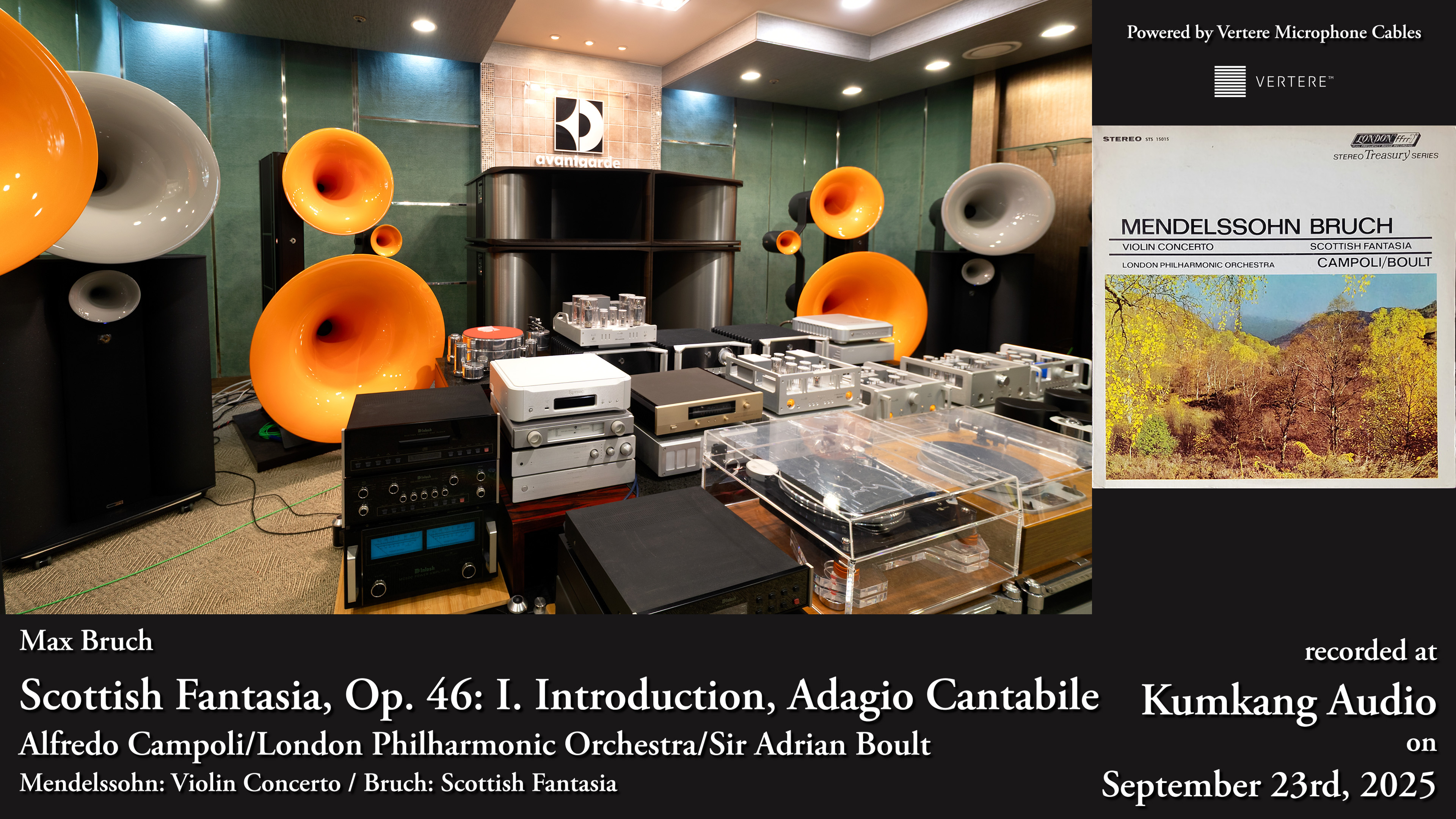
Eloquence dates Campoli and Boult’s account to May 1958. HFI’s source is a different object in that performance’s life: London Records STS 15015, a 1969 stereo LP reissue and repress. Listening here therefore joins two dates. One belongs to the performance captured with Boult; the other belongs to the physical edition turning on the platter in Kumkang Audio.1
Follow the handover into cantabile
Begin with the orchestral frame rather than waiting only for the violin. Notice how the introduction prepares a scale and mood for the solo entrance, then follow the way Campoli’s line becomes the movement’s centre without erasing the orchestra around it. On a second pass, listen for the handover itself: where accompaniment stops feeling like a preface and starts moving with the solo voice.1
The 1969 London pressing couples Bruch’s Scottish Fantasia with Mendelssohn’s Violin Concerto. HFI used its opening movement of the Bruch work for this session.
Equalization between groove and line stage
The record played on a Vertere MG-1 Magic Groove turntable with a Vertere Mystic moving-coil cartridge. An Allnic Audio H-7000V phono stage fed a Plinius Reference M-10 preamplifier and Avantgarde Acoustic Mezzo G3 loudspeakers.
Allnic’s manual makes the phono stage’s task more specific than gain alone. It documents two Multi-Curve LCR units in the H-7000V, one for each channel, with four turnover and four roll-off choices. The equalization filter operates at a constant 600 ohms. In this analog path, record equalization is therefore a distinct stage between the Mystic cartridge and the M-10’s line-level control.2
On the first pass, keep the full orchestral span in view. Then return to the transition and decide how clearly you can follow the violin’s changing relationship with the orchestra. Listen across the phrase, not only at the instant of Campoli’s entrance.
The Kumkang Audio perspective
HFI recorded the system at Kumkang Audio on 23 September 2025. A matched pair of DPA-4011 microphones fed a Zoom F8n Pro at 192 kHz/32-bit float. HFI positioned the pair where those microphones most closely captured the sound heard at the sweet spot and used a laser distance meter to match their distances from the loudspeakers.
Set a comfortable headphone level and let the introduction take its time. Then sit in your own sweet spot and follow Campoli’s singing line as it rises from, returns to and reshapes the orchestral frame around it.1
Watch and listen
The complete HiFi Immersion video
For the clearest sense of the room, listen on headphones at a comfortable, consistent level.