A rhythm pair beneath the changing colours
Peaches en Regalia opens Hot Rats without a singer to tell the ear where to settle. Instead, the piece keeps passing attention among melody, rhythm and instrumental colour. Frank Zappa composed, arranged, produced and directed the album, and the official release archive places this track first in its six-part sequence.12
The same archive identifies Ron Selico on drums and Shuggie Otis on bass for Peaches en Regalia. That credit offers a useful way into the recording: follow the rhythm pair first, then notice how each new instrumental voice changes the surface without making the underlying motion disappear.12
Hear the construction in layers
The Hot Rats sessions were recorded on 16-track tape in August and September 1969. The later session archive preserves prototypes, section takes, master takes and a rhythm-track mix of Peaches en Regalia. Those materials document a work assembled through distinct studio stages, not a single untouched performance captured from one position.12
Begin with the opening drum figure, then keep the bass in view as the melody changes hands. On a second pass, shift attention to the entrances and exits around that pulse. The question is not which instrument sounds most spectacular, but how clearly the recording lets a listener keep the whole design in mind while its colours change.
HFI used a 192 kHz/24-bit edition of Hot Rats, originally released by Bizarre Records on 10 October 1969.1
A hybrid power stage in a familiar Sohgom chain
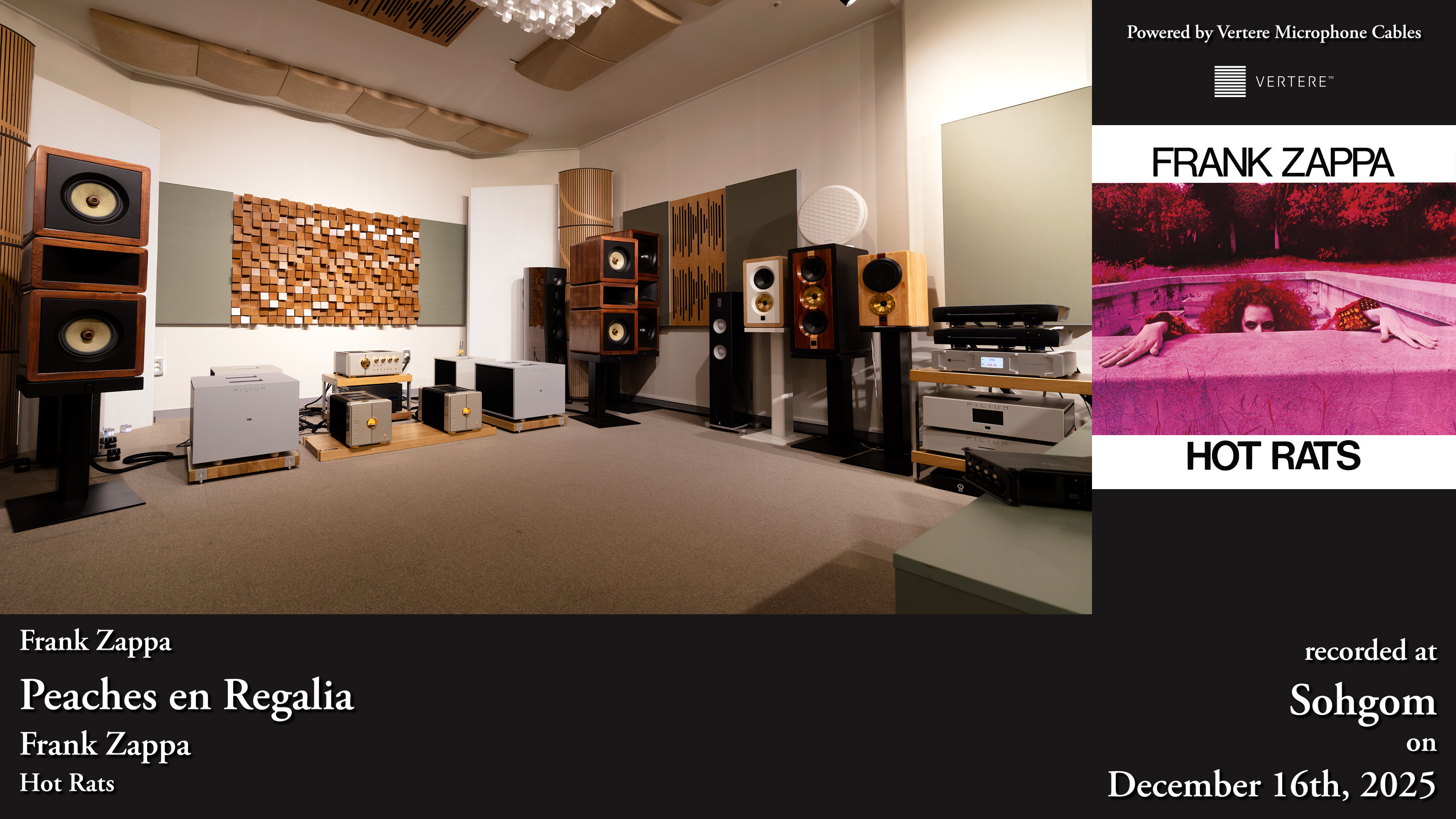
Two Antipodes Audio Oladras fed a Rockna Wavedream Reference DAC. A Riviera APL01 Special Edition preamplifier and AFM100 Special Edition monoblocks drove Klinger Favre Audio STUDIO 20 loudspeakers.
Riviera describes each AFM100 Special Edition as a hybrid Class A monoblock: a triode handles voltage amplification, while solid-state devices form the power section. That is an account of the amplifier’s architecture, and it supplies the new system question for this return to the Sohgom chain: listen through the completed system for whether the rhythm pair remains easy to follow as the track’s instrumental layers accumulate.3
Sohgom from one microphone-specific perspective
HFI recorded the system at Sohgom on 16 December 2025. The matched DPA-4011 pair was positioned where those microphones most closely captured the sound heard at the sweet spot, and a laser distance meter matched their distances from the loudspeakers. Vertere microphone cables connected the pair to a Zoom F8n Pro, which captured the session at 192 kHz/32-bit float.
Use headphones, sit in your own sweet spot, and let the first drum figure establish the scale. Then follow Selico and Otis as Zappa’s studio-built instrumental keeps opening new paths around them.1
Watch and listen
The complete HiFi Immersion video
For the clearest sense of the room, listen on headphones at a comfortable, consistent level.