Let the record be more than a test track
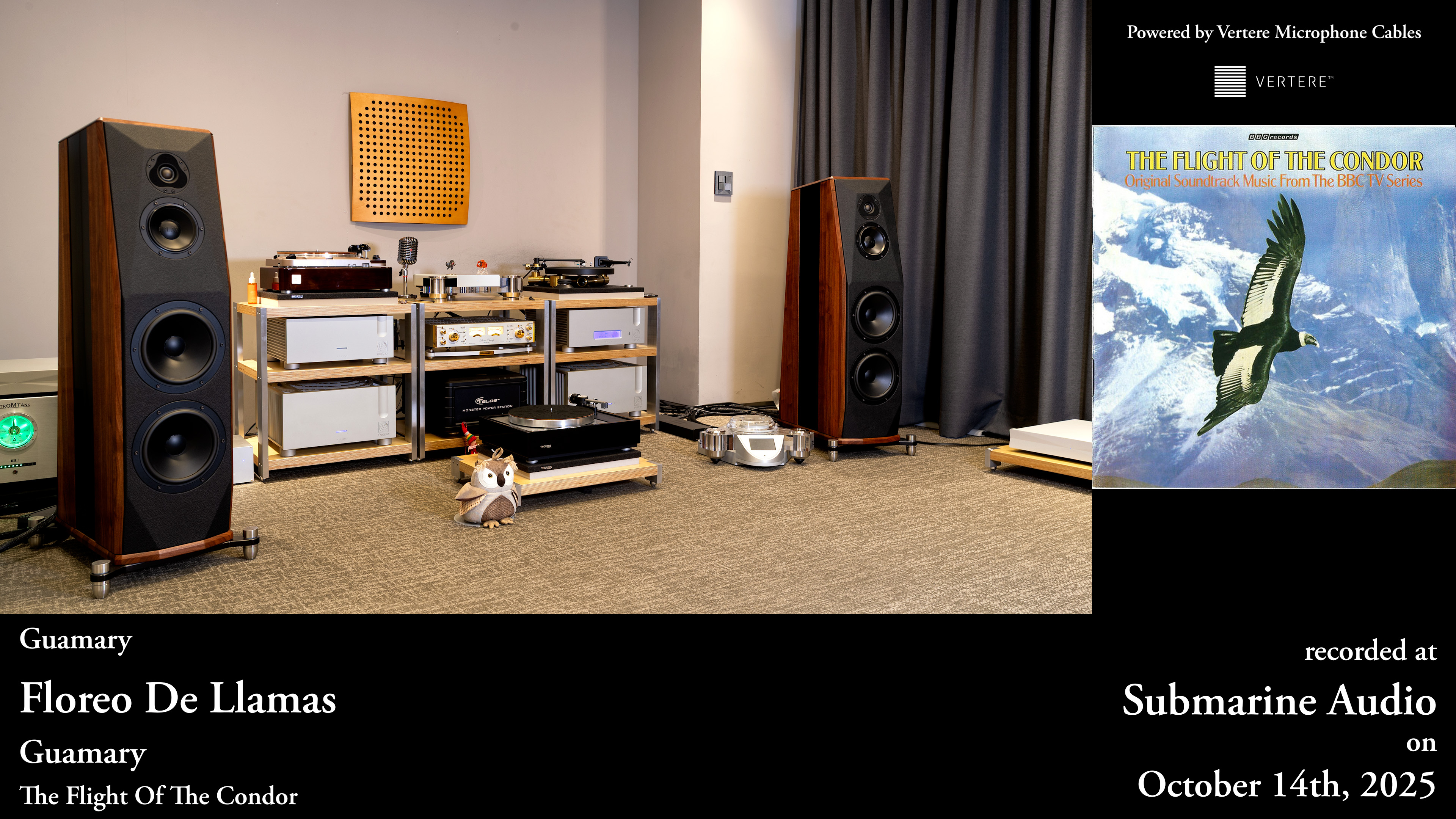
“Floreo de Llamas” comes to this session as a piece on a particular physical record. The credits name Márquez as writer and Guamary as performer; HFI used the 1982 BBC Records stereo gatefold compilation The Flight of the Condor, catalogue REB 440. That source form is the music angle here: the LP is not background metadata but the object from which the performance enters the room.
Begin with one uninterrupted pass and let the performance establish its own direction. On a second listen, choose the musical line that first held your attention and follow how the rest of the ensemble supports, answers or clears space for it. The point is not to turn every phrase into an equipment cue, but to keep Guamary at the centre while the source path remains audible context.
From the groove to the phono stage
A Thorens TD 124 DD 140th Anniversary turntable with the matching Ortofon SPU 124 Anniversary cartridge fed an HSE Swiss Masterline 7 phono stage. A Ypsilon PST-100 Mk2 preamplifier and Aelius II monoblocks then drove Peak El Diablo loudspeakers.
Thorens built the anniversary source as a package: a two-layer aluminium-and-copper platter, silver wiring in the TP 124 tonearm and a special SPU 124 cartridge with silver coils. HSE says the Masterline 7 uses newly developed discrete gain stages and servo-controlled zero-ohm head amplifiers. Together they define this article’s new system question: the low-level path from cartridge to line stage.12
The familiar downstream chain, heard from another source
The Ypsilon PST-100 Mk2, Aelius II monoblocks and Peak El Diablo loudspeakers also appear in HFI’s Beethoven Triple Concerto session from the same venue and recording date.
That repetition is useful context rather than the new thesis. The earlier story examined transformer coupling in the Ypsilon amplification. Here attention moves upstream, where a moving-coil cartridge and phono stage must raise the signal from an LP before the shared preamplifier, power amplifiers and loudspeakers take over. The familiar downstream system makes the change of source architecture easier to understand.
A sweet-spot perspective from Submarine Music & Audio
HFI recorded the session at Submarine Music & Audio on 14 October 2025. A matched pair of DPA-4011 microphones fed a Zoom F8n Pro through Vertere microphone cables at 192 kHz/32-bit float, and Sennheiser HD820 headphones were used during production.
A laser distance meter matched the microphones’ distances from the loudspeakers at the position where that pair most closely captured the sound heard at the sweet spot. That microphone-dependent position is not necessarily the physical listening seat.
Put on headphones and settle into your own sweet spot. Let the first pass belong to Guamary; on the next, listen back through the route from groove, cartridge and phono stage to the returning Ypsilon and Peak system. The pleasure is in holding the music and its physical source in view at the same time.
Watch and listen
The complete HiFi Immersion video
For the clearest sense of the room, listen on headphones at a comfortable, consistent level.