The drummer takes the tune back under his own name
“Take Five” is inseparable from the Dave Brubeck Quartet’s move into odd metre, yet its credits keep two individual stories in view. Paul Desmond wrote the tune, and Joe Morello was the quartet’s drummer when Time Out carried that rhythmic experiment to a wide audience. Morello later placed “Take Five” on Morello Standard Time, a 1994 DMP album issued under his own name. The musical question is therefore personal as well as metrical: how does the drummer meet again a piece already tied to his place in the quartet?1
The approved HFI master identifies Paul Desmond as composer and Joe Morello as performer. HFI used the DMP release Morello Standard Time at 44.1 kHz/16-bit; licensed release metadata places “Take Five” fourth in the ten-track album.
Three driver roles beside three network states
YG Acoustics describes the Summit as a passive three-way floor-standing loudspeaker. Its published driver complement assigns the upper range to a ForgeCore tweeter, the middle to a 7.25-inch aluminium-cone driver and the bass to a 10.25-inch aluminium-cone driver. That division gives the listener a concrete map for following cymbal metal, drum body and lower-frequency weight while the labelled network configuration changes.2
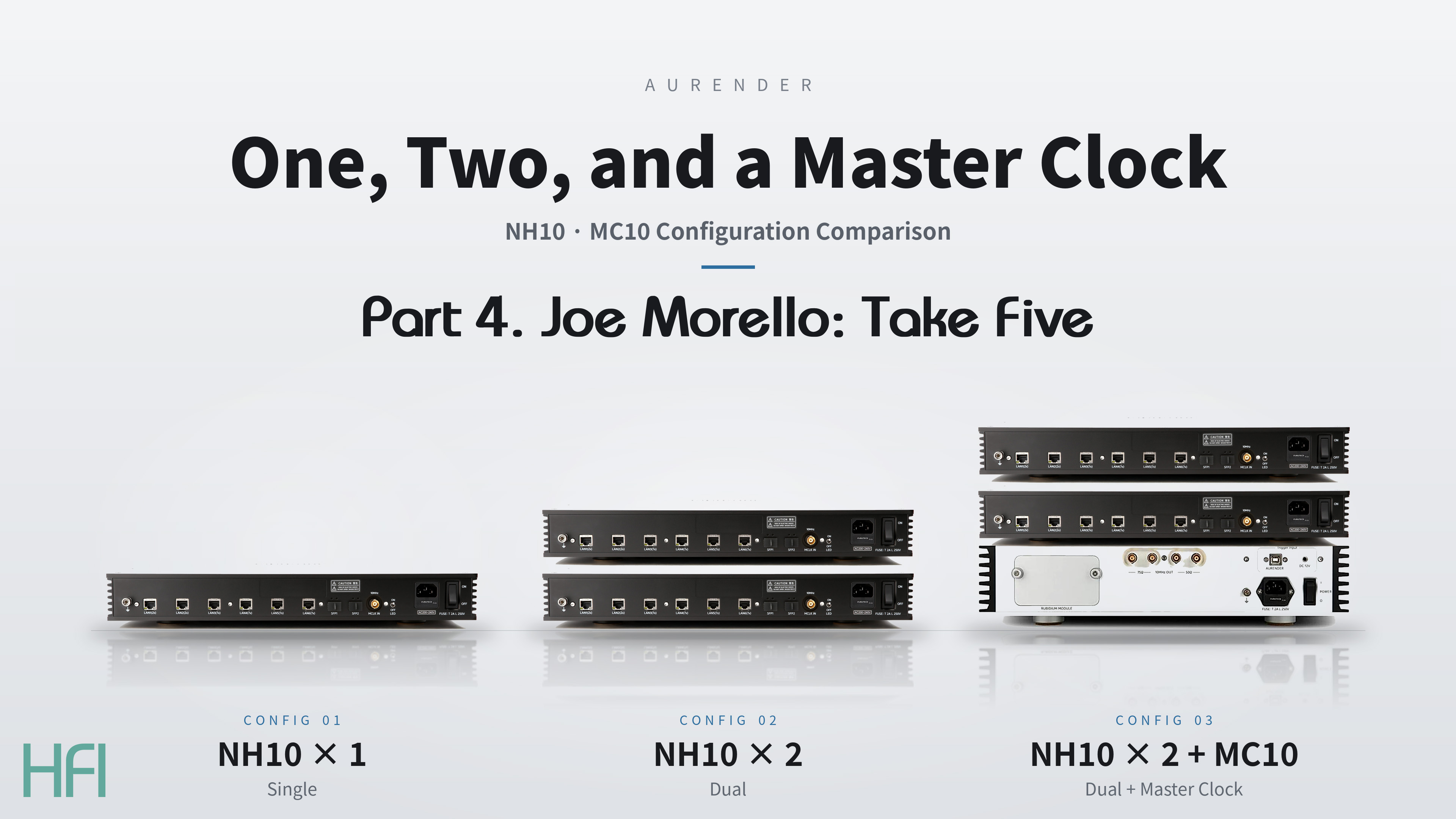
HzProject’s HzCORE music server, HzBRIDGE Roon Bridge and HzRouter supported the session. The labelled states use one Aurender NH10; two NH10s linked by one Aurender-supplied 10G-rated SFP+ cable assembly; and those two NH10s with an Aurender MC10 supplying their 10 MHz reference. The same amplification and YG Acoustics Summit loudspeakers remained in use throughout.
Let the five-beat cycle settle before comparing
On a first pass, leave the configuration labels alone and let the tune’s five-beat cycle become natural. Follow where Morello places emphasis inside it: the pattern should begin to feel like motion rather than arithmetic. On a second pass, choose one event—a cymbal decay, the shape of a drum accent or the weight beneath the pulse—and carry that same question through the labelled states without deciding in advance which state should lead.
After a thirty-second opening in the two-NH10-plus-MC10 state, the first two musical passages each follow one NH10, two NH10s, two NH10s plus MC10, then one NH10 again. A third passage runs once through the three states. From 6:00, the performance advances in successive sections while the one-NH10, two-NH10 and clocked states continue to rotate; the final clocked section runs to 10:38.
The repeated passages are useful for finding a musical landmark. The longer advancing section asks a different question: can that landmark remain meaningful when the performance itself keeps moving? Count only long enough to feel the pulse, then stop counting and listen for the band’s forward motion.
A sweet-spot perspective from HzProject
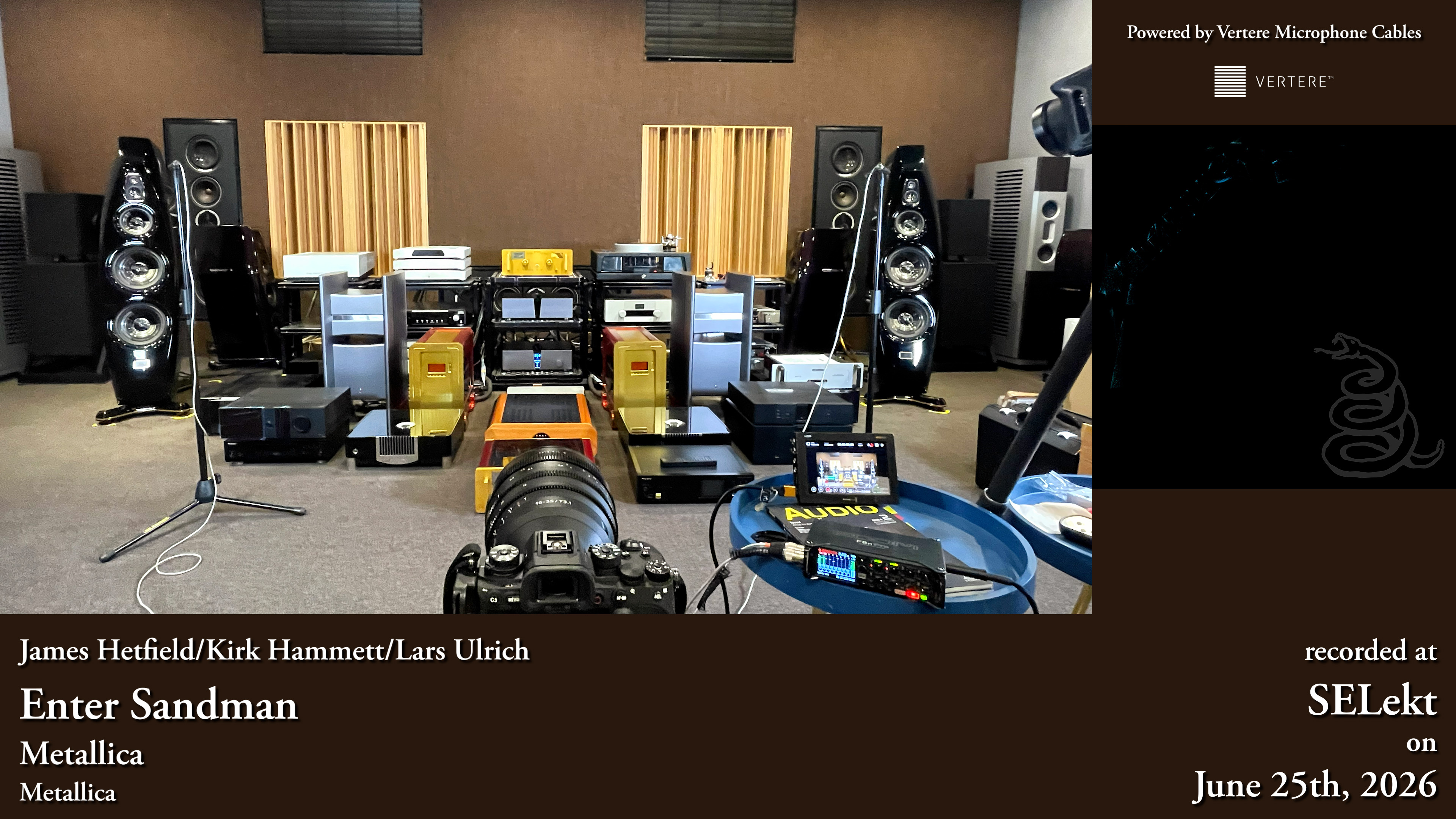
HFI recorded the session at HzProject in Yongin on 7 July 2026. A matched pair of DPA-4011 microphones fed a Zoom F8n Pro through Vertere microphone cables at 192 kHz/32-bit float. A laser distance meter matched the microphones’ distances from the loudspeakers at the position where that pair most closely captured the sound heard at the sweet spot. Sennheiser HD 820 headphones were used during production monitoring.
Set your headphones to a comfortable level and sit in your own sweet spot. Let Morello’s return to “Take Five” lead the session; the configuration labels are there when you want to revisit a moment, but the rhythm remains the reason to stay.
Watch and listen
The complete HiFi Immersion video
For the clearest sense of the room, listen on headphones at a comfortable, consistent level.