The take that did not need replacing
Blue Note’s history of Come Away with Me returns “Don’t Know Why” to Norah Jones’s First Sessions. Jones recalls that the group had not yet played Jesse Harris’s song live. The first take felt settled enough to survive into the finished album, with only harmonies and a doubled guitar added later.1
That history changes the most useful way into the track. Its calm is not the product of sanding away every trace of a first encounter. The performance found its shape early, and the later additions supported that shape rather than replacing it.1
HFI used a 96 kHz/24-bit edition of Come Away with Me, released by Blue Note on 26 February 2002. Jesse Harris wrote the song and Norah Jones performs it.1
Let the small exchanges lead
Begin with the vocal line and the time it leaves around each phrase. Then follow the guitar and bass as parts of the same conversation. The track does not need to become louder or busier to move forward; a change in touch, a held note or a short answer can carry the next step.1
On another pass, listen through the joins rather than isolating each sound. Notice how the voice returns after an instrumental response and how the pulse remains present through the pauses. The first-take history makes those handovers worth hearing as musical decisions, not as a checklist of hi-fi effects.1
Two M10s, one clearly defined mode
The playback chain used a CH Precision X1 external power supply, T1 10 MHz time reference, C10 digital-to-analog converter and L10 line preamplifier. Two M10 stereo power amplifiers were each operated as a monoblock before the Göbel Divin Majestic loudspeakers.
CH Precision treats monaural and bridged operation as different choices. Its M10 manual says that monaural mode uses one amplifier channel with the chassis’s power-supply capacity available to it, and recommends the configuration for low-impedance or reactive loudspeaker loads. Bridged mode uses both channels differently and is presented for higher-impedance, lower-sensitivity loads.2
That distinction keeps “two amplifiers” from being a vague statement about scale. The session record identifies the mode actually used, while the manufacturer’s operating guide explains what that setting means inside the amplifier’s available configurations.2
A September session at KD Sound
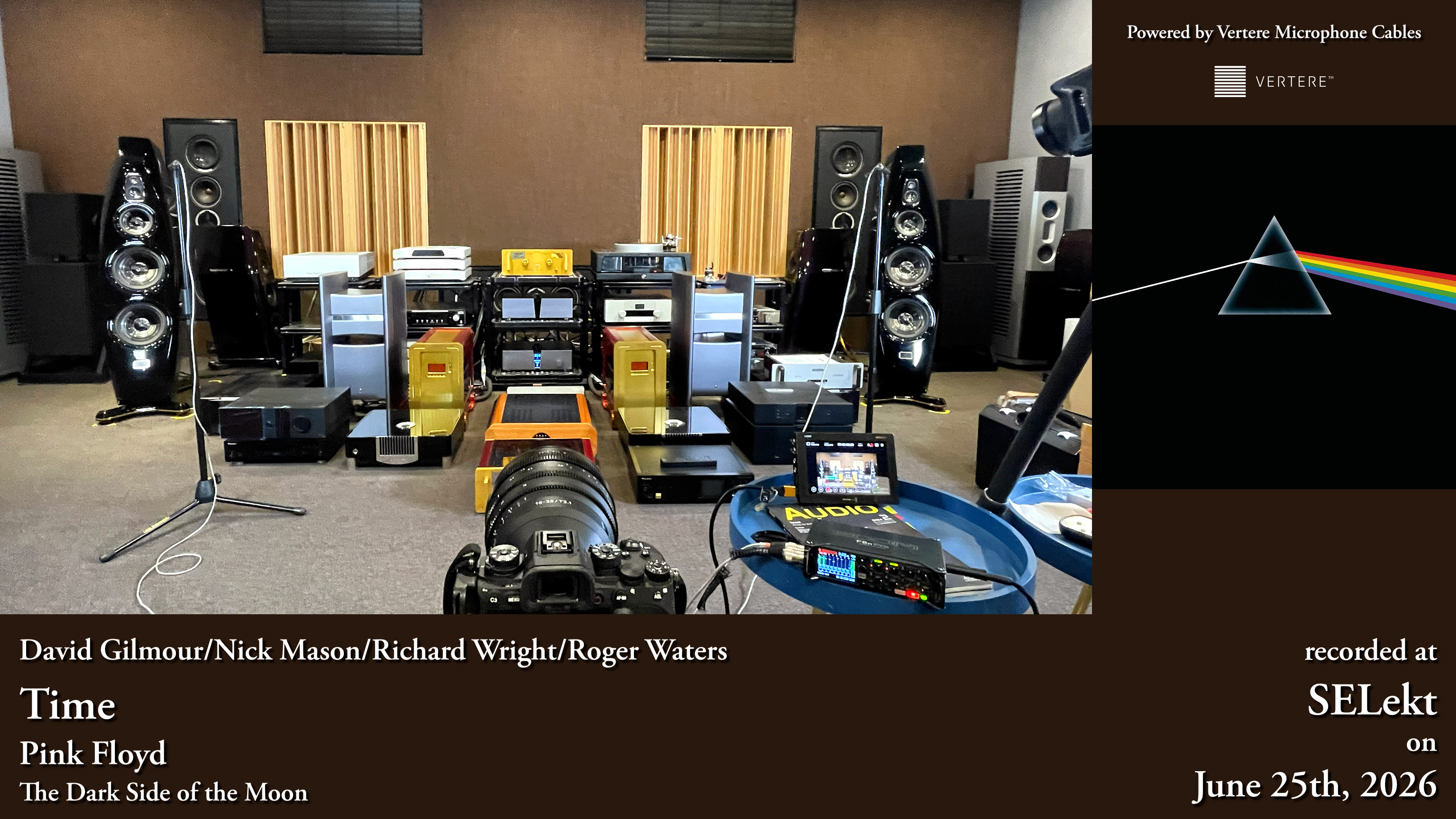
HFI recorded the system at KD Sound in Seoul on 14 September 2025. A matched pair of DPA-4011 microphones fed a Zoom F8n Pro at 192 kHz/32-bit float through Vertere microphone cables.
HFI positions the matched microphones where that pair most closely captures the sound heard at the sweet spot, then uses a laser distance meter to match their distances from the loudspeakers. The position depends on the microphones and is not necessarily the physical listening seat.
Stay with the song’s quiet confidence
Let the first play belong to the song. On the second, keep the level comfortable and follow the spaces between Jones’s phrases, the instrumental answers and the pulse underneath them. A lower-volume repeat can reveal whether those relationships still hold together without turning any one sound into the whole story.
The recording offers no need for a winner or a borrowed verdict. It offers three minutes with a performance that found its form early. Put on headphones, settle into your own sweet spot and give those small exchanges the time they ask for.1
Watch and listen
The complete HiFi Immersion video
For the clearest sense of the room, listen on headphones at a comfortable, consistent level.