The fourth turn on Side One
Pink Floyd’s official 50th-anniversary record places “Time” fourth on Side One of The Dark Side of the Moon. It follows “On the Run” and leads into “The Great Gig in the Sky,” so the track belongs to a larger album-side progression even when heard here on its own.1
HFI used the 96 kHz/24-bit 2023 remaster. The source credits David Gilmour, Nick Mason, Richard Wright and Roger Waters as writers, with Pink Floyd as performer; the official anniversary record credits James Guthrie and Joel Plante for the remaster.1
From alarm to forward motion
The opening gathers clocks into a crowded event before the drum figure establishes a human pulse. When bass, guitar and voice settle into the song, the useful contrast is not simply loud against quiet. It is the change from overlapping mechanical signals to a band moving together.
A first pass can follow that change without stopping to inspect the system. On a second, keep the pulse in view as the vocal lines widen and the instrumental layers arrive around them. The track’s scale grows, but its argument still depends on time being felt one beat at a time.
Where conversion hands over to control
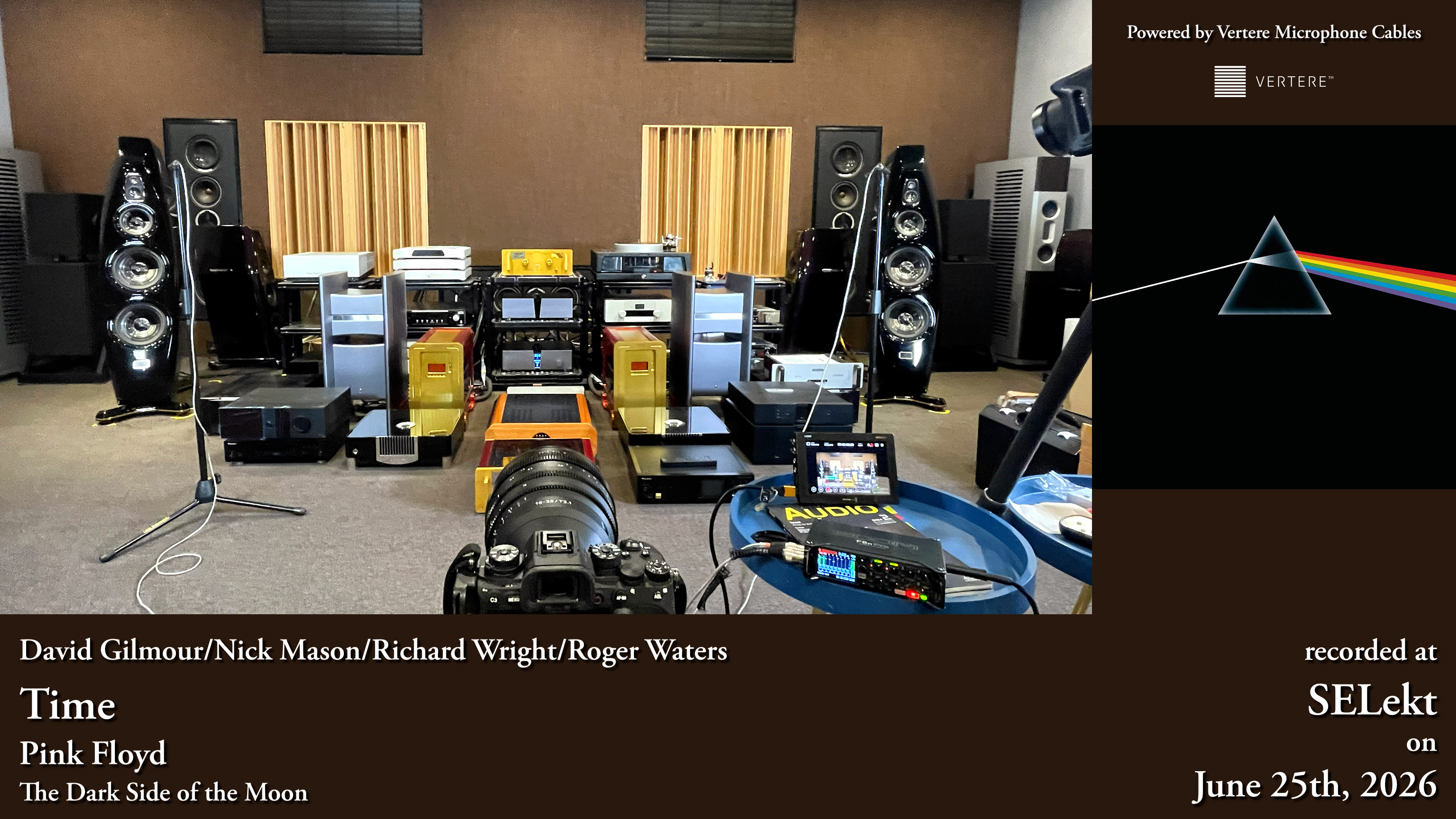
A Laufer Teknik Memory Player MP-32 fed an MSB Technology Cascade DAC. The analog path continued through a Halcro Equinox preamplifier and Halcro Eclipse monoblocks to Kharma Enigma Veyron 4D loudspeakers.
MSB provides balanced analog outputs for connection to either power amplifiers or an external preamplifier. Its Cascade guide also provides a dedicated Preamp Off mode that bypasses the DAC’s volume control for the external-preamplifier route. In this documented chain, the next component after the Cascade is the Halcro Equinox, making the handoff between conversion and level control a visible part of the system architecture.2
Captured at SELekt
HFI recorded the playback at SELekt on 25 June 2026. A matched pair of DPA-4011 microphones fed a Zoom F8n Pro at 192 kHz/32-bit float, and Sennheiser HD820 headphones were used during production.
HFI used a laser distance meter to match the microphones’ distances from the loudspeakers, placing the pair where those microphones most closely captured the sound heard at the sweet spot. That microphone-dependent position is not necessarily the physical listening seat.
Put on headphones and sit in the sweet spot. Let the clocks arrive as a field of separate alarms, then stay with the pulse after the band takes over. “Time” begins by surrounding the listener with signals; its deeper pull comes from how steadily the musicians turn them into motion.
Watch and listen
The complete HiFi Immersion video
For the clearest sense of the room, listen on headphones at a comfortable, consistent level.