One symphony, two completed paths
Mendelssohn’s Fourth Symphony carries the nickname ‘Italian,’ but the source edition asks a more precise question: which completed version? Alia Vox places the final 1834 version first on AVSA9955, followed by the first 1833 version. Both sequences open with Allegro vivace, so the album presents two finished paths through the same symphony rather than a single text with an appendix.1
This HFI video centres on the opening movement performed by Le Concert des Nations under Jordi Savall. Let the first play belong to the movement’s forward motion. On the next, follow how orchestral weight shifts between the larger ensemble and the lines that briefly come to the front. The point is not to guess an edition from sound, but to hear one performance with the work’s double history in mind.1
HFI used Alia Vox’s AVSA9955 SACD, released on 22 September 2023.1
The amplifier and loudspeaker interface
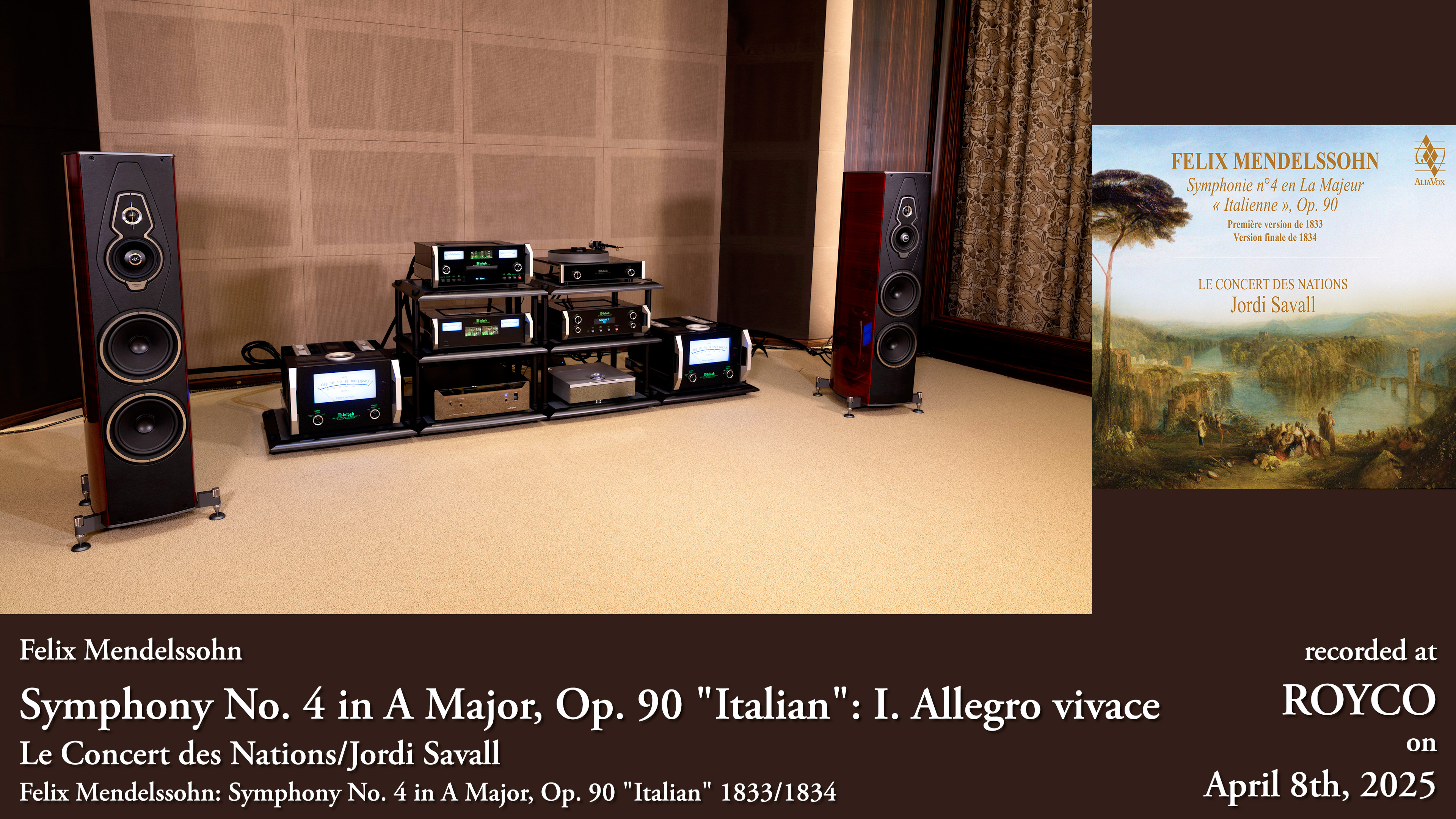
A McIntosh MCD12000 played the SACD through a C12000 preamplifier and MC1.25KW monoblock power amplifiers. Sonus faber Amati G5 loudspeakers completed the playback chain, with an AudioQuest Niagara 7000 power distributor and AudioQuest Dragon, Hurricane and Thunder-series cables.
Earlier ROYCO articles have considered the Amati G5’s sealed-midrange and vented-bass architecture, and the selectable analogue stages upstream. The new question sits at the amplifier–loudspeaker interface. McIntosh rates the MC1.25KW at 1,200 watts into 2, 4 or 8 ohms through its Autoformer; Sonus faber specifies the Amati G5 at a nominal 4 ohms.23
That interface gives the return to the music a concrete focus. Follow the opening’s rhythmic lift, then notice whether individual lines remain easy to follow as the orchestra gathers weight. Savall’s performance supplies the musical event; the system facts explain the route by which it reaches the room.23
A sweet-spot perspective from ROYCO
HFI recorded the system at ROYCO in Seoul on 8 April 2025. A matched pair of DPA-4011 microphones fed a Zoom F8n Pro at 192 kHz/32-bit float. Kennerton Audio Rognir Bog Oak headphones with an Audience frontRow cable were used during production.
A laser distance meter matched the microphones’ distances from the loudspeakers at the position where that pair most closely captured the sound heard at the sweet spot. That microphone-dependent position is not necessarily the physical listening seat.
Sit in your own sweet spot with headphones and give the first movement an uninterrupted pass. Then return to one orchestral line and keep it in view as the scale changes around it. The album preserves two versions of the symphony; this video offers one opening through which to begin that larger story.1
Watch and listen
The complete HiFi Immersion video
For the clearest sense of the room, listen on headphones at a comfortable, consistent level.