A breakthrough in miniature
Killer Queen arrived in 1974 as Queen found a more concise form for its ambition. The band's official history places the song within Sheer Heart Attack's more pop-oriented turn and identifies it as the international breakthrough that Seven Seas of Rhye had not quite become.2
An official Queen account singles out the four-part harmonies and Brian May's guitar solo among the details that carried the song into the charts. Their scale is compact, but the musical character keeps shifting between poised vocal wit, layered harmony and the guitar's answering line.3
Three minutes, several points of focus
HFI used a 44.1 kHz/24-bit FLAC file of Sheer Heart Attack, released by EMI and Elektra on 8 November 1974 and stored on the DELA N1 music library.2
Begin with the song's poise rather than its reputation. On a second pass, follow the harmony around Mercury's lead; on a third, let May's guitar remain the thread. The short running time makes it easy to change attention without breaking the song into isolated demonstrations.3
A new system question in a familiar room
The system included a MUTEC REF10 SE120 master clock, a DELA N1 music library and DELA S1 network switch. A Wattson Audio Madison Streamer with its Madison Power S supply fed Madison amplifiers driving Jean Maurer JM 320E stand-mount loudspeakers.
Wattson Audio describes the Madison Amplifier as a fully symmetrical, fully discrete Class A/B design from the input stage onward. Its external 36 V DC supply is regulated and filtered, and the amplifier can be configured for different system requirements.4
Killer Queen gives this chain a different job from Bohemian Rhapsody in the earlier Han Eum Audio session. Instead of tracing one long sequence of contrasting sections, the useful question is how much character remains distinct inside a much tighter frame: lead voice, stacked harmony and guitar all have work to do before the song has overstayed its welcome.3
A sweet-spot perspective from Han Eum Audio
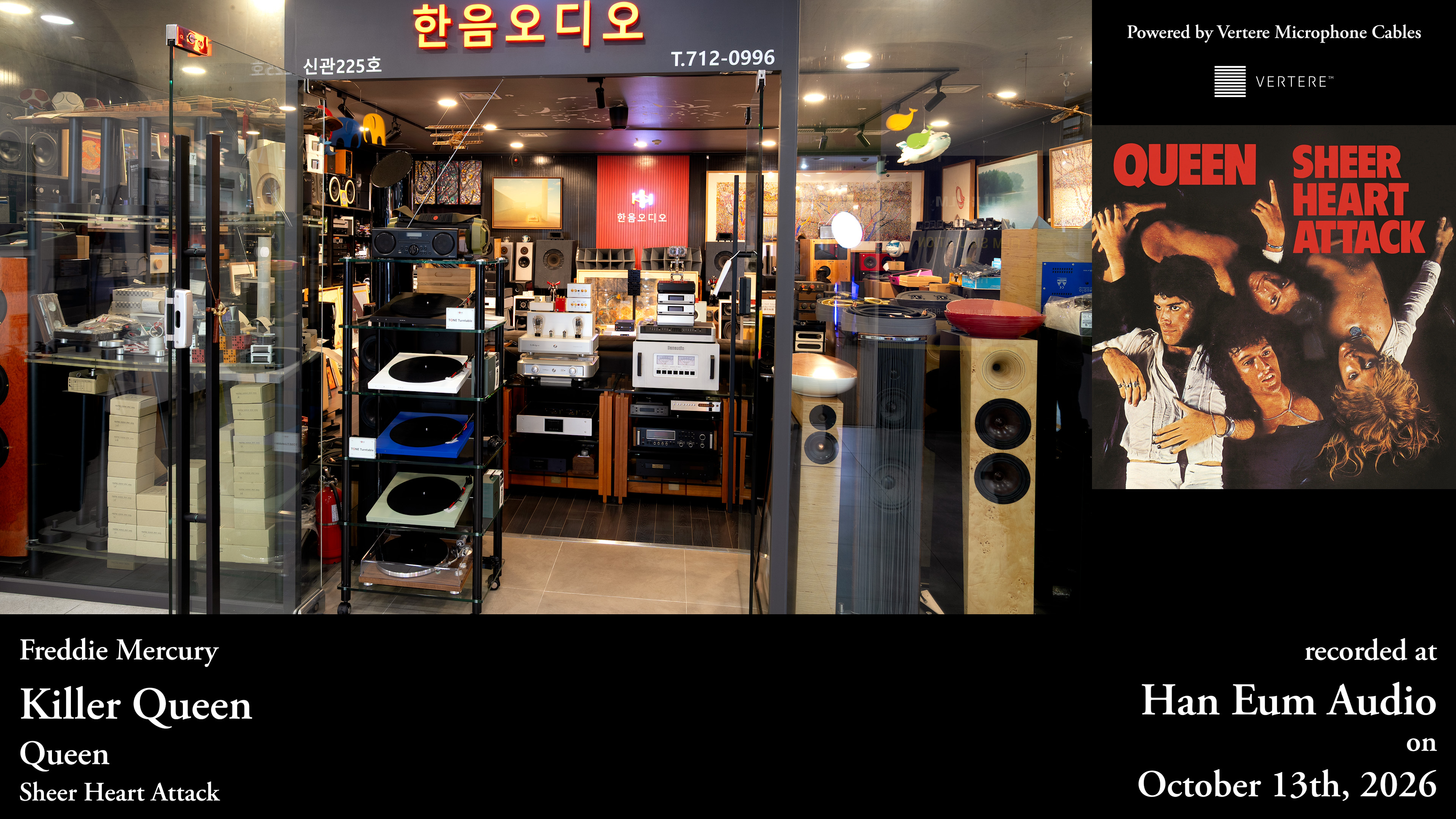
HFI recorded the session at Han Eum Audio on 13 October 2026. A matched pair of DPA-4011 microphones fed a Zoom F8n Pro through Vertere microphone cables at 192 kHz/32-bit float.
A laser distance meter matched the microphones' distances from the loudspeakers at the position where that pair most closely captured the sound heard at the sweet spot. That microphone-dependent position is not necessarily the physical listening seat.
Sit in your own sweet spot with headphones and let the first play belong to the song. Then return for one detail at a time. Killer Queen is brief enough to reward that change of focus without losing the elegant whole that made it a turning point for Queen.2
Watch and listen
The complete HiFi Immersion video
For the clearest sense of the room, listen on headphones at a comfortable, consistent level.