A live Ravel project with two musical lineages
Deutsche Grammophon released Ravel: The Piano Concertos on 21 February 2025. Seong-Jin Cho recorded the two works live at Boston’s Symphony Hall with the Boston Symphony Orchestra and its music director, Andris Nelsons. The G major concerto is the brighter companion to the Concerto for the Left Hand, and this session enters through its first movement, Allegramente.1
The label describes the concerto as bringing jazz together with the Classicism of Mozart and Saint-Saëns. That account offers a useful first question without prescribing an answer: as piano and orchestra exchange the foreground, listen for the movement’s quick turns between rhythmic lift, cleanly shaped gestures and larger symphonic momentum.1
HFI used the 96 kHz/24-bit Deutsche Grammophon source. The album credits Cho with the Boston Symphony Orchestra under Nelsons, and HFI’s approved master identifies the first movement of the G major concerto.1
Three close looks, then six and a half minutes forward
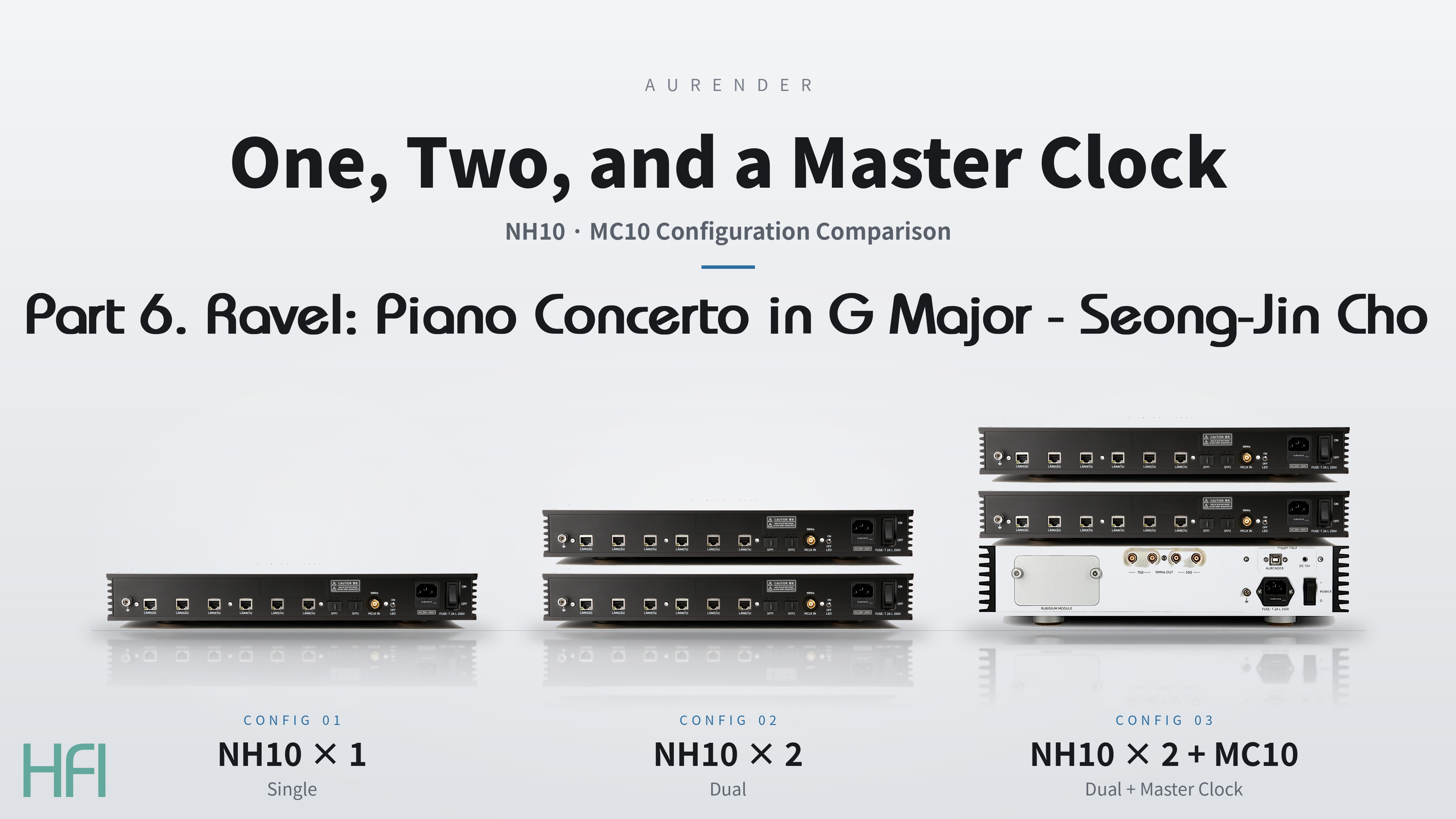
The video begins with thirty seconds of the two-NH10-plus-MC10 state. The first musical region then appears through one NH10, two NH10s and two NH10s plus MC10 before returning to one NH10. A second region follows the same four-step order, while a third moves once through the three labelled states.
At 6:00, the method changes. The movement no longer returns to the same thirty-second passage: new music continues while the three configurations rotate in order, with the final clocked section running for one minute to 12:30. The repeated opening windows help establish nearby landmarks; the longer second half asks whether those landmarks still matter when the piano and orchestra keep developing the movement rather than replaying it.
Begin with the full movement sequence and let Ravel set the scale. On another pass, choose one relationship—piano attack against orchestral reply, a woodwind colour beside the keyboard, or the weight of a larger entrance—and carry that question from the repeated windows into the advancing section. The labels make the route visible; they do not decide what you should prefer.
What remains steady as the labels change
The comparison centres on the Aurender NH10 and MC10. HzProject’s HzCORE music server, HzBRIDGE Roon Bridge and HzRouter supported the playback environment, with YG Acoustics Summit loudspeakers in use throughout. The amplification and volume setting remained unchanged across the three labelled states.
In the two-NH10 states, one unit faced the router and Internet while an Aurender-supplied 10G-rated SFP+ cable assembly linked it to the second NH10 on the downstream audio network. In the clocked state, the MC10 supplied a 10 MHz reference to both NH10 units.
A sweet-spot perspective from HzProject
HFI recorded the session at HzProject in Yongin on 7 July 2026. A matched pair of DPA-4011 microphones fed a Zoom F8n Pro through Vertere microphone cables at 192 kHz/32-bit float. Sennheiser HD 820 headphones were used during production.
A laser distance meter matched the microphones’ distances from the loudspeakers at the position where that pair most closely captured the sound heard at the sweet spot. That microphone-dependent position is not necessarily the physical listening seat.
Put on headphones, settle into your own sweet spot and let the Allegramente run once without comparison. When you return, use the short repeated regions to find your bearings, then follow the final six and a half minutes as one continuous musical argument. Ravel keeps moving; the choice of where to listen remains yours.
Watch and listen
The complete HiFi Immersion video
For the clearest sense of the room, listen on headphones at a comfortable, consistent level.